A strong influencer outreach email is short, personalized, and clear about the offer.
The templates below cover every main scenario, such as gifting, paid, affiliate, ambassador, event, usage rights, and user-generated content (UGC), and are ready to copy and adapt.
This influencer outreach email template library covers every scenario, a before-and-after example of how to personalize, what to put in the subject line, the elements that drive replies, the follow-up timing that works, verified response rate benchmarks, and the mistakes that get outreach ignored.
Influencer Outreach Email Templates for Every Scenario
These email templates for influencer outreach are starting points to adapt rather than scripts to send as-is.
A single personalized detail is what separates a reply from silence.
Each template below has a subject line and bracketed placeholders to fill in. The scenario label tells you when to use each one.
1. Product Gifting Outreach
Use it when you want to send a product in exchange for authentic content, with no payment obligation.
Subject: [Brand Name], we'd love to send you [Product Name] Hi [First Name], I came across your [recent post / content style / niche reference] and immediately thought of [Brand Name]. Your audience feels like the right crowd for what we make. We’d love to send you [Product Name], no strings attached, no content requirement. If you enjoy it and want to share that with your audience, we’d be thrilled. If not, that's completely fine too. [Brief product description in one sentence.] Let me know if you’d like us to send one over, and I’ll follow up with the details. [Your Name] [Brand Name] |
2. Paid Collaboration Outreach
Use when proposing a paid partnership with defined deliverables and compensation.
Subject: Paid collaboration, [Brand Name] x [Creator Handle] Hi [First Name], Your content on [specific topic or recent post] caught our attention, particularly [specific detail]. That’s the [style/voice/niche] we’ve been looking for. We’re running a campaign for [product or campaign name] in [month/quarter] and would love to work with you. Here’s what we have in mind:
Creative direction would be yours. We’d provide the brief and product, and you’d bring your own voice to it. If this sounds interesting, I’m happy to send over more details or jump on a quick call. [Your Name] [Brand Name] |
3. Affiliate or Commission Outreach
Use when the compensation model is a commission or affiliate link rather than a flat fee.
Subject: Affiliate opportunity with [Brand Name], earn [X]% Hi [First Name], I’ve been following your [niche] content for a while and think [Brand Name] is a real fit for your audience. We’re inviting a small group of creators to join our affiliate program. Here’s how it works:
[Product or brand description in one sentence.] Happy to send you some product first so you can try it before deciding. Let me know if you’re interested, and I’ll send over the details. [Your Name] [Brand Name] |
4. Brand Ambassador or Long-Term Outreach
Use when inviting a creator to an ongoing relationship rather than a single campaign.
Subject: Long-term partnership with [Brand Name] Hi [First Name], We’ve been fans of your content for a while. [specific post or theme] is the sort of work our audience responds to. We’re building a small ambassador group for [Brand Name]: creators who connect with the brand and want to be part of it over time, rather than a one-off campaign. It would look like [brief description, monthly posts, seasonal campaigns, early access to products, etc.] with [compensation structure]. We keep the roster small so the relationships stay personal and long-term. If this sounds like something you’d want to be part of, I’d love to tell you more. [Your Name] [Brand Name] |
5. Event or Product Launch Invite
Use when inviting a creator to an event, launch, or press moment.
Subject: You’re invited to [Event or Launch Name], [Date] Hi [First Name], We’re launching [product or event name] on [date] and would love to have you there. [One sentence on what the event or launch is and why it is worth attending.] We’re keeping the guest list small, a group of creators whose content connects with the brand. If you’re able to join, we’ll cover [travel / accommodation / product / whatever is relevant], and you’d be welcome to share anything from the day in whatever way works for you. Let me know if you’re interested, and I’ll send over the full details. [Your Name] [Brand Name] |
6. UGC-Only Outreach
Use when you want content for brand use rather than organic posting to the creator's audience.
Subject: UGC content opportunity with [Brand Name] Hi [First Name], Your [style / aesthetic / video quality] is what we’re after, and we’d like to commission some content from you. Here’s what we have in mind: ● Content type: [e.g., 3 short videos demonstrating the product] ● Usage: [e.g., for paid social ads and website] ● Timeline: [date needed by] ● Rate: [fee or ask for their UGC rate] The content is for our use only and will not be posted to your own channels. Full creative brief available on request. Let me know if you’re interested, and I’ll send over the details. [Your Name] [Brand Name] |
7. Product Exchange or Barter Outreach
Use when the offer is product or perks in exchange for content, with no cash payment.
Subject: [Brand Name] product exchange opportunity Hi [First Name], I noticed your [recent content / niche] and think [Brand Name] would be a good fit. We’re offering a product exchange: we send you [product or products], and in return we’d like [one Instagram post / a short video / a story sequence, whichever suits you]. No scripts, no tight approval process, just honest content if you enjoy what you receive. [One sentence on the product.] Happy to answer any questions. Let me know if you’re interested and we can go from there. [Your Name] [Brand Name] |
8. Re-Engaging a Past Partner
Use when reaching out to a creator you have worked with before.
Subject: Round two? [Brand Name] x [Creator Handle] Hi [First Name], It was great working together on [previous campaign name or product]. The content you produced landed really well, especially, [specific detail you liked]. We’re planning [new campaign or product] for [timeframe] and you were the first person we thought of. The format would be [brief description], and compensation would be [rate or structure]. Let me know if you’re up for it and I’ll send over the brief. [Your Name] [Brand Name] |
9. Talent Manager or Agency Outreach
Use when a creator lists a manager, agent, or agency as the partnership contact, which is standard above roughly 100,000 followers. Pitching the creator directly at this tier usually gets forwarded or ignored.
Subject: Paid collaboration inquiry, [Brand Name] x [Creator Name] Hi [First Name], I'm [Your Name] from [Brand Name], reaching out about a paid collaboration with [Creator Name] for [month/quarter]. - Campaign: [one line on the product or campaign] - Deliverables: [e.g., 1 Reel, 2 Stories, 30-day paid usage rights] - Timeline: [posting window] - Budget: [fee or range] Could you confirm whether [Creator Name] is available in that window, and share current rates and any requirements on your side? Happy to send the full brief and a contract draft. [Your Name] [Brand Name] |
10. Usage Rights Request
Use when a creator has already posted content and you want to reuse it in ads or on owned channels. Rights are cheaper negotiated up front, so treat this as the fallback rather than the plan.
Subject: Usage rights for your [content type] from [date] Hi [First Name], Your [Reel / post / video] from [date] performed really well for us, and we'd like to use it more widely. Specifically, we'd like to: - [Repost it on our brand channels] - [Run it as a paid ad on [platforms]] - [Feature it on our [website / product page]] For [30 days / 6 months / a window you're comfortable with]. Let me know your rate for that and whether you have any restrictions. If you're represented, happy to route this through your manager instead. [Your Name] [Brand Name] |
11. Short Instagram DM Outreach
Use for a brief first contact with smaller creators or when no email is listed.
Hi [First Name], love your [specific post or theme]. We’re [Brand Name] and we’d like to send you [product] to try. No commitment required. Would you be interested? Happy to send details over email if you have one listed. |
12. Short TikTok DM Outreach
Use for first contact on TikTok, where a DM is often the only route and the character limit is tighter than Instagram.
Hi [First Name], your [specific video or series] is great. I'm [Your Name] from [Brand Name] and we're looking for creators for a paid [product] campaign this [month]. Budget is [range]. Interested? I can send the brief wherever is easiest for you. |
13. Cold DM Asking For the Best Contact
Use when you want to move a conversation to email but no address is listed in the bio.
Hi [First Name], I’m reaching out about a potential collaboration with [Brand Name]. Do you have an email I can send the details to? Happy to keep it brief. |
What to Put in the Subject Line
The subject line decides whether the rest of the email gets read. Four patterns do most of the work.
Name the offer. "Paid collaboration, [Brand Name] x [Creator Handle]" tells the creator what the message is before they open it.
Name the brand and the ask. "[Brand Name], we'd like to send you [Product Name]" works for gifting because there is no ambiguity about the request.
Lead with the number. "Affiliate opportunity with [Brand Name], earn [X]%" puts the commercial term upfront, which filters out anyone the rate does not suit.
Reference their content. "Your [topic] video and an idea from [Brand Name]" shows the message was written for them, though it only works if the body follows through.
Avoid vague openers like "Collaboration opportunity" or "Quick question," all caps, stacked emoji, and false urgency such as "Last chance." Creators filter on all of these.
How to Personalize an Outreach Template
Personalization is the difference between a reply and no reply. Creators receive mass templates daily. A single specific reference to their actual content signals that the brand knows who they are and why the fit makes sense.
What to reference: a specific recent post, a content theme they return to, a comment their audience made that caught your eye, or a piece of content that directly relates to the product. The reference does not need to be long. One sentence is enough.
How much to change: one or two specific details in the opening and closing are sufficient. Do not rewrite the whole template; the structure and brevity are working in your favor.
Before (generic): Hi [Name], I love your content and think [Brand Name] would be a great fit for your audience. We would love to work with you.
After (personalized): Hi [Name], your video on [specific topic] last week was great. The way you broke down [specific detail] is what our audience engages with. We make [product], and I think there’s a real fit here.
The second version takes one extra look at their profile and reads completely differently on the other end.
Six references that work:
A specific recent post. "Your breakdown of [topic] last week was the clearest explanation of it I've seen."
Why the fit works. "Your [audience type] audience plus your [format] style is the combination we've been looking for."
They already use the product. "I noticed [product] in your [post]. Our best collaborations tend to start with people who were already customers."
A past brand partnership. "The way you worked [Brand] into your [format] last month felt effortless. I'd like to try something similar."
A public milestone. "Congratulations on [milestone]. The consistency behind that is obvious."
What their audience said. "The comments on your [series] are full of people asking where to buy [category]. That's the reason I'm writing."
Don’t manufacture any of these.
A reference that turns out to be wrong does more damage than no reference at all.
How to Write an Influencer Outreach Email That Gets a Reply
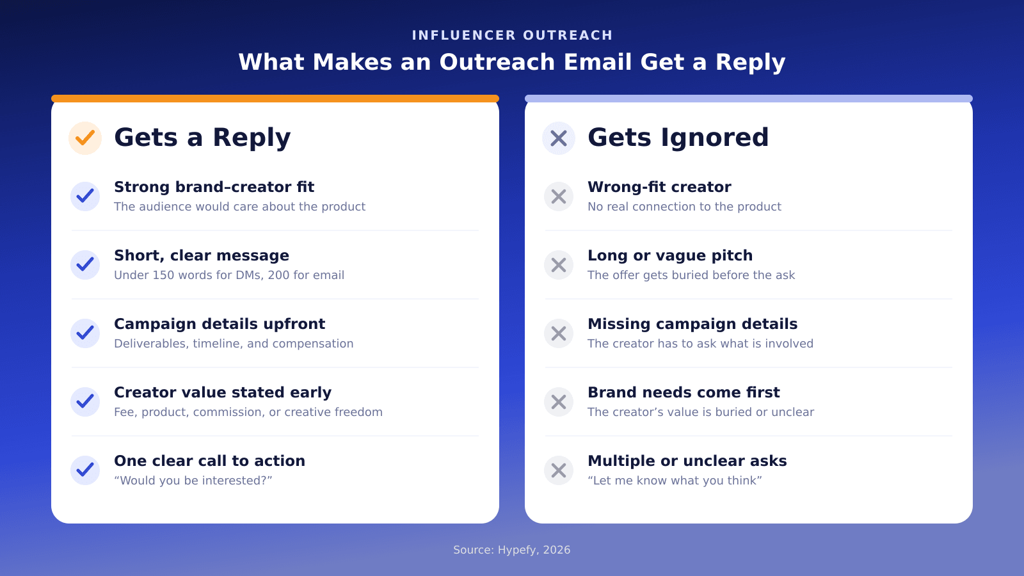
These are the elements that separate replied-to outreach from ignored outreach.
Relevance between brand and creator. If the product has nothing to do with the creator's content, no amount of polish recovers the pitch. The first check before sending is whether this creator's audience would care about the product.
A short, clear message. Under 150 words for a DM, under 200 for an email. The creator should be able to read it in under a minute and understand the offer without scrolling.
Campaign details upfront. Deliverables, timeline, and compensation go in the first message. Creators who have to ask what the campaign involves usually do not reply.
A clear value for the creator. What do they get? State the fee, the product, the commission, the creative freedom, or the early access in the opening. A message that leads with what the brand needs and buries what the creator receives reads as one-sided.
One clear call to action. A question that invites a simple yes or a request for more details. "Would you be interested?" and "happy to send the brief if this sounds like a fit" both work. "Let me know what you think" doesn’t, because it asks the creator to work out what to say.
What to Do Before You Send
Outreach that lands well starts before the message is written.
Define one goal for the campaign. Awareness, content production, conversion, or a long-term partnership. Each calls for a different creator profile and a different template. Outreach that is vague about the goal produces responses that are vague about commitment.
Find creators by relevance and engagement, not follower count. Our own invitation data shows creators under 10,000 followers reply to 47.2% of campaign invitations, against 26.3% for creators above 500,000. Smaller creators are easier to reach and usually cheaper to work with. Use the discovery tool to find creators whose content and audience match the brief rather than a follower count threshold.
Choose the right channel. Email is the right channel for paid partnerships, formal campaigns, and UGC commissions; it signals the seriousness of the ask. A DM is the right channel for first contact with smaller creators, for warming up a conversation before sending a full pitch, or when a creator's email is not listed anywhere. Always check the bio for a listed contact preference first.
Warm up the account first. Follow the creator and engage with a few posts from the brand account before the first message lands. A brand with a current, active profile is easier to say yes to than a dormant one.
How to Find a Creator's Email
Half of outreach problems are contact problems. Check these in order:
The Instagram or TikTok bio, including the link-in-bio page
The email button on business and creator accounts
Their website, About page, or downloadable media kit
The "for business inquiries" line, which often names a manager instead
Their YouTube About tab, where an address is often listed even when Instagram has none
If none of those turn anything up, send the cold DM above and ask. Past a shortlist of ten or so, a discovery tool that surfaces verified contact details in bulk is the only workable route.
Follow-Up Templates and When to Send Them
Most non-replies are not rejections. Creators are busy, inboxes are full, and a message sent on a Tuesday morning competes with everything else in the feed. A well-timed follow-up recovers replies that a single message would’ve lost.
The timing rule: send the first follow-up 2 to 3 days after the original message. Send a second, final follow-up 5 to 7 days after the first. After two follow-ups with no response, move on. More than two messages shifts from persistent to pressuring. That is not the foundation of a good working relationship.
The three follow-up templates below keep each message short and low-pressure.
14. Follow-Up After No Response (First)
Use 2 to 3 days after the first message with no reply.
Hi [First Name], just following up on my message from [day]. We’re still interested in working with you on [brief campaign description] and would like to hear your thoughts when you get a chance. [Your Name] |
15. Value-Add Follow-Up
Use in place of the first follow-up when you have a detail you left out. A follow-up that adds something performs better than one that asks whether the creator saw the last email.
Hi [First Name], one thing I left out of my first message: [new detail, such as the creative freedom on offer, the other creators involved, the usage window, or a higher rate]. Thought it might change the picture. Happy to send the full brief either way. [Your Name] |
16. Follow-Up After No Response (Final)
Use 5 to 7 days after the first follow-up.
Hi [First Name], one last nudge on [Brand Name]. If the timing isn't right or it isn't the right fit, completely understood. If you'd like to hear more before deciding, I'm happy to send over the brief. [Your Name] |
These are the things to avoid in follow-ups:
Sending multiple messages in rapid succession signals desperation
Rewriting the entire pitch in the follow-up creates confusion about what the actual ask is
Pressure language ("last chance," "limited spots") is off-putting and rarely true
Hitting every channel at once, such as email, DM, and a story mention is the fastest way to get blocked
A follow-up that adds one small piece of new value ("I wanted to share one more detail about the campaign that I left out of my first message") performs better than one that simply asks whether the creator saw the first message.
When a Creator Replies
A reply is not a yes. Two answers come back more than any others, and both need a response ready before the first message goes out.
A rate above budget. Treat it as an opening position rather than a rejection. Say what you have and ask what fits inside it.
17. Responding to a Rate Above Budget
Hi [First Name], thanks for coming back with that.
[Rate] is above what we have for this campaign, which is [budget].
A few options: we could reduce the deliverables to [smaller scope], run it as [gifting plus a smaller fee / affiliate on top of a reduced fee], or hold your rate and look at [later campaign] when the budget is larger.
Which of those works best for you?
[Your Name]
A decline. A no is still worth one more question, because creators know other creators in the same niche.
18. Referral Ask After a Decline
Hi [First Name], completely understood, and thanks for the quick reply.
One last thing: if you know anyone in [niche] who might be a fit for this, I'd be grateful for a name. Happy to keep the door open for [later timeframe] as well.
[Your Name]
Common Outreach Mistakes to Avoid
Generic opening. "I love your content" without any specific reference reads as a template. Fix: add one specific detail from a recent post before the pitch.
Unclear campaign details. A message that describes the campaign without stating what the creator is expected to produce, when, and for what compensation produces questions rather than replies and most creators will not ask. Fix: include deliverables, timeline, and compensation in the first message.
No clear value for the creator. A pitch focused entirely on the brand's campaign goals tells the creator nothing about what they get. Fix: state the creator's value (fee, product, commission, creative freedom) in the opening paragraph.
Wrong-fit creators. Outreach to a creator whose audience has nothing to do with the product tells the creator that the brand did not do basic research. Fix: check the creator's recent content and audience before reaching out, not after.
Sending too long a message. A four-paragraph pitch with a three-sentence backstory on the brand reads as homework for the creator. Fix: keep it under 200 words for email, under 150 for DMs. If the creator needs to know more, they will ask.
Wrong channel choice. A DM pitching a $5,000 campaign to a macro creator with agency representation will not get a professional reply. Fix: find the email, use it.
Following up too fast or too often. A follow-up 12 hours after the first message reads as aggressive. Three follow-ups in a week feels like harassment. Fix: 2 to 3 days for the first follow-up, 5 to 7 for the second, then stop.
No plan for a yes. Outreach that lands a positive reply and then goes quiet for a week while the brief and the contract get written loses the creator. Fix: have the brief, the rate, and the contract ready before the first message goes out.
How to Measure Your Outreach Results
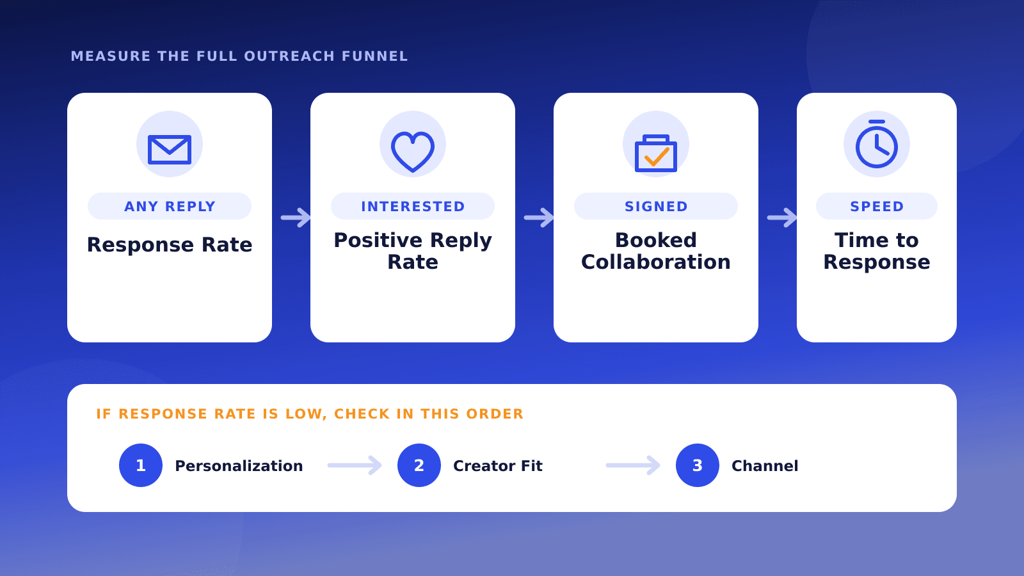
Measuring outreach tells you whether the templates, the creator selection, and the channel are working and which one to fix when results are low.
Response rate is the share of outreach messages that receive any reply. Consistently low response rates are a reason to check creator fit and personalization before changing the template.
A positive reply rate is the share of responses that express interest rather than declining. This is the number that improves most with better creator selection.
Conversion to booked collaboration is the share of positive replies that result in a signed agreement. Low conversion here usually points to a gap between the offer in the outreach and the terms that emerge in negotiation.
Time to response tells you whether the channel and timing are right. A response rate that is reasonable but slow may indicate the channel is not the creator's preferred one.
If response rates are low, check creator fit first, then personalization. The template itself is rarely the problem when the first two are wrong.
What a Reasonable Response Rate Looks Like
Most published benchmarks for influencer outreach carry no source, and the ones that do usually measure cold email to general business contacts rather than to creators. Treat any single number you find with suspicion.
What holds up is the pattern instead of the rate.
Response rates fall steadily as creator size rises. In our own campaign data, creators under 10,000 followers reply to invitations roughly 1.8x as often as creators above 500,000. That is the practical argument for weighting a shortlist toward nano and micro creators rather than chasing reach.
The number worth tracking is your own. Measure the response rate on your first campaign, then watch whether it moves as you change creator selection, personalization, and channel.
A trend line from your own outreach tells you more than an industry average built on someone else's list quality.
Scaling Outreach Without the Manual Work
Sending personalized outreach, tracking replies, and following up on time gets hard as volume grows. Five creators is manageable in a spreadsheet. Twenty is where messages fall through the gaps, follow-ups get missed, and the whole system starts producing inconsistent results.
Hypefy's outreach tool manages messages, follow-ups, and tracking in one place, from first contact through to a signed collaboration, so the process scales without the manual overhead. Use the discovery tool first to find creators that match the brief, then run outreach from the same platform.
Influencer Outreach Email Templates FAQs
How do you write an influencer outreach email?
An influencer outreach email should be short, personalized, and clear about the offer. Reference one specific detail from their content, state the campaign and creator value upfront, and end with one clear question, all in under 200 words.
What should an influencer outreach email include?
An influencer outreach email should include a personalized opener, the campaign description, deliverables and timeline, the compensation or product offer, and one call to action. Everything the creator needs to say yes belongs in the first message.
What is a good response rate for influencer outreach?
Published benchmarks for influencer outreach are mostly unsourced, so treat specific numbers with caution.
The pattern is more reliable than the rate. Response rates fall as follower counts rise, and in our own campaign data, creators under 10,000 followers reply roughly 1.8x as often as creators above 500,000. Track your own rate as the baseline.
Should I contact influencers by email or DM?
Use email for paid campaigns and UGC commissions, and a DM for first contact with smaller creators or when no email is listed. Always check the bio for a stated preference first.
How many times should I follow up with an influencer?
Follow up no more than twice, first after 2 to 3 days and again after 5 to 7. After two follow-ups with no reply, move on.
How do I personalize an outreach template?
You personalize an outreach template with one specific reference to recent content in the opening, such as a post or a recurring theme that connects to the brand. One sentence is enough.
Why are influencers not responding to my outreach?
Influencers usually go quiet when the message reads as a mass template, the campaign details are vague, or the fit is wrong. Check personalization and creator relevance first.
What should the subject line of an influencer outreach email say?
Name the offer, or the brand and the ask, such as "Paid collaboration, [Brand] x [Handle]" or "[Brand], we'd like to send you [Product]." Avoid vague lines like "Collaboration opportunity," all caps, and false urgency.
How do I find an influencer's email address?
Check the bio and link-in-bio page, the email button on business accounts, their website or media kit, and their YouTube About tab. If nothing is listed, send a short DM asking where to send details.
What do I say if an influencer's rate is above my budget?
Say what your budget is and offer options: a smaller scope, a mix of gifting and fee, affiliate on top of a reduced fee, or a later campaign with more budget. Most creators will negotiate scope.