TikTok influencer marketing is the practice of partnering with TikTok creators to promote a brand through short-form video that is native to the platform’s feed.
TikTok has the highest engagement of any major social platform, with a median engagement rate of around 8% in 2026, roughly two to three times Instagram’s.
That gap is a big part of why roughly a third of marketers now name TikTok their top influencer channel, more than any other platform.
Why TikTok Is the Top Platform for Influencer Marketing in 2026
TikTok’s dominance in influencer marketing comes down to three things that no other platform combines at the same level:
- An algorithm that rewards content quality over account size
- Engagement rates that are materially higher than those of any major competitor
- A native commerce layer that turns discovery into purchase without leaving the app
The sections below break down each one.
The Algorithm Surfaces Content, Not Followers
TikTok’s For You Page distributes content based on how viewers engage with it. Follower count barely factors in.
A video that holds attention, gets shared, or gets saved pushes further into new feeds regardless of whether the creator has 500 followers or 500,000. For brands, this changes the selection logic entirely.
A smaller creator with an engaged audience in a specific niche can achieve the same or greater reach than a large creator whose audience is passive.
Nano creators (1,000 to 10,000 followers) average 8 to 12% engagement on TikTok, according to Hypefy’s own campaign data. That is not a marginal difference. It reflects the quality of the relationship between a smaller creator and the people who actively follow them.
See how Hypefy runs TikTok campaigns end to end-> See How Hypefy Works
Engagement Runs Materially Higher Than Other Platforms
TikTok’s median engagement rate across all creator tiers runs materially higher than any major competing platform in 2026.
Instagram’s platform-wide average sits well below TikTok’s, even accounting for the lift that Reels provides for influencer accounts.
At the nano tier, TikTok engagement climbs further still, reflecting how tightly connected small creators are to the audiences that follow them specifically for their content.
For brands evaluating where to put influencer budget, this gap is the single most important number in the conversation.
Raw Content Beats Polished Production
TikTok’s culture rewards authenticity over production value. A creator filming a genuine first reaction in their kitchen will typically outperform a carefully lit brand-produced video.
This is the reason audiences trust creator content more than advertising. When content looks native, it is treated as a recommendation. When it looks like an ad, it is treated as an ad.
TikTok Shop Collapsed the Path to Purchase
TikTok Shop turned the platform into a full-funnel channel. A user can discover a product, watch a creator demonstrate it, and complete the purchase without leaving the app. For brands selling directly to consumers, TikTok Shop affiliate campaigns are among the most trackable creator marketing formats available in 2026.
More than 40% of US TikTok users buy directly on the platform, a higher share than on Facebook or Instagram. Source: eMarketer
Is TikTok Influencer Marketing Right for Your Brand?
Before committing the budget, here is a short framework.
Influencer marketing on TikTok tends to work well for brands that sell something visual or demonstrable, have an audience that skews under 40, can give creators genuine creative latitude, and want either broad awareness or direct sales through TikTok Shop.
Consumer goods, food and beverage, beauty, fashion, fitness, and entertainment all have strong creator ecosystems and receptive audiences on the platform.
It tends to work less well for brands that are selling to business buyers who are not on TikTok, need tight message control because of regulatory requirements, or are looking for immediate high-ticket B2B conversions.
The platform is not wrong for those use cases. It is just not where that audience lives or where that kind of trust is built.
A quick definition for anyone encountering the term for the first time: TikTok influencer marketing is when a brand pays or gifts a TikTok creator to post content that features the brand’s product or service, with the goal of reaching the creator’s audience through content that looks and sounds like the creator’s normal output rather than a brand advertisement.
Not sure if TikTok is the right channel for your brief? Book a 30-minute call, and we will help you figure out where to start.
What TikTok Influencer Marketing Costs in 2026
Rate Ranges by Creator Tier
| Creator tier | Followers | Typical rate per video |
|---|---|---|
| Nano | 1K-10K | $25-$200 |
| Micro | 10K-100K | $200-$1,500 |
| Macro | 100K-1M | $1,500-$5,000 |
| Mega | 1M+ | $5,000+ |
These ranges reflect standard sponsored video content. Several factors move a quote within its range.
Niche premiums apply in finance, legal, healthcare, and B2B technology, where creators with specialist audiences command rates two to three times those of the equivalent lifestyle creator. The audience is harder to reach and the endorsement carries more weight.
Usage rights add cost when a brand wants to run the creator’s content in paid ads (Spark Ads) or reuse it across its own channels. A typical usage rights uplift runs 20 to 50% on top of the base video rate.
Exclusivity restricts the creator from working with competing brands during the campaign window or for a defined period after. The longer the window, the higher the premium.
Spark Ads mean the brand boosts the creator’s own post as a paid ad. This format consistently outperforms brand-originated in-feed ads because the content and the creator’s account are the same as what the user would encounter organically. Budget for the boost separately from the creator fee.
How to Judge Whether a Quote Is Fair
The cost per engagement framework divides the quoted fee by the creator’s likely engagements (followers multiplied by engagement rate).
For example, a creator with 50,000 followers and a 6% engagement rate will generate roughly 3,000 engagements per post. A fee of $600 gives a cost per engagement of $0.20.
Compare that to the platform average and to what paid social costs you per engagement on the same audience. If TikTok creator content is cheaper per genuine engagement than your paid social equivalent, the math supports the investment.
Use the CPM calculator to run this comparison before committing.
6 TikTok Influencer Campaign Types and Strategies
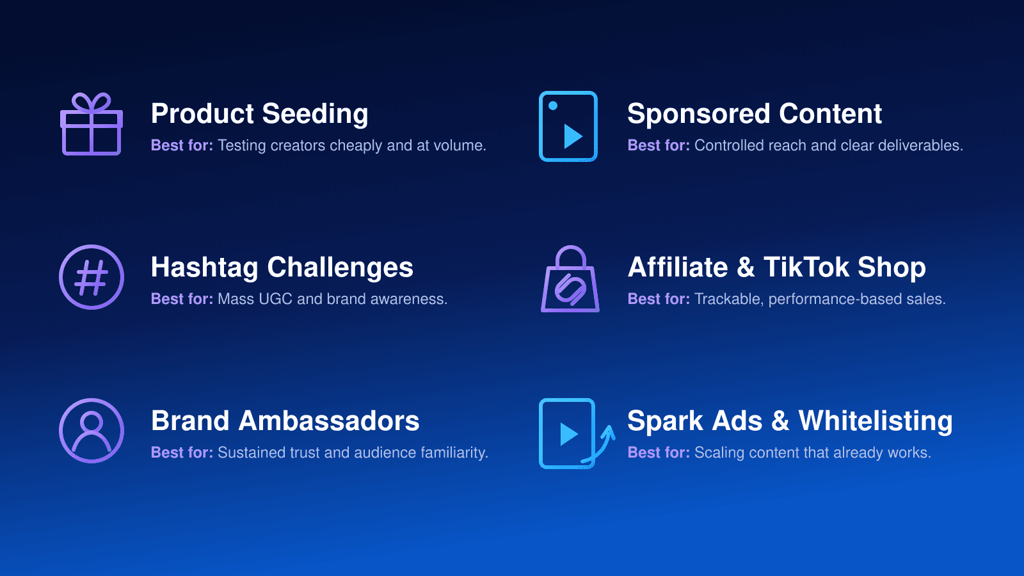
Most good TikTok campaigns combine two or three of these formats rather than running just one.
The most common stack seeds product to find which creators and content styles perform, then puts Spark Ads behind the best performer to scale what is already working.
1. Product Seeding and Gifting
Best for: Testing creators cheaply and at volume before committing paid budget.
Send the product to a curated set of nano and micro creators without a paid arrangement and invite them to post if they genuinely like it. The content that comes back is unscripted and authentic.
The creators who perform well become candidates for paid campaigns. This format is the lowest-risk entry point into TikTok creator marketing because the cost is the product itself, and the data it generates informs every subsequent decision.
2. Sponsored Content
Best for: Controlled reach with a clear brief and defined deliverables.
A paid agreement with a creator to produce a specified number of TikTok videos featuring the brand within a defined window.
The brief defines the message, the required disclosure, what is off-limits, and the format. The creator decides the execution. Over-scripting kills the authenticity that makes TikTok content work. This is the standard format most brands start with.
3. Hashtag Challenges
Best for: Mass UGC and brand awareness through participation.
A branded challenge invites the TikTok community to create content around a theme, a sound, or a physical challenge, tagged with a brand hashtag. The brand and its initial creator partners seed the challenge.
If it catches, the UGC volume compounds without additional cost. Challenges work when the creative prompt is genuinely fun and low-friction to participate in. They rarely work when the brief requires participants to do something complicated or visibly promotional.
4. Affiliate and TikTok Shop Commission Deals
Best for: Trackable, performance-based sales with clear attribution.
The creator earns a percentage of the sales they drive, tracked through unique affiliate links or TikTok Shop’s built-in attribution. This aligns creator incentives directly with sales outcomes and removes the ambiguity around whether creator activity drove revenue.
It is also the format that works best with TikTok Shop’s in-app purchase flow, where the creator’s video, the product listing, and the checkout are all in the same experience.
5. Brand Ambassador and Long-Term Partnerships
Best for: Sustained trust and audience familiarity over time.
A recurring relationship with a creator over three to twelve months, with a defined deliverable cadence. The creator’s audience builds familiarity with the brand across multiple touchpoints.
By the fourth or fifth post, the association feels organic rather than sponsored. Ambassador formats consistently outperform one-off posts on conversion and brand recall, and most creators offer meaningful rate discounts for longer commitments.
6. Spark Ads and Whitelisting
Best for: Scaling the content that is already working.
Spark Ads allow a brand to boost a creator’s existing organic TikTok post as a paid ad, served through the creator’s account. This preserves the native feel of the content while extending its reach beyond the creator’s organic audience.
Spark Ads outperform standard in-feed ads by a meaningful margin on click-through rate because the post looks like creator content, not brand advertising. The workflow is: identify the best-performing organic creator posts, get whitelisting permission from the creator, and boost from there.
TikTok’s native creative tools, such as Duet, Stitch, and Branded Effects, are tactics that sit within these formats rather than separate campaign types. Duet and Stitch let creators build on existing content, which works well for challenge formats. Branded effects are creator-facing tools that the brand can commission and then seed through sponsored content.
What You Get Back: TikTok Influencer Marketing ROI
The average ROI benchmark for influencer marketing sits well above that of most traditional digital channels. This figure varies by category, creator tier, and how tightly the campaign is tracked. Treat it as a directional benchmark, not a guarantee.
The formula is simple. Return on investment equals revenue minus cost, divided by cost. Customer acquisition cost on a given campaign is the total spend divided by the new customers acquired.
Views are not returns. A TikTok video accumulating millions of views is a reach event. The return comes from what those views caused: clicks, codes redeemed, products purchased, accounts followed, or searches generated.
The campaigns that cannot prove ROI are almost always the ones where tracking was not set up before the first video went live. Creator-specific discount codes, trackable affiliate links, and Spark Ads attribution are the tools that connect TikTok activity to business outcomes. Build them in before launch every time.
Check your expected return before committing to a creator budget with the ROI calculator.
How to Find the Right TikTok Influencers
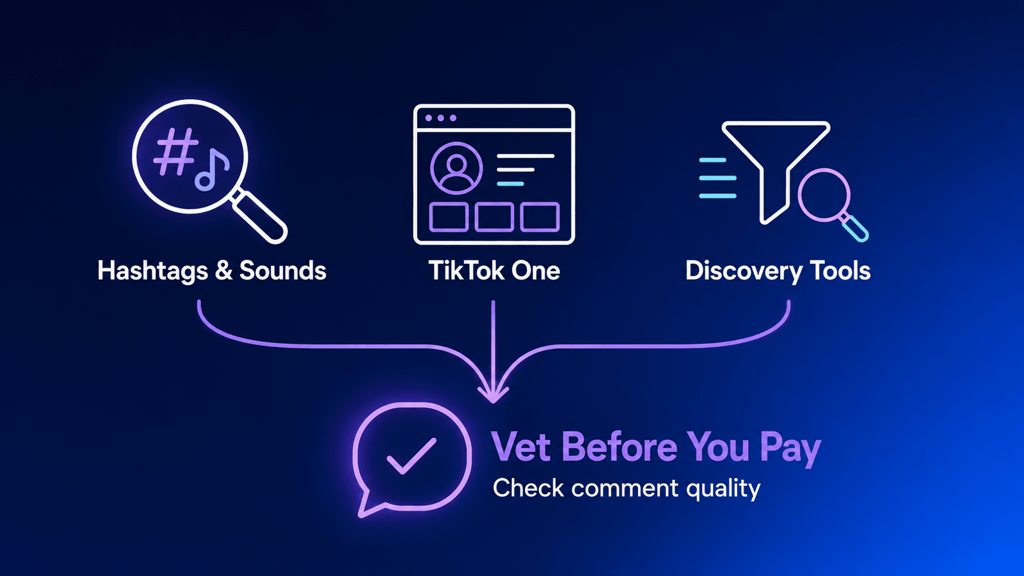
The essentials are focusing on fit over follower count, with content style and genuine audience engagement as the primary filters. Check whether the creator’s audience matches your target customer. Vet for real engagement before committing budget by looking at comment quality and saves alongside raw engagement rate.
The three main discovery routes are:
- Manual search through relevant hashtags and sounds,
- TikTok’s Creator Marketplace, which lists creators who have opted in and are open to brand partnerships
- Dedicated discovery platforms that search beyond the marketplace to find creators who are relevant, regardless of whether they have signed up to a third-party tool
The warning that matters: check for inflated engagement before you pay. Comment quality is the fastest signal. A comment section full of generic phrases, single words, or emoji-only reactions indicates low authenticity regardless of what the engagement rate says.
For the full step-by-step process, the guide to finding TikTok influencers covers creator discovery on the platform in detail.
Hypefy’s discovery tool searches creators directly from TikTok by the meaning and style of their content, so the brief drives the match.
Why Most TikTok Influencer Campaigns Underperform
Picking creators on follower count rather than engagement and fit. Fix: look at engagement rate and comment quality first. Follower count is the last thing to check.
Over-scripting and killing authenticity. Fix: brief the message and the outcome. Leave the execution to the creator. If it sounds like a brand script, it will perform like one.
One-off posts with no plan to reuse the content. Fix: negotiate usage rights upfront and build a Spark Ads plan alongside the organic campaign from day one.
No tracking set up before launch. Fix: unique codes and trackable links per creator, set up before the first video goes live.
Ignoring the comments. Fix: the comment section is the clearest signal of how the audience is responding in real time. Check it. Reply to it. Use it to adjust.
Chasing mega creators when micro or nano would convert better. Fix: engagement data consistently favors smaller creators in conversion campaigns. Save the mega budget for awareness objectives where reach is genuinely the goal.
Treating TikTok as a pure awareness channel. Fix: TikTok Shop and affiliate formats make TikTok a direct sales channel. Build the conversion mechanism into the campaign from the start rather than hoping awareness converts on its own.
Real Brands Winning on TikTok
1. How Jaffa Crvenka Launched Buttons in Croatia
Read the full Jaffa case study
Jaffa used Hypefy to launch their Buttons product across Croatia, targeting a specific demographic across major cities. 16 matched creators produced 41 pieces of content.
The campaign reached 1.8 million people, generated 2.6 million impressions, and saw its best-performing single post accounts for nearly 30% of total campaign reach.
Every KPI was exceeded. The result became the brief for twelve further campaigns across four markets.
2. How Argeta Cracked Fourteen European Markets
Read the full Argeta case study
Argeta, the Balkan pâté brand owned by Atlantic Grupa, used Hypefy to move into Western and Northern Europe without setting up a separate operation in every country. Over 18 months it ran 21 campaigns across 14 markets, reaching 4.6 million people with more than 90 creators, all through one platform.
The TikTok-native work carried the highest engagement. In Austria, the Extra Pikant campaign hit 8.18% engagement per reach, the best of the entire run. A synchronized Fish Friday launch went live across five Balkan markets on the same day, and a leaner TikTok Made Me Buy It test aimed at German Gen Z outperformed the brand’s earlier hero campaign.
3. How Stanley Grew From $75M to $750M on TikTok
Stanley 1913, a 110-year-old thermos maker, repositioned its Quencher tumbler toward women and leaned into TikTok creators and user-generated content. A viral clip of a Quencher surviving a car fire with the ice still intact became a durability proof point, and limited-color drops manufactured scarcity and FOMO. Creators showcasing their collections turned a water bottle into a lifestyle symbol.
Stanley’s annual sales grew from around $75 million in 2019 to $750 million in 2023. That is a tenfold jump in about four years, driven largely by TikTok creators and user-generated content.
4. How Duolingo Turned Its Mascot Into a TikTok Phenomenon
Duolingo made its own account for the campaign, giving its owl mascot an unhinged, in-joke persona built for TikTok’s raw culture. In February 2025, it “killed” Duo in a six-day stunt that spread across news outlets and rival brands before the owl was revived, all tied back to getting lapsed learners into their lessons.
Duolingo grew from 50,000 to more than 16 million TikTok followers in about four years.
The “Death of Duo” campaign generated 1.7 billion organic impressions.
How Hypefy Runs This for You
TikTok influencer marketing has a well-documented operational side: finding creators, judging whether their rates are fair, managing briefs and content approvals, processing payments across multiple creators, and tracking what each one drove.
Every one of those steps costs time, and most brands do them in spreadsheets until the volume breaks the process.
Hypefy handles the operational layer. Its Semantic Selection matches TikTok creators to your brief by reading the meaning of their content, so a creator whose posts fit the campaign surfaces even when their bio never says so.
It sets fair rates using Smart Pricing based on a creator’s real, recent engagement, and manages outreach, content review, contracts, payments, and performance reporting in one place.
The result is that a lean team can run a multi-creator TikTok campaign without the spreadsheet chaos.
TikTok Influencer Marketing in 2026 FAQs
How much does TikTok influencer marketing cost?
Nano creators typically charge $25 to $200 per video. Micro creators run $200 to $1,500. Macro creators run $1,500 to $5,000. Mega creators start at $5,000. Niche premiums, usage rights, and Spark Ads add to base rates. Use the marketing budget calculator to model spend by tier before briefing anyone.
Is TikTok good for influencer marketing?
Yes, particularly for brands targeting under-40 audiences with visual or demonstrable products. TikTok leads all major platforms in engagement, and the algorithm distributes content based on performance, which means a well-matched creator with a modest following can reach far more people than the follower count suggests.
How do brands find TikTok influencers?
Through manual hashtag and sound search, TikTok’s Creator Marketplace, or dedicated discovery platforms. The full step-by-step process is covered in the TikTok influencer discovery guide. Hypefy’s discovery tool searches creators by the meaning of their content.
What is a good engagement rate on TikTok?
The median across all creator tiers is approximately 8% in 2026. A good TikTok engagement rate depends on the creator’s audience size, niche, and the calculation method used. In 2026, approximately 8% is a useful benchmark for creators, with median rates remaining relatively consistent across follower tiers. Compare creators against accounts of a similar size and assess comment quality, shares, and saves alongside the headline rate.
What content performs best on TikTok?
Content that holds attention in the first two seconds, looks native rather than produced, and prompts saves or shares. Recipe content, product demonstrations, first reactions, and tutorials with genuine utility consistently outperform purely promotional or highly scripted content. TikTok’s February 2026 algorithm update further prioritized saves and shares over likes in content distribution.
How long should a TikTok influencer campaign run?
A seeding or product gifting campaign can generate useful data within two to three weeks. A sponsored content campaign with defined deliverables typically runs two to six weeks. Ambassador programs run three to twelve months and produce compounding results as the creator’s audience builds familiarity with the brand over time.
What is the ROI of TikTok influencer marketing?
Higher than most digital channels when tracked properly. TikTok-specific ROI varies by category, creator tier, and campaign structure, but campaigns with proper attribution, unique codes, affiliate links, and Spark Ads tracking consistently report stronger returns than those relying on reach and engagement metrics alone because they can connect creator activity to actual revenue.