
The best influencer marketing setup for your brand in 2026 might be an agency, a platform, or a combination of both.
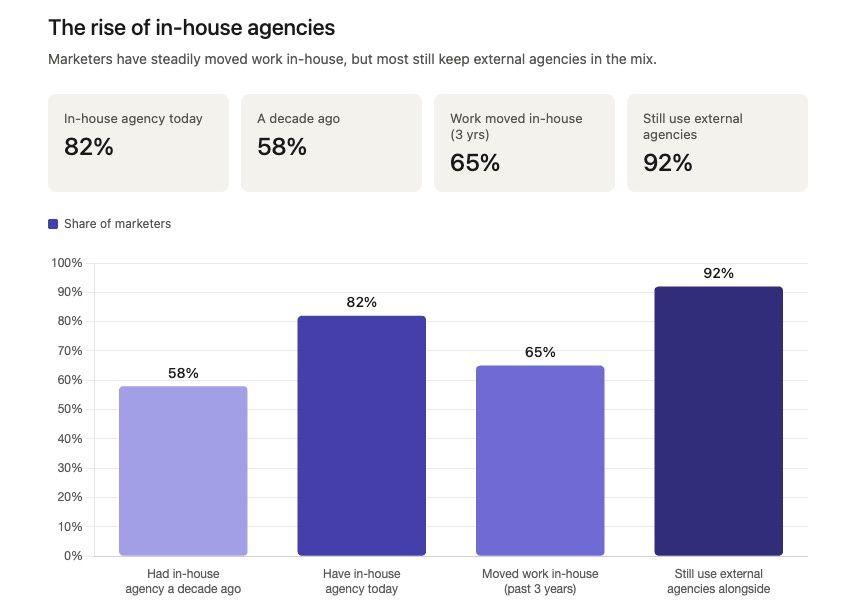
According to ANA’s 2023 in-house agency study, 82% of marketers now run an in-house agency, up from 58% a decade ago, and 65% have moved work that used to sit with external agencies back in-house over the past three years.
At the same time, 92% still use external agencies alongside the in-house team.
The honest answer for most brands isn’t agency or in-house – it is often a mix of the two. It’s a platform that handles the operational work while the internal team keeps the strategy.
This guide covers what influencer marketing agencies actually do, what they cost, when they’re the right choice, and when a platform like Hypefy is the better call.
Agency or Platform? What Most Brands Get Wrong Before They Even Start
Before any agency comparison is useful, this is the call that matters most. And it is worth thinking this through before you pick a model.
When you hire a full-service agency, that agency owns the strategy, the creator relationships, and the reporting. If the engagement ends, the institutional knowledge often leaves with them.
When you end an agency relationship, check whether you keep the creator relationships that were built during the engagement.
A platform sits on the other side of that trade-off. You keep the strategy in-house, you own the creator list, and you see the raw data instead of a sanitized PDF.
Here is the honest split.
Agencies are stronger at: deep creative strategy for complex launches, existing relationships with high-tier creators and talent managers, full production at scale, FTC and brand-safety compliance for regulated categories, and serving brands that have no internal marketing team to lean on.
Platforms are stronger at: cost per campaign, full transparency into performance data, speed of execution, pricing intelligence on creator rates, and flexible, campaign-by-campaign commitment. They also let internal teams build long-term creator relationships that stay with the brand.
There is one situation where neither a platform nor an agency is enough on its own: large brands running global, multi-market programs with regulatory complexity across regions. At that scale, you need both.
The platform layer handles discovery, pricing intelligence, and performance data across markets, while an agency layer handles creative direction, local market nuance, and the operational coordination that cannot be automated.
Those teams typically keep strategy and brand voice internal, run the platform for execution and reporting, and bring in an agency partner for the parts that still require human judgment at scale.
The direct recommendation: if you have an internal marketing team and a recurring campaign budget, a platform is usually a very cost-efficient option on ROI per dollar spent.
What Do Influencer Marketing Actually Do?
A full-service influencer marketing agency covers the entire workflow, from creator discovery and vetting, strategy and brief development, and outreach and negotiation, to content management and approval, payment processing, FTC compliance, and post-campaign reporting and analytics.
The agency acts as the operational layer between the brand and the creator.
There are two broad models.
Full-service agencies handle every step end-to-end and usually charge a retainer or a percentage of total spend.
Specialist agencies focus on a narrower scope, such as TikTok-only, UGC-only, or B2B-only, and often work on a project-fee basis. The specialist model tends to be more cost-efficient when your needs match their focus, but limiting when they do not.
Pricing typically follows one of three models.
The retainer model is a flat monthly fee that covers ongoing strategy and execution, usually starting at around $5,000/month and going much higher for enterprise engagements.
The campaign fee model is a fixed per-project price, which works well for one-off launches and tends to suit specialist agencies.
The percentage-of-spend model charges a cut of the total campaign budget, usually 15-25%, and is most common at agencies that manage paid amplification alongside influencer work.
Enterprise agencies often have campaign minimums ranging from $25,000 to $50,000 or more, while Fortune 500-focused agencies start at around $100,000 per engagement.
Creator payments are typically billed separately from agency fees.
Sources: https://www.stackmatix.com/blog/best-tiktok-marketing-agencies-2026; https://clutch.co/profile/ubiquitous; https://theinfluencermarketingfactory.com/influencer-marketing-in-house-vs-agency/; https://hireinfluence.com/blog/houston-influencer-marketing-agency/
The Top Influencer Marketing Agencies in 2026: Quick Overview
| Agency | Best For | Speciality | Min. Campaign Size | Platforms | Rating |
|---|---|---|---|---|---|
| Viral Nation | Enterprise, global brands | Full-funnel, paid amplification | $50,000+/project | TikTok, IG, YouTube, Meta | 4.4/5 |
| inBeat Agency | DTC, performance creative | Micro-influencer UGC, paid ads | $5,000+/month | TikTok, IG, YouTube | 4.8/5 |
| The Social Shepherd | Mid-market, e-commerce | Creative-first, end-to-end social | Custom retainer | TikTok, IG, YouTube | 4.5/5 |
| Moburst | Mobile apps, SaaS | Mobile-first, performance UA | Custom retainer | TikTok, YouTube, LinkedIn | 4.1/5 |
| Open Influence | Enterprise, Fortune 500 | AI-driven, global creator data | Custom retainer | TikTok, IG, YouTube, Meta | 4.4/5 |
| The Shelf | Mid-market, multi-vertical | Data-driven, full-funnel | Custom retainer | TikTok, IG, YouTube, Pinterest | 4.6/5 |
| Ubiquitous | TikTok-first brands | TikTok influencer + paid | $25,000+/project | TikTok, IG, YouTube | 4.7/5 |
| HireInfluence | Fortune 500, premium brands | White-glove, experiential | ~$100,000+ | IG, TikTok, YouTube | 4.0/5 |
| Fresh Content Society | B2B, mid-market | Long-term creator ecosystems | Custom retainer | IG, TikTok, LinkedIn, YouTube | 5.0/5 |
| Mediakix | Lifestyle, ROI-focused | Data-heavy, multi-platform | Custom | YouTube, TikTok, IG | 4.3/5 |
The 10 Best Influencer Marketing Agencies in 2026: Full Breakdown
1. Viral Nation
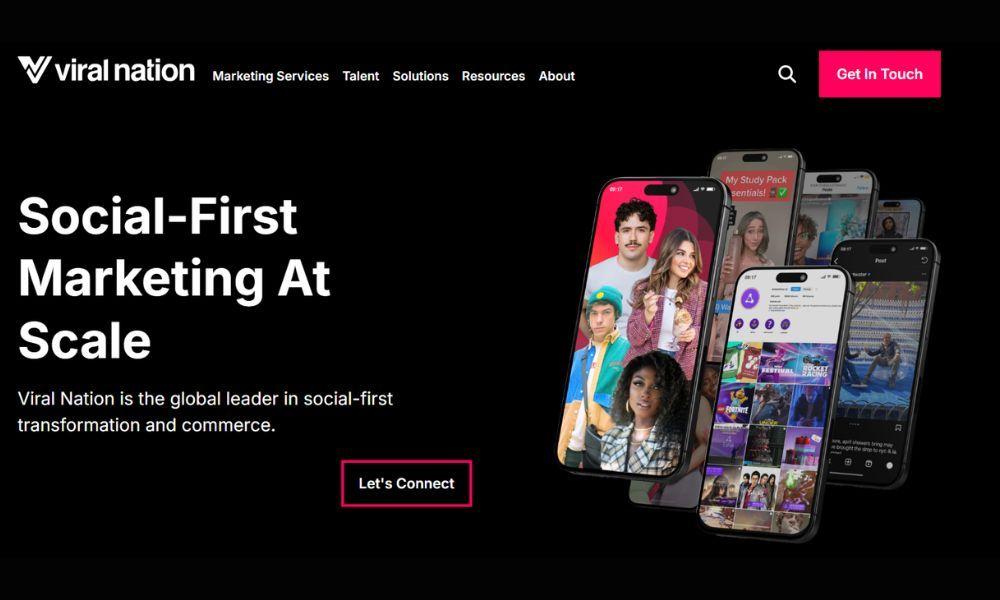
Viral Nation is a global, enterprise-grade influencer marketing agency that combines AI-driven creator vetting with full-service campaign execution for Fortune 500 brands.
The agency runs campaigns in 30+ countries, has a network of 18,000+ vetted creators, and supports proprietary AI tools for creator matching and brand safety.
It is one of the few agencies that genuinely operates at enterprise scale.
Pricing: Ranges from $50,000 for specific projects to $400,000-$600,000 CAD for larger engagements, based on verified Clutch reviews.
Pros:
- Proven track record with brands like Disney, Uber, Meta, and Tencent Games.
- Integrated paid media amplification built into the influencer workflow.
- Strong attribution and brand-safety tooling, including CreatorOS, for regulated categories.
Cons:
- $50,000 project minimums put it out of reach for most mid-market brands.
- Enterprise-style processes can feel slow for fast-moving DTC teams.
- Glassdoor employee reviews flag heavy AI reliance and pace-driven workload, which can affect account team turnover and continuity for clients.
Rating: 4.4/5
Sources for data: https://www.influencer-hero.com/blogs/viral-nation-agency-a-leader-in-influencer-marketing; https://www.stackmatix.com/blog/best-tiktok-marketing-agencies-2026
2. inBeat Agency
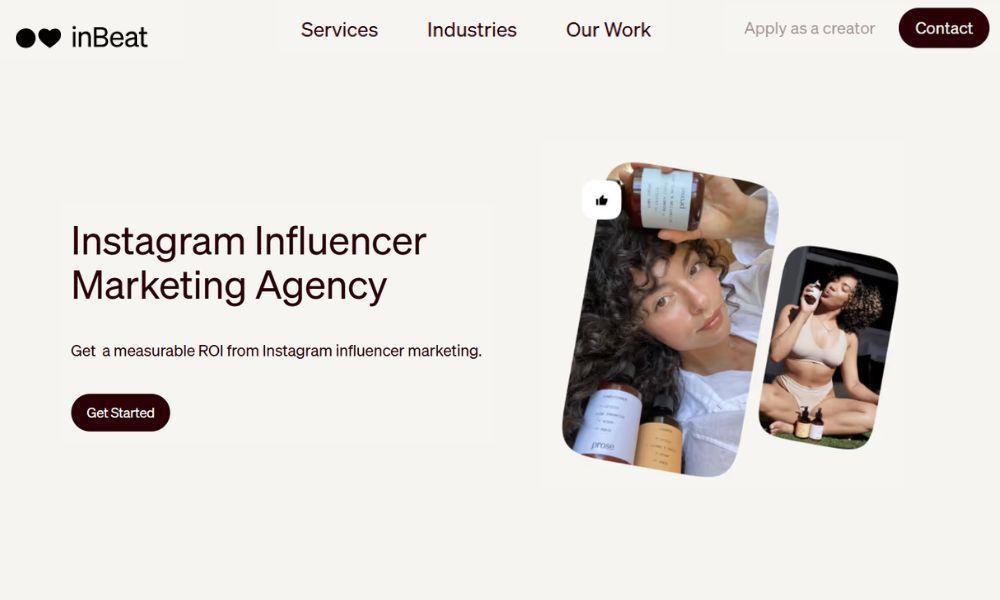
inBeat is a performance-focused influencer and UGC agency built around micro-creators and content designed to run as paid ads.
Based in Canada with US offices, inBeat works with hundreds of CPG, eCommerce, tech, and health brands. The angle is high-volume creative testing rather than celebrity reach or polished brand storytelling.
Pricing: Monthly retainers typically start around $5,000, with project sizes from $10,000 for smaller engagements to $50,000+ for larger UGC programs.
Pros:
- Strong fit for DTC brands that need creative volume for paid social testing.
- Transparent pricing model compared to most enterprise agencies.
- Genuine micro-influencer specialisation rather than a recycled celebrity list.
Cons:
- Less suited to brand-led strategy work or large-scale awareness campaigns.
- The performance-creative focus is the wrong fit if you need editorial storytelling.
- Limited reach for premium or celebrity-tier creators, since the model is built around the long tail.
Rating: 4.8/5
Sources for data: https://www.stackmatix.com/blog/best-tiktok-marketing-agencies-2026; https://clutch.co/profile/inbeat-agency
3. The Social Shepherd
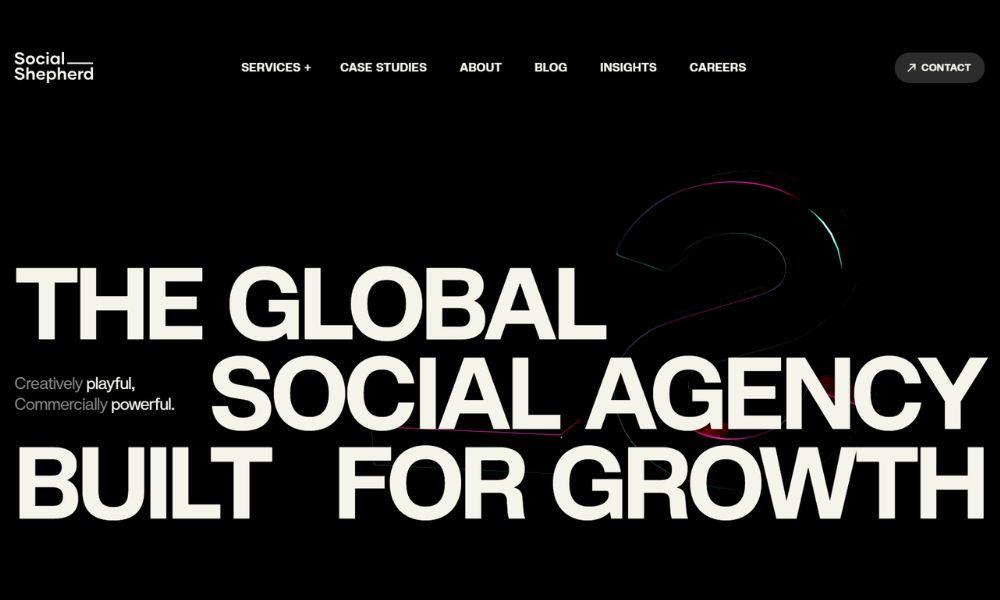
The Social Shepherd is a UK and US social-first agency offering end-to-end influencer marketing, paid social, organic, and creative as one integrated service.
The 70+ person team works with brands like UNIQLO, Lavazza, ASICS, and Premier Inn, and has been named Best Large Social Media Agency at the UK Agency Awards three years running.
Pricing: Custom retainers based on scope. Social media management retainers in this tier typically range from $3K to $15K per month.
Pros:
- Strong creative output and award-winning campaign execution.
- Combines influencer work with paid social and organic content under one roof.
- Real bench depth, with specialists dedicated to specific platforms rather than generalists.
Cons:
- Mixed Trustpilot reviews suggest client experience varies by team.
- Primarily B2C-focused; less suited to deep B2B or SaaS programs.
- Pricing requires a custom sales call, with no published rate cards or transparent minimums.
Rating: 4.5/5
Source for data: https://www.agencycluster.com/agency/the-social-shepherd
4. Moburst
Moburst is a mobile-first digital marketing agency that specializes in influencer marketing for SaaS and subscription apps.
Offices in New York, San Francisco, London, and Tel Aviv, with clients including Google, Samsung, Reddit, Uber, and Bumble.
Its influencer programs are tightly integrated with mobile user acquisition funnels, ASO, and performance creative.
Pricing: Custom retainer, generally priced for mid-to-large mobile brands rather than early-stage startups.
Pros:
- Deep understanding of subscription economics and LTV:CAC modelling.
- Strong on tech-savvy creators across TikTok, YouTube, and LinkedIn for SaaS.
- Award-winning ASO and creative production built around mobile growth.
Cons:
- Limited brand-led storytelling depth compared to creative-first agencies.
- Better suited to mobile and app-first brands than traditional e-commerce or pure web SaaS.
- The mobile-UA framing can feel narrow for brands that need broader brand-building work beyond user acquisition.
Rating: 4.1/5
5. Open Influence
Open Influence is a global creator marketing agency that combines AI-supported creator matching with managed services and in-house production through Studio OI.
Founded in 2013, the agency works with Fortune 500 brands like McDonald’s, Adidas, Hyundai, and Verizon, and supports campaigns across 70+ countries and 15 languages.
Pricing: Custom enterprise pricing. Positioned for large, cross-functional campaigns.
Pros:
- One of the largest proprietary creator-data sets in the industry, analysing 100M+ pieces of content.
- Strong in-house production capability for high-volume creative across multiple markets.
- Genuine multi-market expertise with localisation support.
Cons:
- The enterprise setup can feel heavier than needed for smaller brands.
- Pricing is opaque without a sales call.
- The breadth across markets and verticals can mean less depth in any single niche compared to specialist agencies.
Rating: 4.4/5
Sources for data: https://openinfluence.com/; https://www.linkedin.com/company/openinfluence
6. The Shelf
The Shelf is a data-first influencer marketing agency focused on enterprise brands that need creator campaigns tied to measurable revenue.
Headquartered in Atlanta and New York, with a proprietary SaaS platform for discovery and audience analysis. Clients include Neutrogena, Hulu, Nordstrom, and Papa Murphy’s.
Pricing: Custom retainer. The agency targets mid-market and enterprise budgets.
Pros:
- Proprietary technology paired with creative execution.
- Strong focus on conversion tracking and EMV (earned media value) rather than vanity metrics.
- Works across most major social platforms, not platform-locked.
Cons:
- Less suited to high-end editorial creator work or pure brand storytelling.
- Higher minimums than micro-influencer specialists.
- The data-heavy approach can deprioritize raw creative quality in favor of measurable performance, which is the wrong trade for brand-building campaigns.
Rating: 4.6/5
7. Ubiquitous
Ubiquitous is a TikTok-first influencer marketing agency built around viral content and fast execution at scale.
Headquartered in Los Angeles, it works with brands like Lyft, Disney, Target, Netflix, and Amazon, and has built a database of more than 14,000 vetted TikTok creators.
The agency also runs Instagram and YouTube campaigns.
Pricing: Minimum project size is $25,000+, with reported monthly minimums around $21,000 for enterprise engagements.
Pros:
- One of the strongest dedicated TikTok specialists in the market.
- Proprietary tech stack for creator discovery and predictive analytics.
- Fast execution and integrated paid amplification with Spark Ads.
Cons:
- TikTok-first focus is a limitation if you need multi-channel breadth.
- The high-volume, viral approach may feel off-brand for traditional or regulated industries.
- Heavy dependency on the TikTok platform’s health, which is a structural risk given the ongoing regulatory pressure in the US.
Rating: 4.7/5
Sources for data: https://clutch.co/profile/ubiquitous; https://www.influencer-hero.com/blogs/ubiquitous-agency-insights-overview-unique-selling-points-pricing-reviews-and-key-clients
8. HireInfluence
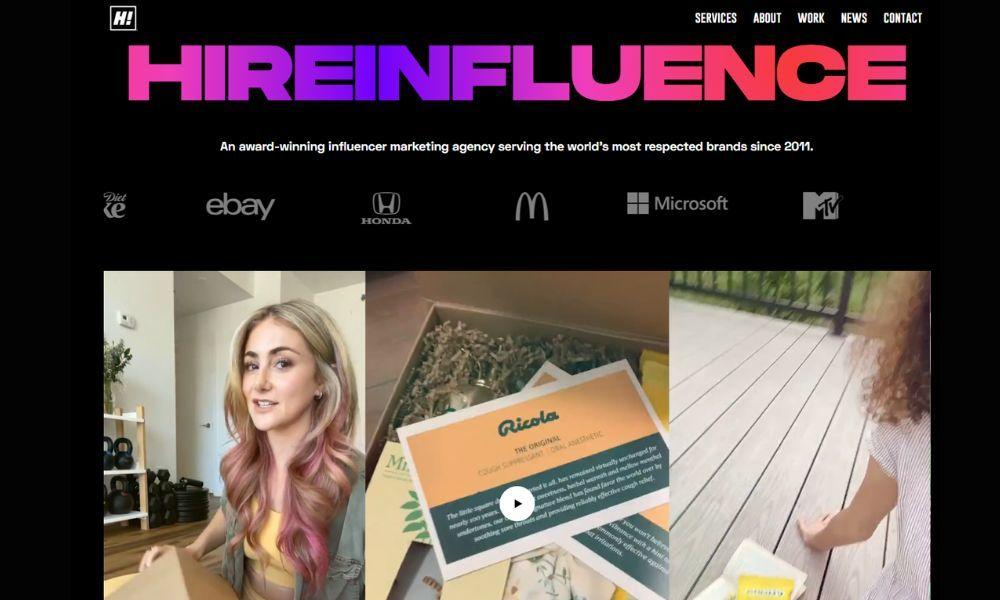
HireInfluence is a premium, full-service influencer marketing agency that focuses on Fortune 500 brands and complex multi-platform campaigns.
Founded in 2011 and based across Houston, Austin, Los Angeles, and New York, the agency has worked with Microsoft, MTV, Adidas, McDonald’s, and eBay.
It positions itself as a white-glove partner for brands that need experiential ideation, FTC compliance, and C-suite-ready reporting.
Pricing: Engagements start at approximately $100,000.
Pros:
- True end-to-end capability for enterprise campaigns, including legal, compliance, and 1099 management.
- Strong experiential and on-site brand activation arm.
- NY Digital Award winner for Influencer Marketing Agency of the Year in 2024 and 2025.
Cons:
- The $100K starting price puts it out of reach for small and mid-market brands.
- White-glove service comes with white-glove timelines, which can feel slow for performance-driven teams.
- The premium-production model is overbuilt for brands that primarily need creator content for paid social testing.
Rating: 4.0/5
Sources for data: https://clutch.co/profile/hireinfluence; https://hireinfluence.com/blog/houston-influencer-marketing-agency/
9. Fresh Content Society
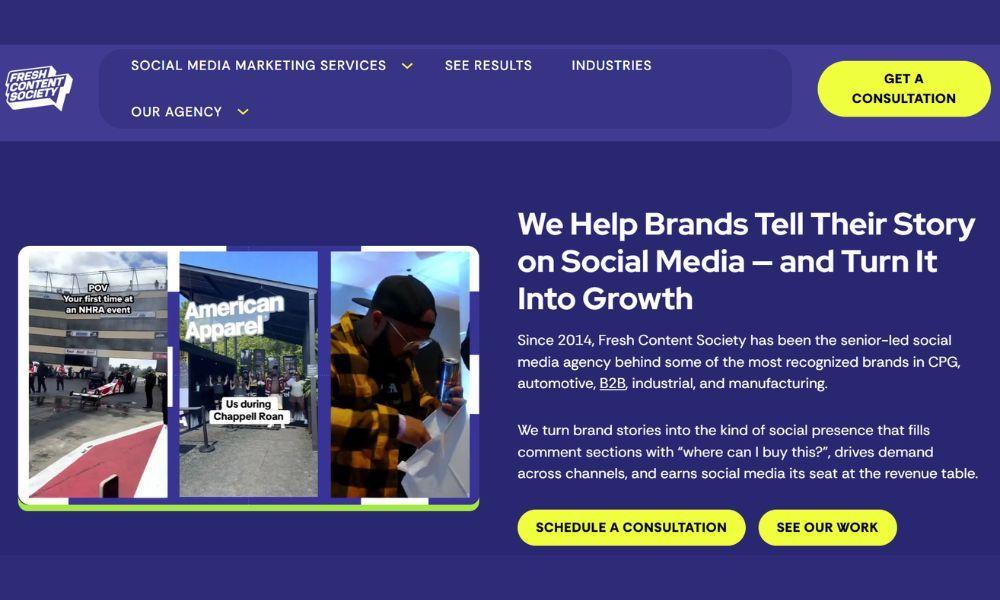
Fresh Content Society (FCS) is a senior-led social media and influencer marketing agency built for B2B and mid-market brands.
Based in Northfield, Illinois, the team works across manufacturing, construction, automotive, CPG, and B2B services, with a focus on long-term creator ecosystems rather than one-off campaigns.
The agency has generated 90M+ video views and $15M in earned media value for clients.
Pricing: Custom retainer. Positioned for mid-to-large B2B and consumer brands looking for ongoing programs.
Pros:
- Genuine B2B expertise in a category most agencies neglect.
- Senior-led execution with low junior-staff turnover risk.
- Strong reviews and consistent 9%+ engagement rates.
Cons:
- Smaller scale than enterprise agencies, which can limit massive global rollouts.
- Less suited to brands that need pure DTC viral creative.
- A long-term ecosystem model is a poor fit for brands that need fast one-off campaign execution.
Rating: 5.0/5 (based on limited but consistently positive third-party reviews)
Source for data: https://freshcontentsociety.com/influencer-marketing/
10. NeoReach
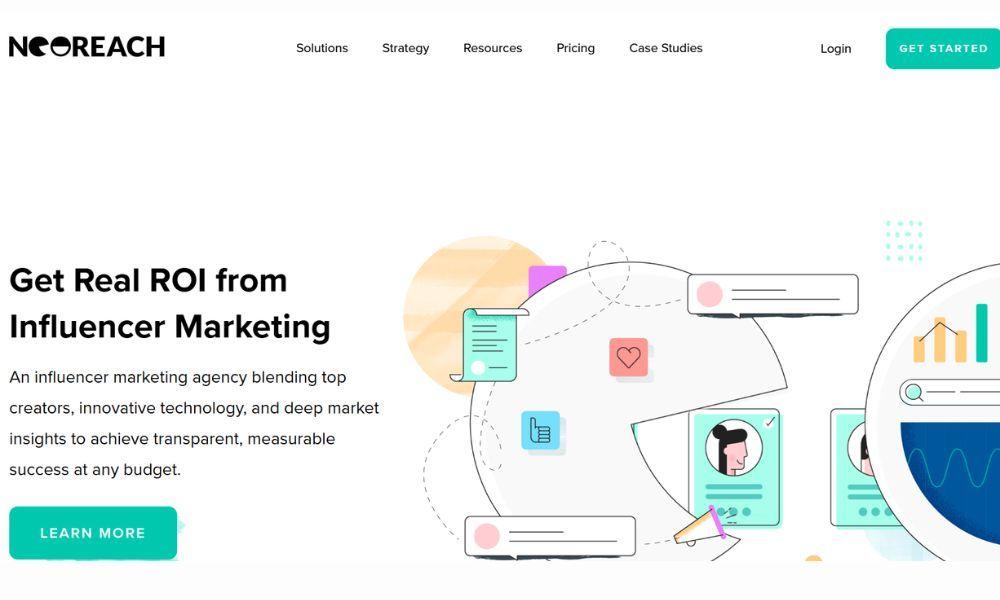
NeoReach is one of the longest-running tech-enabled influencer marketing agencies in the industry, founded in 2014 by Stanford alumnus and Thiel Fellow Jesse Leimgruber, with headquarters in San Francisco.
The agency has worked with Fortune 500 brands including NVIDIA, Netflix, Walmart, Microsoft, FanDuel, Robinhood, FIFA, and Macy’s, and was responsible for the influencer activation behind TikTok’s US relaunch after its rebrand from Musical.ly.
The focus is on data-driven, full-service campaigns across YouTube, TikTok, and Instagram, with $250 million+ in influencer spend managed to date and a proprietary creator database of 3 million+ profiles.
Pricing: Custom. Managed campaigns typically start at $50,000 and scale into six and seven figures depending on platform mix and scope.
Pros:
- Decade-plus track record with consistent Fortune 500 client roster and large-scale campaign execution.
- Proprietary creator database and analytics technology built in-house, which gives the agency real measurement depth beyond third-party tools.
- Played a defining role in shaping early industry standards for influencer activation and ROI measurement.
Cons:
- Pricing and engagement model is built for enterprise budgets, with limited fit for smaller brands or pilot campaigns.
- Mixed G2 reviews flag interface clunkiness on the SaaS platform side, though this affects software users more than agency clients.
- Less brand and category specialization than newer challenger agencies; the offering is broad rather than vertical-specific.
Rating: 4.1/5 (strong industry pedigree and Fortune 500 reach; best suited to brands with enterprise budgets)
Sources for data: https://neoreach.com/case-studies/; https://influencermarketinghub.com/neoreach/
How to Choose an Influencer Marketing Agency That’s Right for You
There are five criteria that matter more than anything else, and a good agency will pass all five without flinching.
1. Speciality match over general competence. An agency that says it works with “all industries” is a red flag. The best agencies know one or two verticals deeply, whether that is SaaS, beauty, gaming, or B2B manufacturing. If the case studies in your category are weak, the actual execution will be weak too.
2. Pricing model transparency. Ask for a ballpark number early – any partner should be able to give you a realistic range before a sales call. Real agencies share their minimums upfront, explain how creator costs are billed separately, and put their margin model on the table. If the conversation feels like a sales funnel, it is one.
3. Creator network depth vs. claimed network size. Ask how large a partner's active creator network really is, and how often new creators are added to it. Ask how they source beyond their existing contacts. Ask what their vetting process looks like when a brand brings them a brief in a category they have not worked in. A real answer is specific, and a marketing answer is vague.
4. Reporting and data ownership. Do you get access to raw data or a sanitized PDF? This matters enormously for brands building institutional knowledge. If a partner owns your reporting layer, make sure you can export it, so you can bring the program in-house later without starting from scratch.
5. Cultural fit and communication style. The best agency relationship feels like an extension of your team. If the pitch deck was polished but the first account manager call felt generic, trust that instinct. Senior-led agencies tend to outperform junior-staffed ones by a wide margin, and the difference shows up in the first month.
The agency that scores highest across all five is a good fit. The agency that deflects on two or more is not.
Why a Growing Number of Brands Are Adding a Platform to Their Influencer Marketing Mix
The biggest shift in influencer marketing over the past two years is brands taking back ownership of their influencer strategy. The rise of AI-powered platforms has made it possible for a team of two to run the kind of program that used to require a team of ten.
The challenge with the traditional model is twofold.
Costs can be high and returns uncertain, particularly for brands spending under $20K/month, where fixed fees eat into actual campaign budget. And the manual grind of outreach, negotiation, and creator coordination is where most of the budget gets spent, even though it is the part that automation handles best.
The shift that platforms enable is moving from influencer-first to audience-first thinking. Instead of starting with “which creators are popular,” you start with who your customer is and work backwards to the creators whose audiences match.
That changes everything about how a program is built, because you are now paying for relevant reach.
Hypefy is built around this idea.
The platform runs on a:
- An AI-powered brief that turns your campaign goal into a creator-ready scope
- An audience-matching layer that maps your target customer to creators whose followers fit that profile
- An auto-management layer that handles outreach, negotiation, and content tracking without manual overhead.
The pricing point matters too.
Influencer pricing has historically been opaque, with margins often added on top of creator rates that brands never see.
Hypefy’s smart pricing shows you fair market rates before you reach out, so there is no guessing, no inflated quotes, and no post-campaign surprise invoices.
The outcome brands report when moving to this model is consistent: more content, less risk, better results. That is the direction the winning brands are moving in 2026.
The Best Influencer Marketing Agencies FAQs
1. What is an influencer marketing agency?
An influencer marketing agency is a specialist marketing firm that plans, manages, and executes influencer campaigns on behalf of brands. Services typically include creator discovery, strategy, outreach, content management, compliance, and reporting.
2. What does an influencer marketing agency do?
A full-service agency handles the entire workflow: identifying the right creators, negotiating contracts, managing content production and approval, ensuring FTC compliance, processing payments, and reporting on campaign performance.
3. How much does an influencer marketing agency cost?
Pricing varies widely. Small-business-focused agencies start around $5,000 per month, mid-market retainers range from $5,000 to $20,000 per month, and enterprise agencies often require $25,000 to $100,000+ per campaign or month, with creator fees billed separately.
Sources: https://www.stackmatix.com/blog/best-tiktok-marketing-agencies-2026; https://hireinfluence.com/blog/houston-influencer-marketing-agency/
4. What is the best influencer marketing agency for small businesses?
For small businesses, inBeat Agency is a strong fit because it works with budgets starting around $5,000/month and focuses on micro-creator UGC, which gives smaller brands real reach without enterprise-level overhead. A platform like Hypefy is often a better fit for brands under $5K/month.
5. What is the best influencer marketing agency for SaaS companies?
Moburst is the most established SaaS-focused agency, with deep experience in subscription economics, mobile UA, and tech-savvy creators across TikTok, YouTube, and LinkedIn. For pure B2B SaaS without a mobile component, Fresh Content Society is a credible alternative.
6. What is the difference between an influencer marketing agency and a platform?
An agency provides a managed service: their team runs your campaigns. A platform provides software, and your team runs campaigns using its automation. Agencies offer hands-off execution and require less internal work; platforms cost less and give you more control, data ownership, and speed.
7. How do I know if an influencer marketing agency is legitimate?
Look for verifiable case studies in your category, transparent pricing, third-party reviews on Clutch or G2, named senior leadership, and a clear answer on data ownership. Agencies that deflect on any of these are worth avoiding.
8. Is it worth hiring an influencer marketing agency?
It depends on your internal capacity. If you have no marketing team and need a turnkey program, an agency is worth it. If you have an internal team and a recurring campaign budget, a platform will almost always deliver better ROI per dollar.
9. What should I look for when choosing an influencer marketing agency?
Speciality match, pricing transparency, creator network depth, data ownership, and cultural fit. The agency that passes all five criteria is the right one.
10. How long does it take to see results from an influencer marketing agency?
Most programs see early performance signals within the first quarter, with stronger results compounding over six to twelve months as creator relationships mature and content libraries grow. Timelines depend heavily on category, creator tier, and whether the campaign is performance-driven or brand-led.
11. Do influencer marketing agencies work with micro-influencers?
Yes, and a growing share of agency work is now micro-focused. Nano-influencers account for about 75.9% of Instagram’s influencer base and deliver higher engagement rates than larger tiers, which is why agencies like inBeat have built their model around them.
Source: https://influencermarketinghub.com/influencer-marketing-experts-report/
12. Can an influencer marketing platform replace an agency?
For most brands with an internal marketing team, yes. Platforms now handle creator discovery, outreach, negotiation, content tracking, and reporting, complementing what agencies traditionally offered. The strategic and creative work stays with the brand, where it belongs.
13. What is the best influencer marketing agency for B2B brands?
Fresh Content Society is the most credible B2B specialist on this list, with proven case studies in manufacturing, construction, automotive, and B2B services. For B2B SaaS specifically, Moburst is also worth evaluating.