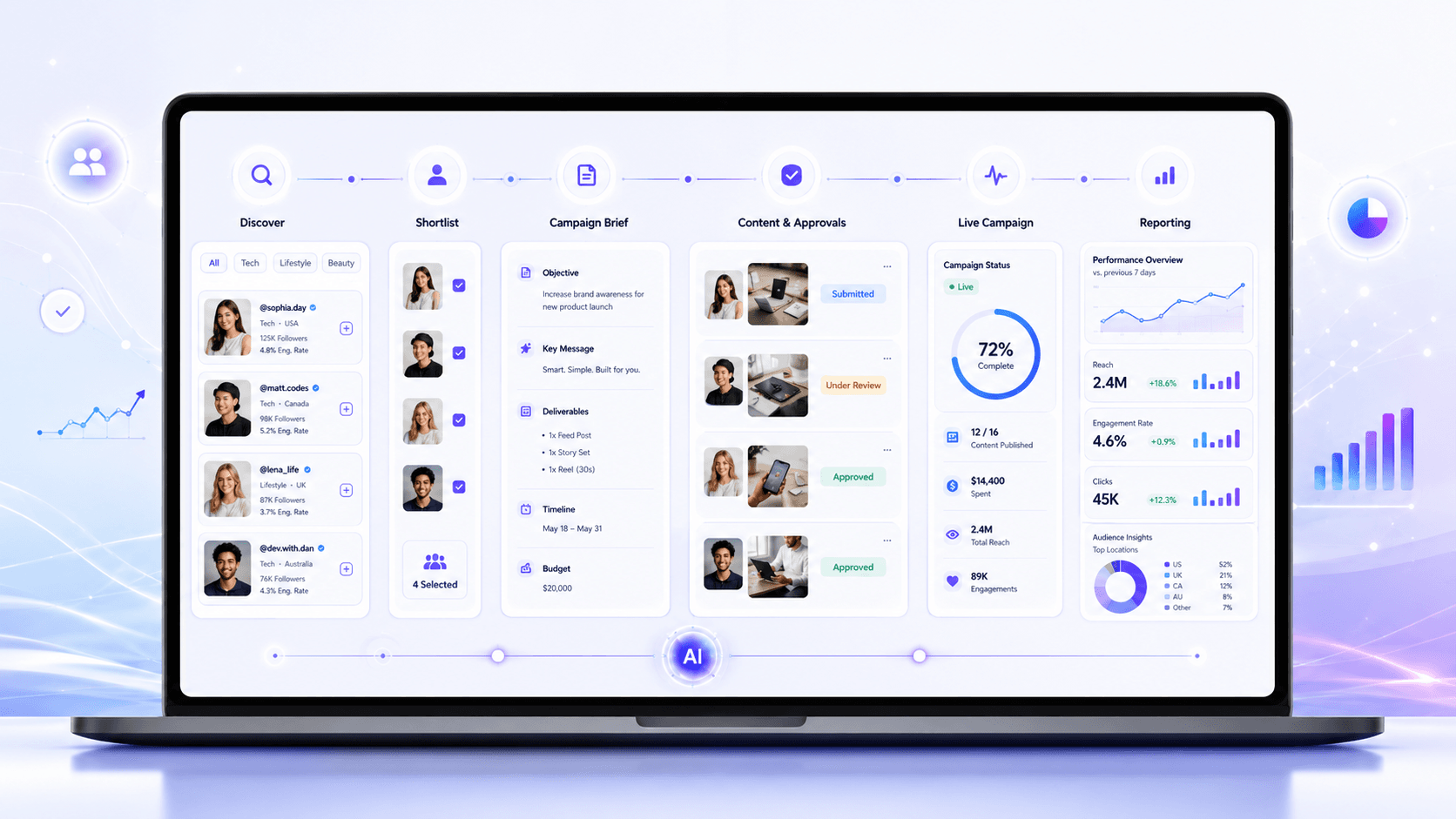
End-to-end influencer campaign management runs every stage of a campaign, including discovery, vetting, outreach, briefing, launch, and performance tracking in a single, connected workflow, rather than stitching together separate tools.
This guide walks through the full lifecycle, shows what each stage involves, and identifies which platforms handle it in full rather than just parts of it.
What Is End-to-End Influencer Campaign Management?
End-to-end influencer campaign management means owning the full lifecycle of a campaign in one place. You set goals, find and vet creators, reach out and negotiate, brief them, launch and monitor content, then measure and report, all without exporting data between disconnected tools at each step.
The six stages are:
- Goal setting and KPI definition
- Creator discovery and vetting
- Outreach and negotiation
- Briefing
- Launch, monitoring, and optimization
- Measurement and reporting
The point most brands miss is that the value comes from how the six stages share data.
When discovery, outreach, and reporting live in one system, you can compare campaigns against each other, trace which creators drove which outcomes, and build on what worked rather than starting from zero each time.
The common alternative is a discovery tool, a spreadsheet, and a separate analytics dashboard, with manual handoffs between them.
Campaigns break at exactly these handoffs. A creator who was vetted and approved in tool one gets lost in the spreadsheet handoff.
A posting date slips because the content approval lives in email. An attribution gap opens because the tracking links were set up after the first post went live. In influencer marketing, process failures cause more campaign damage than strategic ones.
Why Does End-to-End Management Matter for Campaign Results?
Disconnected tools create gaps, such as missed deadlines, double payments to creators, and ROI you cannot trace.
Those gaps compound as campaign volume increases. Running two campaigns a year in a spreadsheet is manageable, but twelve campaigns across four markets quickly becomes challenging.
The actual benefits a marketer feels with an end-to-end workflow are:
- Faster launches, because approvals and contracts sit alongside the brief instead of being separate inboxes
- Cleaner attribution, because tracking links are set up as part of outreach rather than bolted on after the first post
- Stronger creator relationships, because communication history, contract terms, and payment records all live in one record
- The capacity to run several campaigns at once without losing track of which creator sits at which stage
The Burgerme case study shows what that looks like in practice.
In five months, Burgerme ran five campaigns in Germany and reached over 1.4 million people, with 19 creators, no brief overlap, no retainer, and no platform subscription. All done with Hypefy.
The five campaigns were deliberately different: a veggie burger launch, a regional special, a flagship chicken bundle, a lunch deal, and a review campaign.
Each one pulled a fresh set of German food and lifestyle creators matched to that specific product, so no campaign competed with another for creators’ attention, and every result landed in a single comparable report.
A lunch deal that most brands skip as too small to bother with ran anyway, because the workflow did not grow heavier with each new brief.
That is the real argument for managing campaigns end-to-end. The brands that struggle rarely lose on strategy. They lose in the handoffs, and a single connected workflow is what removes them.
The Six Stages of an End-to-End Influencer Campaign
Stage 1: How Do You Set Goals and KPIs for an Influencer Campaign?
You set campaign goals by deciding on a single primary outcome, be it awareness, engagement, or conversion, and then picking the one or two metrics that track it.
The most common mistake at this stage is defaulting to follower count as a proxy for quality. It is not.
A creator with 500,000 followers and 0.9% engagement per reach will underperform a creator with 50,000 followers and 8% engagement per reach on virtually every conversion metric.
Engagement per reach: engagements divided by unique reach is the right starting KPI because it accounts for audience size and campaigns over time.
Follower counts inflate. Raw like counts vary by content type and algorithm. Engagement per reach is the signal that holds. Set this number as the benchmark before the campaign launches, not after it ends.
Use the ROI calculator to model expected outcomes before briefing anyone.
Stage 2: How Do You Discover and Vet the Right Creators?
You discover creators by filtering on audience fit and performance data, then vet them on engagement quality and authenticity before you ever reach out.
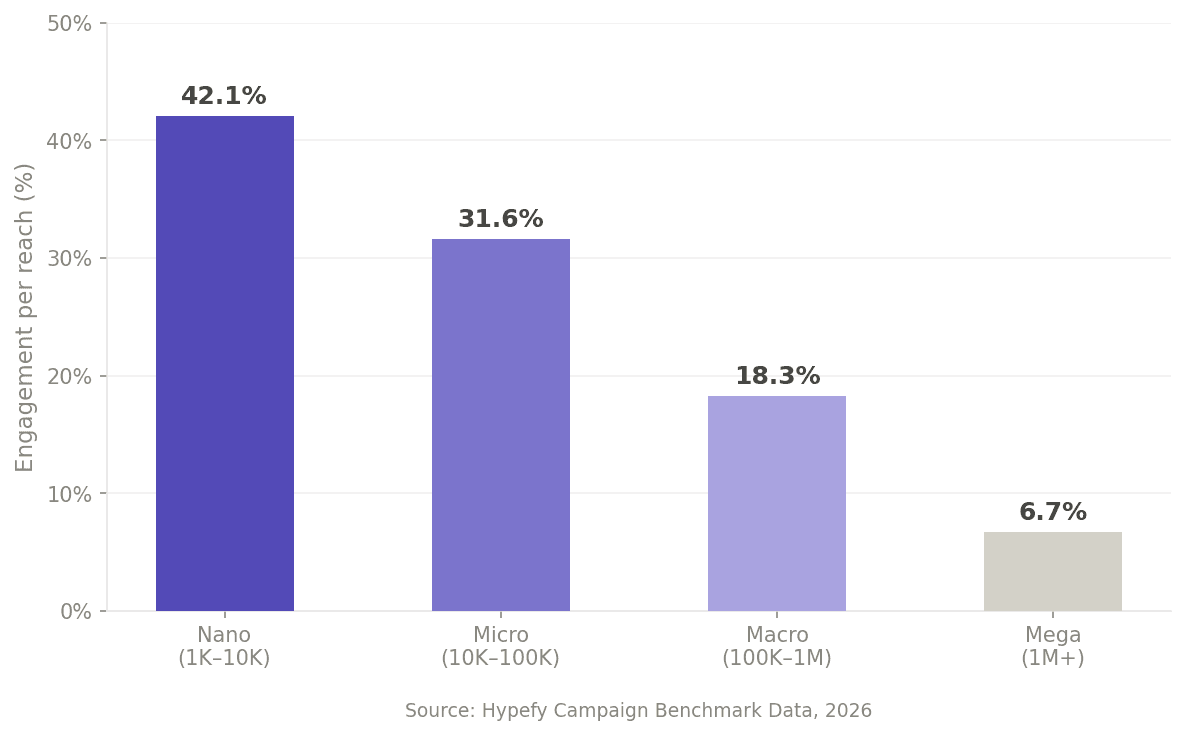
The tier data matters here. In Hypefy’s CEE benchmark data, micro creators (10K-100K followers) hit 31.6% engagement per reach, the highest of any tier on the platform. Mega creators (1M+ followers) drop to 6.7%.
The implication for most mid-market brand campaigns is that a budget split across micro creators outperforms the same budget concentrated on one mega-creator, not in every case, but in most.
Vetting is where the process either holds or leaks. Accounts with over 500,000 followers have around 15% of their followers flagged as inactive, bots, or fake on TikTok.That is not a niche problem.
Large accounts grow this way structurally, so audience quality degrades as follower count rises. A creator with 800,000 followers and 14% fake followers is effectively a 688,000-follower creator. The engagement rate and reach numbers need to be adjusted accordingly.
In an end-to-end platform, vetting runs automatically as part of the discovery workflow rather than as a separate manual check in a third tool. That distinction prevents the process from leaking at this stage.
Find and vet creators whose audience genuinely fits your brief with Hypefy’s discovery tool.
Stage 3: How Do You Handle Outreach and Negotiation at Scale?
Effective outreach is a multi-touch process, and skipping follow-ups is the single most common way brands lose creators they wanted.
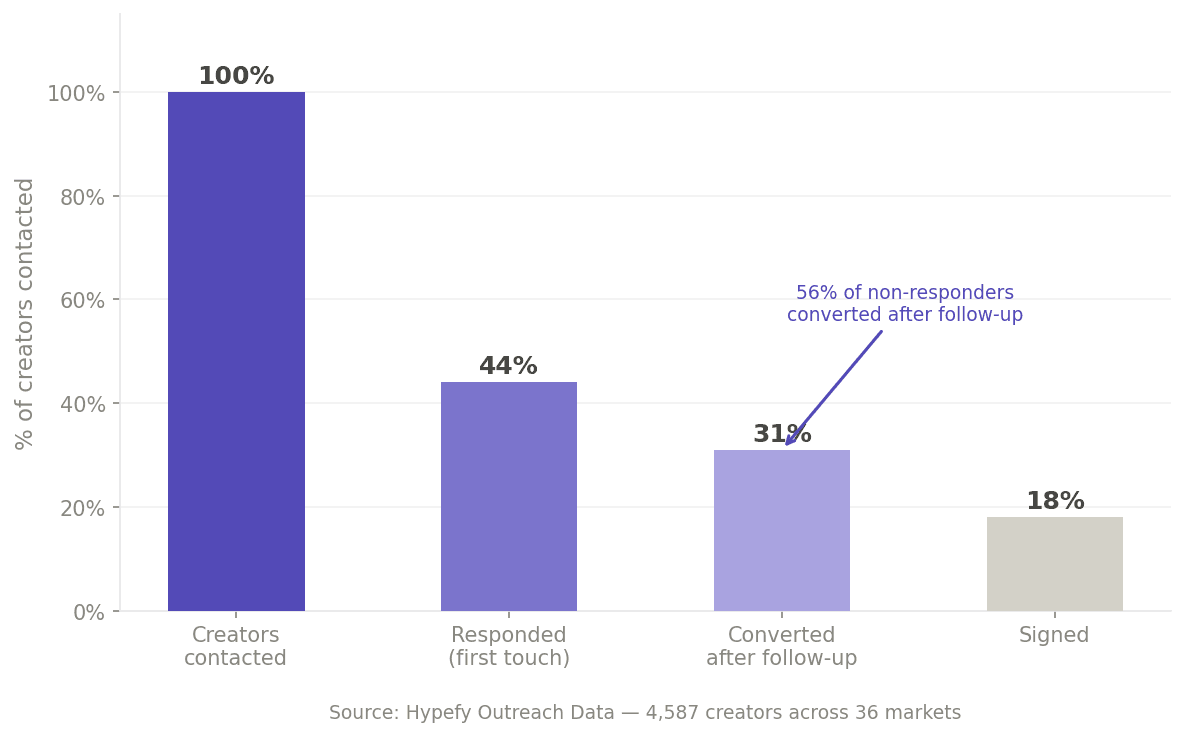
The funnel data is specific. In Hypefy’s outreach data, across 4,587 creators contacted in 36 markets, 56% of non-responders converted after a follow-up.
The overall sign rate is around 18%. Most brands contact far fewer creators than that math requires and interpret the low response rate as rejection, when it is actually incomplete outreach.
In negotiations, brands frequently overpay because they lack a benchmark for what others paid in the same tier and market.
The end-to-end point at this stage is that outreach, follow-up sequences, and pricing benchmarks need to live in the same system as discovery and briefing.
When they are managed in a separate CRM or email thread, the follow-up either does not happen or cannot be tracked against the eventual outcome.
See how Hypefy handles outreach, follow-ups, and negotiations automatically with Influencer Outreach Tool.
Stage 4: How Do You Write Briefs That Creators Actually Follow?
A good brief gives creators clear direction and guardrails while leaving enough room for their own voice because over-scripted content underperforms.
Telling a creator exactly what to say, in what order, with what caption, produces content that sounds like an ad because it is one. The audience knows, and the engagement reflects it.
A complete brief covers campaign goal, key message, what must be included (e.g., discount code, required hashtag, product name), what must be avoided (e.g., competitor mentions, off-brand language), format and platform, posting timing, and deliverables.
That is the full boundary. Everything inside the boundary belongs to the creator.
Platform specifics matter in 2026 more than they used to.
TikTok content that performs is sound-on, trend-aware, and paced for the first three seconds of attention.
Instagram Feed works for polished, shoppable content aimed at slightly older audiences with higher purchase intent.
Stories convert for time-limited offers and direct swipe-up mechanics.
A brief that specifies format and platform implicitly is doing more work than one that only names the deliverable.
Stage 5: How Do You Launch, Monitor, and Optimize a Campaign?
You launch with a pre-flight check, then monitor performance in real time so you can shift budget toward what is working while the campaign is still live rather than reading a post-mortem.
The pre-launch checklist includes signed contracts, approved content, unique tracking links live for each creator, a confirmed posting schedule with each creator, and screenshots enabled for ephemeral content. Most attribution gaps trace back to one item on this list being skipped.
Real-time monitoring means watching engagement per reach and saves as they accumulate, not waiting for a campaign wrap report.
Saves are the strongest purchase-intent signal available on either platform because they indicate a viewer planned to come back, which is the clearest behavioral proxy for intent to buy.
One timing insight that most brands miss: timing alone can shift cost per engagement by 3.6x.
A brand that monitors and plans around seasonal cost variation is optimizing in a way most competitors never do.
Live monitoring only works when launch and analytics share the same system. When they live in different tools, the monitoring either happens too late or requires a manual export that takes longer than the optimization window.
Stage 6: How Do You Measure Results and Report True ROI?
You measure influencer ROI by tracking engagement per reach, audience quality, and conversion signals like saves, not follower counts or raw likes, because those are the metrics that stay comparable across campaigns and actually predict downstream purchase behavior.
This stage closes the lifecycle and pays off the measurement philosophy from Stage 1. A real performance review at the end of a campaign asks four questions:
- Which creators beat the engagement-per-reach benchmark set at the start?
- Which content formats generated the most saves?
- What was the actual cost per engagement versus the planned cost?
- Which market or tier performed best?
Those four questions produce the inputs for the next campaign’s discovery and briefing stages.
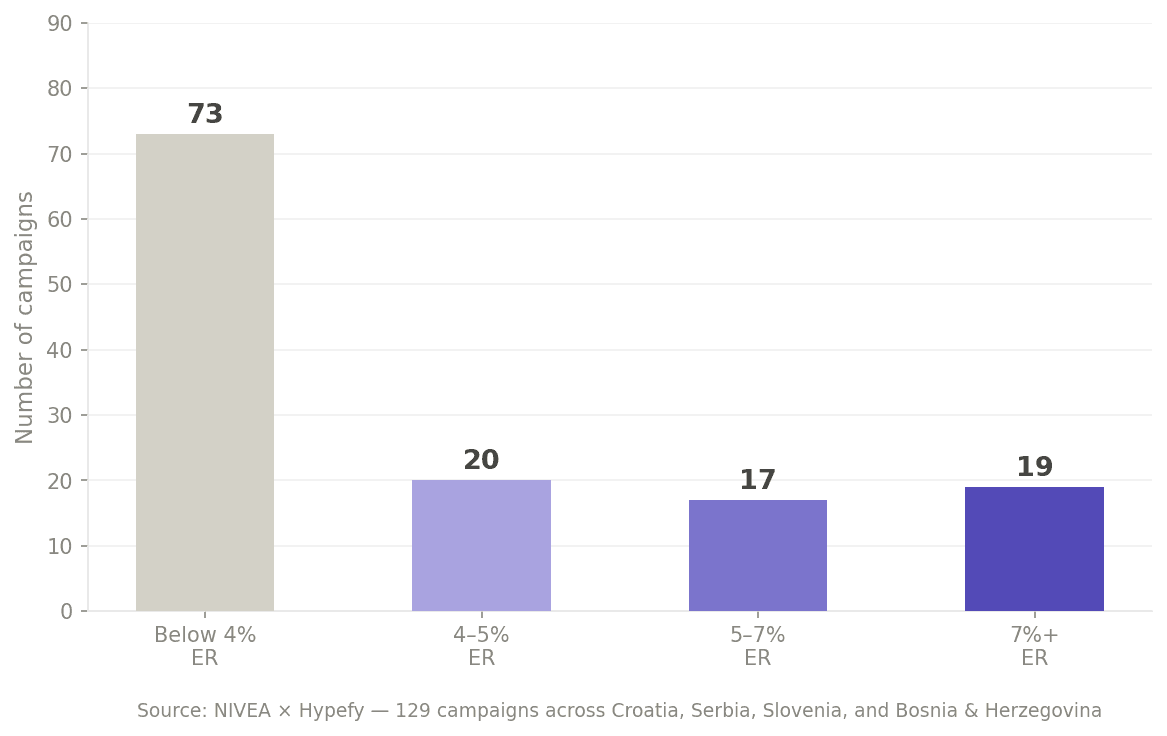
Consistent metrics across campaigns matter more than any single campaign’s numbers. NIVEA ran 129 campaigns across Croatia, Serbia, Slovenia, and Bosnia and Herzegovina.
The view that became meaningful was the tiered distribution across the run: 56 campaigns delivered engagement per reach above 4%, 36 cleared 5%, and 19 reached 7%. That kind of view is only possible when all 129 campaigns are measured against the same metrics in the same system, which is what end-to-end management looks like at scale.
→ How Hypefy Works YouTube Video
Which Platforms Handle End-to-End Influencer Campaign Management?
The platforms that manage campaigns end-to-end fall into three categories:
- Discovery-first tools that are strong at finding and analyzing creators but hand off execution to the brand
- Analytics-first tools built around audience data and fraud detection
- Full-workflow platforms that cover discovery through reporting in one connected system.
Hypefy
Hypefy covers every stage of the campaign lifecycle on a single platform.
AI-led discovery that searches for creators directly on Instagram and TikTok rather than an opt-in database, outreach with built-in follow-up sequences and pricing benchmarks, briefing, content review, contracts, payments, and performance reporting, all connected.
Brands running campaigns across multiple markets can coordinate them from a single dashboard with built-in translation. The platform charges no subscription or setup fees, and the fee is built into the campaign budget rather than added on top.
Upfluence
Upfluence is strongest for DTC eCommerce brands that need to tie influencer activity directly to Shopify, WooCommerce, or Amazon sales.
Its AI assistant, Jaice, handles creator matching, brief generation, personalized outreach, and follow-up automation, and Upfluence Pay processes creator payments through Stripe across more than 120 countries.
Its center of gravity is conversion and revenue attribution rather than high-volume discovery, making it a strong fit for brands that primarily measure influencer marketing by sales.
Modash
Modash built its reputation on discovery, indexing every public profile across Instagram, TikTok, and YouTube rather than a smaller opt-in pool. It has since grown into a more comprehensive workflow, with bulk outreach, automated content tracking, creator payments, and Shopify-based affiliate and gifting tools.
Discovery and audience vetting remain where it is strongest, and its execution features are most complete for Shopify-connected brands, while teams on other storefronts handle more of the attribution themselves.
CreatorIQ
CreatorIQ is built for enterprise programs with governance and compliance requirements. Its AI semantic search returns creator recommendations based on content and audience behavior rather than keyword filters, and it integrates with Shopify, Google Analytics, and Amazon for attribution.
The platform is designed for large teams and typically requires dedicated headcount to run effectively. Pricing is enterprise-level and quote-only, with annual contracts rather than monthly plans, and no rates are published publicly.
HypeAuditor
HypeAuditor began as an audience analytics and fraud detection tool, and that remains its core strength and the reason most brands reach for it.
It has since expanded into a full campaign platform, adding mass outreach, contract generation and signing, briefs, draft review, creator payments, and e-commerce integrations.
For brands where audience authenticity and fake-follower screening are priorities, the depth of analytics is the draw, with the campaign-management layer rounding out the lifecycle rather than leading it.
| Platform | Type | Discovery | Outreach & contracts | Briefing | Launch & monitoring | Performance tracking | Best for |
|---|---|---|---|---|---|---|---|
| Hypefy | Full workflow (done-for-you) | Yes (open universe) | Yes | Yes | Yes | Yes | Brands and agencies running full campaigns end-to-end |
| Upfluence | Full workflow (e-commerce) | Yes (database) | Yes | Yes | Yes | Yes (eCommerce attribution) | DTC e-commerce brands tying creators to sales |
| Modash | Discovery-led, self-serve | Yes (open universe) | Partial | Partial | Yes | Yes | Discovery-heavy programs, strongest on Shopify |
| CreatorIQ | Enterprise suite | Yes (database) | Partial | Partial | Yes | Yes | Large enterprises with governance needs |
| HypeAuditor | Analytics-led, full workflow | Yes (database) | Yes | Yes | Yes | Yes | Brands prioritizing audience vetting and fraud detection |
One Platform, Every Stage: See Hypefy in Action
End-to-end management wins because the stages share data, and platforms that span the whole lifecycle prevent campaigns from leaking between tools. The pattern holds across all campaign types and market sizes.
In Germany, Burgerme ran five campaigns in five months with no creator overlap between them. NIVEA ran 129 campaigns across four CEE markets over three years and could read performance across the entire run in a single dashboard. In both cases, the operational system is what made the scale possible. Strategy did not change. The process did.
A good strategy run through disconnected tools loses to a decent strategy run through one connected workflow. The gaps eat whatever advantage the strategy started with.
Managing Influencer Campaigns End-to-End: Discovery to Reporting FAQs
What does end-to-end influencer campaign management mean?
End-to-end influencer campaign management means running every stage: discovery, vetting, outreach, briefing, launch, and tracking in one connected workflow instead of across separate tools.
What are the stages of an influencer campaign?
Influencer campaigns go through six stages: goal setting, creator discovery and vetting, outreach and negotiation, briefing, launch and monitoring, and measurement and reporting.
Which platform is best for managing influencer campaigns end-to-end?
Hypefy covers all six stages in one platform, with built-in outreach, contracts, content review, payments, and reporting. No subscription fee on top of campaign spend.
How much does an influencer campaign cost?
Rates vary widely by platform, content format, and niche, so tier benchmarks are a starting point rather than fixed prices. As a per-post guide, nano creators (under 10K followers) typically charge around $10 to $100, micro creators (10K to 100K) roughly $100 to $1,500, and macro creators from several thousand dollars upward, according to Influencer Marketing Hub. Use the budget calculator to model spend by tier.
How do you track influencer campaign performance?
Set unique tracking links (UTMs) for each creator before launch. Monitor engagement per reach and saves during the live window. Measure three layers: platform metrics, business metrics like cost per thousand impressions (CPM) and cost per engagement (CPE), and brand metrics.
How many creators should one campaign use?
10-30 for a concentrated launch and 5-15 for an always-on program. Tier matters more than number: ten micro creators typically outperform two macro at the same budget.
What is the difference between a discovery tool and a campaign management platform?
A discovery tool finds creators. A campaign platform covers everything after that, too, including outreach, briefs, contracts, payments, and reporting. The gap is roughly 10-20 hours of coordination per campaign.
How do you measure influencer marketing ROI?
Track engagement per reach as the primary signal, sales as the purchase-intent indicator, and revenue via creator-specific UTMs or discount codes.
How long does it take to run an influencer campaign?
Two to four weeks for micro campaigns, four to six weeks for macro or launch campaigns. Follow-up sequences compress timelines by recovering non-responders.
Do you need separate tools for discovery and reporting?
Not if you use a full-workflow platform. Every handoff between separate tools is a potential data gap. For teams running five or more campaigns a year, those gaps compound.