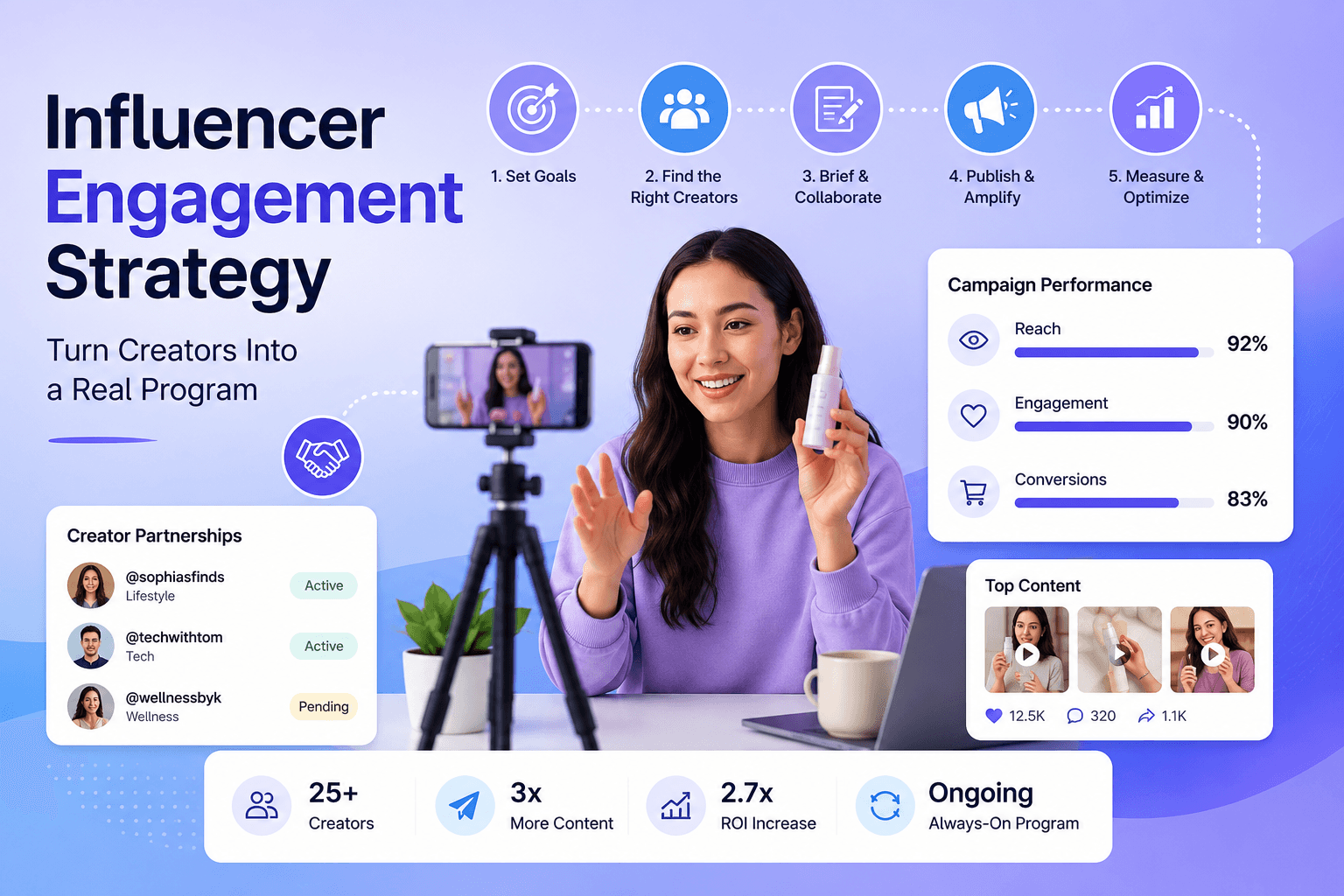
Working with creators only pays off when there is a plan behind it. A single post from the right creator can move product. A structured influencer engagement strategy compounds that result across every campaign, every quarter, and every creator relationship you build.
Brands that treat influencer engagement as a program rather than a series of one-off activations get better content, stronger partnerships, and results they can measure against real business goals.
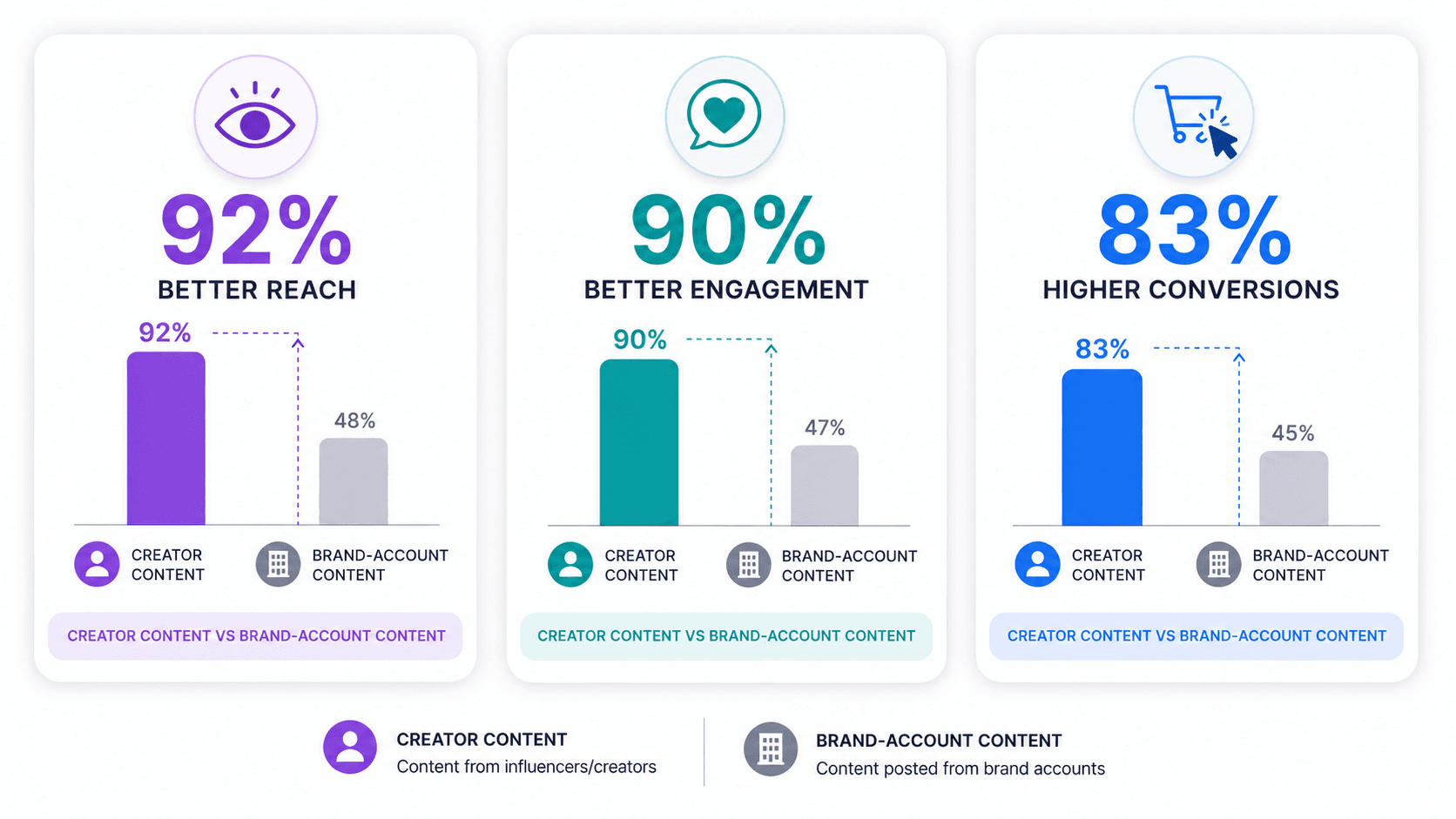
According to Sprout Social’s Influencer Marketing Report, 92% of marketers report better reach, 90% see better engagement, and 83% report higher conversions when using influencer content compared to content posted directly on brand accounts. The gap is not marginal. It is the difference between content people engage with and content people scroll past.
This guide covers what an influencer engagement strategy is, why it matters, what a strong one looks like, how to put it into action, and how to measure whether it is working.
What Is an Influencer Engagement Strategy?
An influencer engagement strategy is the plan for how a brand identifies, connects with, and works with creators to reach and engage the right audience. It covers who you work with, how you brief them, what you measure, and how you keep the program running over time.
A quick note on terminology: some people use “influencer engagement” to refer to the engagement rate, a metric that measures how much a creator’s audience interacts with their content. That is a different use of the word.
Engagement rate is calculated as interactions divided by followers, and it is one of the most useful signals for evaluating a creator before you work with them.
Smaller creators tend to score higher because their audiences know them more personally. If you want to check a specific creator’s rate, the Instagram engagement rate calculator gives you a fast answer.
This guide is about covers the strategy itself. It is the structured plan for how a brand works with creators to produce content that reaches the right audience and moves them toward a real outcome.
Why an Engagement Strategy Matters
Working with creators without a strategy is like running paid ads without a targeting brief. You might get lucky, but you are mostly spending on reach that does not convert and content that does not compound.
A strategy keeps you working with creators who fit your brand and audience. Without one, creator selection defaults to whoever has the most followers or whoever responded to your outreach, neither of which predicts performance.
It produces content people engage with rather than scroll past. In Sprout Social’s research, 90% of marketers say sponsored influencer content out-engages the content they post on their own brand accounts, and the reason is authenticity. Audiences respond to content that sounds like the creator rather than a brand brief read aloud.
It builds partnerships worth repeating. The second campaign with a creator who knows your brand almost always produces better content than the first. Ambassador-style relationships compound in ways that one-off posts cannot.
It gives you a way to tie creator work to business results. Without a strategy that includes tracking setup, creator content is disconnected from the metrics your business actually cares about. With one, every creator relationship feeds data back into the next decision.
What a Strong Influencer Engagement Strategy Looks Like
A strong influencer engagement strategy has five core ingredients. Each one is the difference between a program that works and a collection of scattered posts.
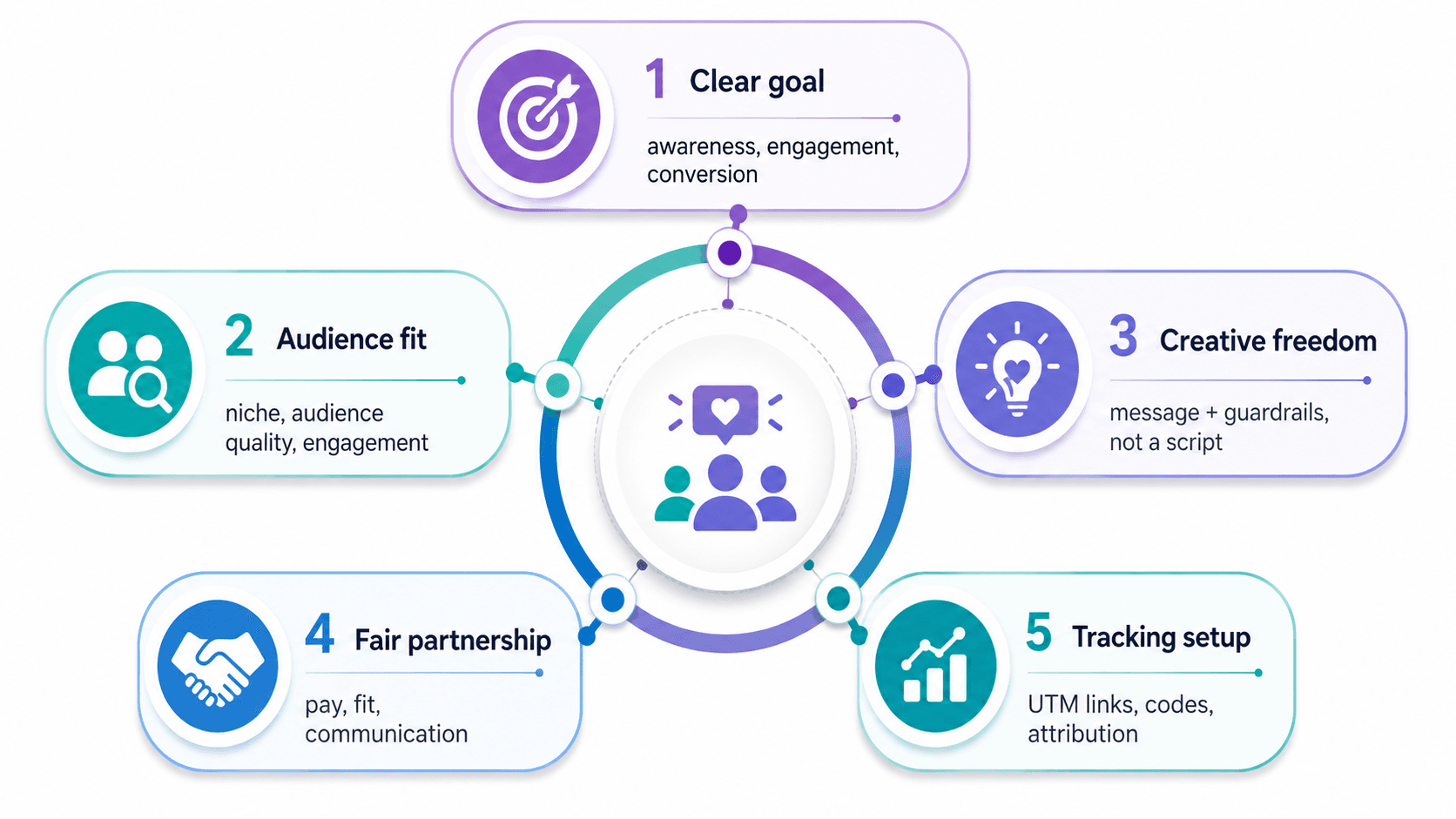
1. Clear goals tied to the wider marketing plan. The strategy starts with knowing what you want creator content to do: drive awareness, generate demand, or convert sales. Each goal requires different creators, different formats, and different measurements. A strategy trying to do all three at once with a single brief typically does none of them well.
2. Creators chosen by audience fit and engagement quality. Micro-influencers (10K–100K followers) generate an average engagement rate of 3.86% compared to 1.21% for mega-influencers, at 60% lower cost per post, according to Digital Applied’s 2026 data.
The audience that matters is the creator’s actual audience. A creator with 15,000 followers in your exact niche will often outperform one with 500,000 followers in an adjacent category.
3. Creative direction without a script. The brief defines the message, the required disclosure, what is off-limits, and the deliverables. It does not define the exact words, the shot list, or the caption. Creators who sound like they are reading a brief produce content that reads like a brief. Give them the boundary and let them fill the space inside it.
4. A partnership that is worth the creator’s time. Fair terms matter for content quality as much as for compliance. Creators who feel respected and fairly compensated produce better work and are more likely to post again.
That includes payment, yes, but also early access to products, genuine brand fit, and clear communication throughout. 83% of creators are willing to work for gifting alone if the brand fit is right, which makes product seeding a viable entry point for brands building relationships with nano and micro creators.
5. Tracking set up from the start. Creator-specific UTMs, unique discount codes, and attribution windows set before the first post goes live. Without these, you cannot connect creator activity to business outcomes, and the program is impossible to defend or optimize.
Model your tracking setup and expected return before launch with the ROI calculator.
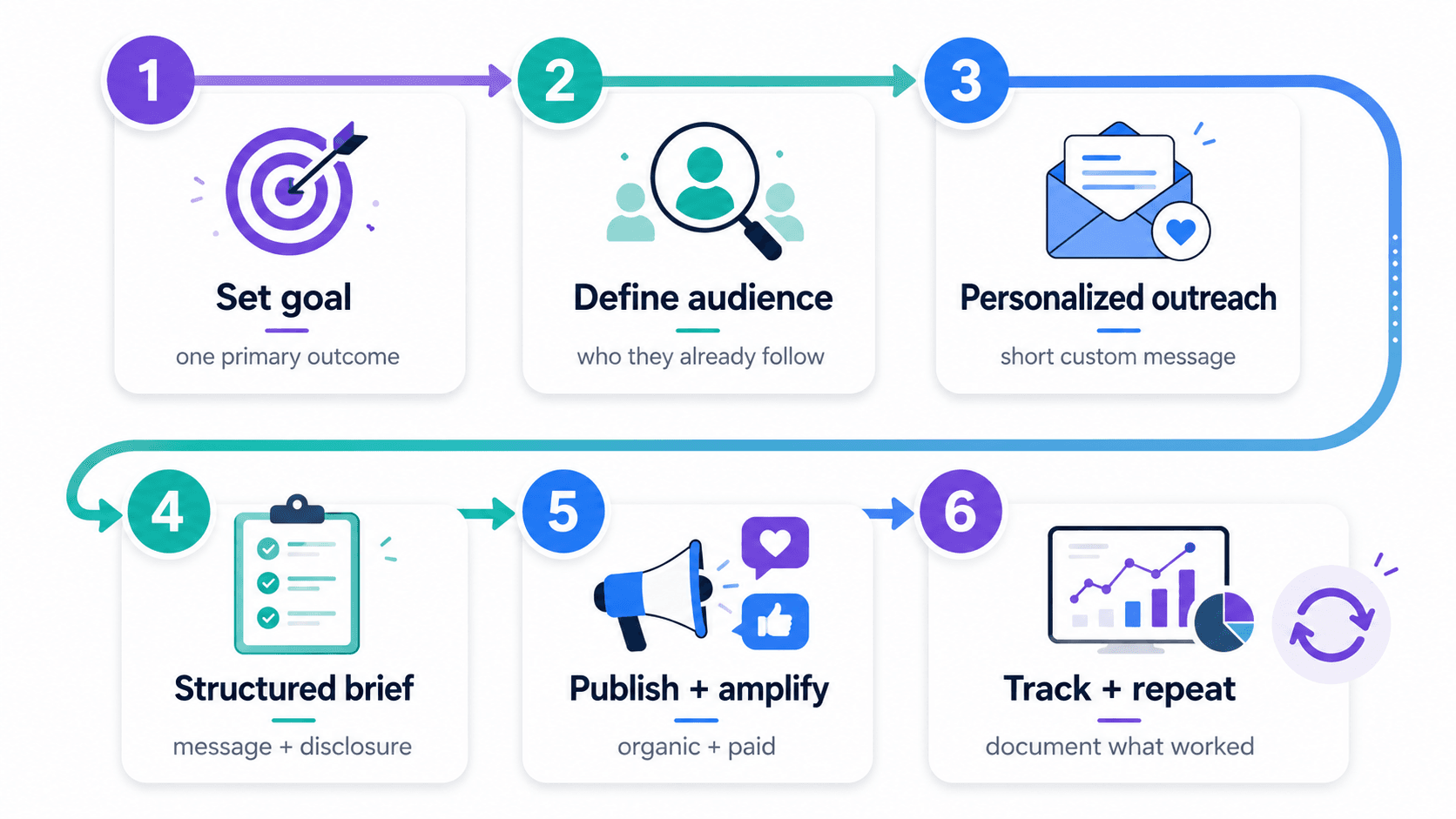
How to Put Your Engagement Strategy Into Action
1. Set Clear Goals
Before you search for a single creator, define the one primary outcome: awareness, engagement, or conversion. Each one maps to different creators, different briefs, and different success metrics. Setting goals after a campaign runs is measuring noise.
Set the budget at the same time. The goal determines the creator tier and format mix, and the budget determines how many creators you can brief properly, so deciding both together prevents a plan the budget cannot carry.
2. Define Your Audience and Find Creators Who Already Reach It
Start with your target customer rather than the creator. Who are they, what platform are they on, what content do they already consume, and which creators do they follow in your category or an adjacent one?
That customer profile is the filter for everything that follows. Use it to search by niche, geography, and engagement quality rather than follower count. The discovery tool searches creators directly on Instagram and TikTok so you can filter by the audience behind the profile.
3. Reach Out With a Personalized Message
Outreach that reads as a mass template gets treated like one. Reference something specific about the creator’s recent content, explain briefly why the brand fit makes sense, and make the ask clear.
The first message only needs to earn a reply. The contract comes later. Keep it under 120 words, friendly and direct, and include one clear next step.
4. Brief Creators With Structure and Room for Their Own Voice
The brief covers the campaign goal, the key message, the required disclosure, what is off-limits, the platform and format, the deliverable, and the posting window. That is the complete structure. The execution, the styling, the caption, the hook, those belong to the creator.
Disclosure is the one part of the brief with legal weight, and the rules differ by market: the FTC in the US, the ASA in the UK, and national consumer-protection rules across the EU all require paid partnerships to be clearly labelled, so state exactly how each post must be marked.
For guidance on building a brief that hits all of these without over-scripting, the influencer brief guide covers the full format.
5. Publish and Amplify
Creator content does not stop working when it goes live organically. A lot of marketers repurpose creator content in paid social campaigns to extend its impact beyond organic reach.
Amplifying creator content through paid social extends its reach while keeping the authentic format that makes it perform better than studio-produced ads.
6. Track Results and Document What to Repeat
Pull performance data while the campaign is live. Screenshots, engagement numbers, click data, and conversion figures all get harder to access after a campaign closes.
Use what you capture to decide which creators to brief again, which formats to prioritize, and which goals the program should focus on next.
For keeping creator relationships going after a campaign ends, the influencer relationship management guide covers what happens after the first campaign.
How to Measure Whether Your Strategy Is Working
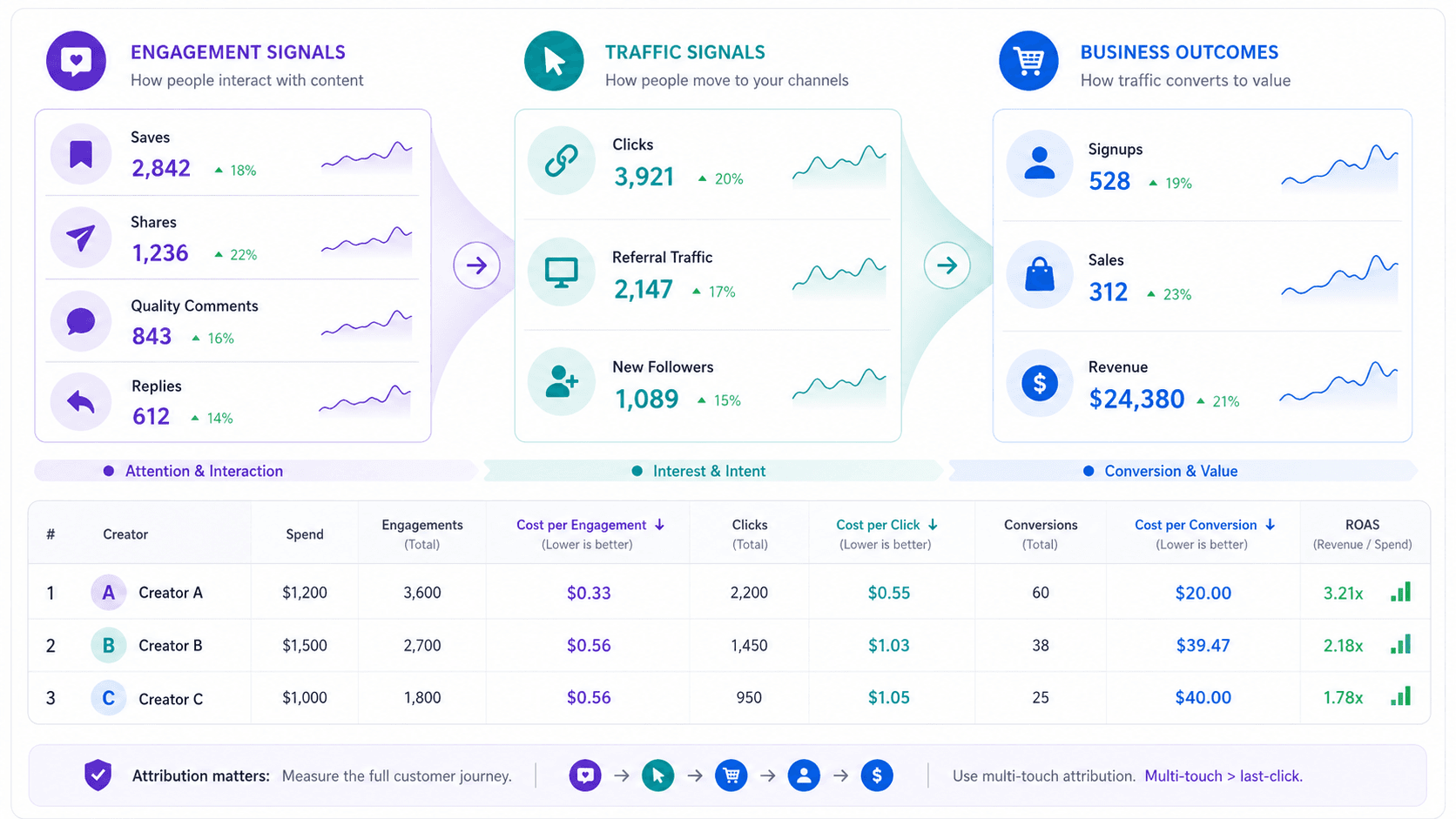
Most measurement guides stop at likes. Likes are where measurement starts. The framework below connects creator work to outcomes a business cares about.
Engagement signals that matter. Comments with specific product questions or personal references, shares, saves, and reply threads are the signals that indicate genuine audience interest. A 6% engagement rate built entirely on emoji reactions and single-word comments tells a different story than a 2% engagement rate built on real questions and saves.
Audience and traffic signals. Clicks from unique links, referral traffic to the brand site, and new followers acquired during the campaign window. These sit between engagement and conversion, and indicate intent without requiring a purchase.
Business outcomes. Signups, trials, sales, and revenue tracked through creator-specific UTMs and unique discount codes. These are the numbers that make the program defensible in a budget conversation.
The attribution model matters as much as the tracking itself. Last-click undercounts creator influence, so, where possible, use a multi-touch model that credits assists as well as the final click.
The practical starting point: after each campaign, rank creators by cost per engagement, cost per click, and cost per conversion. The creators and content formats that score best on those metrics get prioritized in the next round. The ones that do not get cut or briefed differently.
Use the ROI calculator to model expected returns before committing budget to a new creator or format.
Tools to Run Your Engagement Strategy
The right tools reduce the operational overhead of running a creator program, which is the main reason programs stall when they try to scale.
Finding and vetting creators. You need a way to search by niche, audience geography, and engagement quality rather than follower count alone. Tools that only show who opted into their platform show you a fraction of the actual creator pool. Platforms that search Instagram and TikTok directly surface significantly more relevant candidates for any given brief.
Managing outreach and content. Outreach sequences, follow-ups, content approvals, and contract management all need a home. Without a centralized system, these live across email threads, shared documents, and spreadsheets that break the moment you have more than ten active creator relationships.
Tracking performance. Creator-specific links, engagement data by post, and consolidated reporting across all active relationships. A spreadsheet works for five creators. It stops working reliably at twenty.
All-in-one. Hypefy covers the full workflow: AI-led creator discovery that searches Instagram and TikTok directly, Smart Pricing that sets fair rates based on real engagement data, outreach with built-in follow-up sequences, content review, contracts, payments, and performance reporting in one place. A lean team can run an always-on program without the manual coordination overhead that usually requires a much larger team.
Run Your Influencer Program With Hypefy
An influencer engagement strategy is only as effective as the system behind it. Hypefy helps you find creators that match your brand using AI, agree on fair terms based on real engagement rather than surface-level follower counts, and manage the whole program in one place so you can focus on the strategy rather than the admin.
Influencer Engagement Strategy FAQs
What is influencer engagement?
Influencer engagement has two meanings. It refers to the engagement rate metric (interactions divided by followers) and the strategy for how a brand connects and works with creators. Related but distinct. This guide covers the strategy.
What is an influencer engagement strategy?
Influencer engagement strategy is the plan for how a brand finds, works with, and keeps creators. It covers who you work with, how you brief them, what you measure, and how the program runs beyond a single campaign.
What is a good influencer engagement rate?
Industry benchmarks put nano creators (1K-10K) at roughly 4-8% on Instagram, micro 2-4%, macro and mega below 2%. TikTok rates run higher across all tiers. Check any creator’s actual rate with the engagement rate calculator.
How do you build an influencer engagement strategy?
To build an influencer engagement strategy, you need to set one goal, define your audience before searching for creators, find creators whose audiences match, reach out personally, brief with structure and creative room, set up tracking before launch, and review after each campaign.
How do you measure influencer engagement?
To measure influencer engagement, look beyond the rate. Pay attention to comment quality, saves, shares, clicks from attribution links, referral traffic, and business outcomes. Rank creators by cost per engagement and cost per conversion after each campaign.
How is influencer engagement different from influencer relationship management?
Engagement strategy covers finding, briefing, and measuring creators. Relationship management is the ongoing work of maintaining those partnerships over time. For the relationship side, the relationship management guide goes deeper.