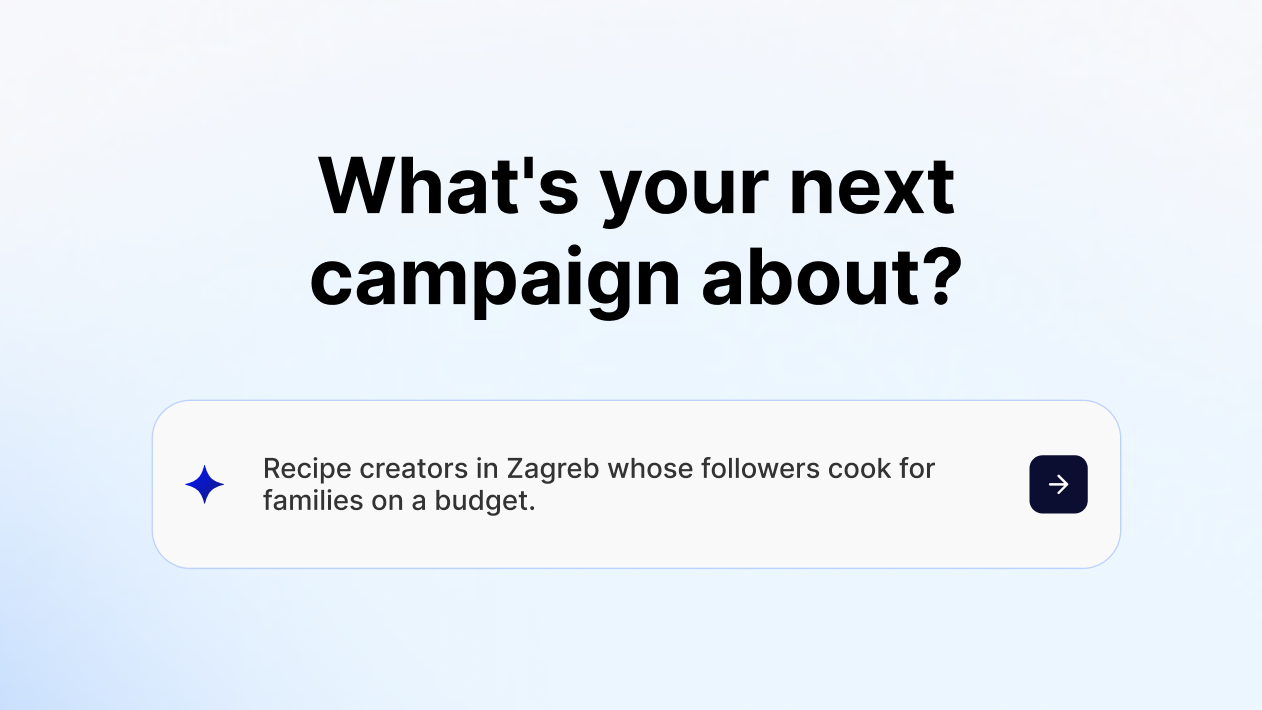
Write your brief.
You can write even just one sentence, e.g., "Recipe creators in Zagreb whose followers cook for families on a budget." That content carries everything the tool needs, though a fuller brief makes the matching more precise.
Where a food creator's followers live matters more than how many there are. A national audience does little for a restaurant on one street. Tell Hypefy what you're promoting and which market it needs to reach, and the search comes back with creators whose followers are close enough to order.
Describe what you're promoting and the market it needs to reach. The tool searches Instagram and TikTok against both and comes back with food creators who fit. Add your email to see them.
The food influencer search works in three stages, start to shortlist.
You can write even just one sentence, e.g., "Recipe creators in Zagreb whose followers cook for families on a budget." That content carries everything the tool needs, though a fuller brief makes the matching more precise.
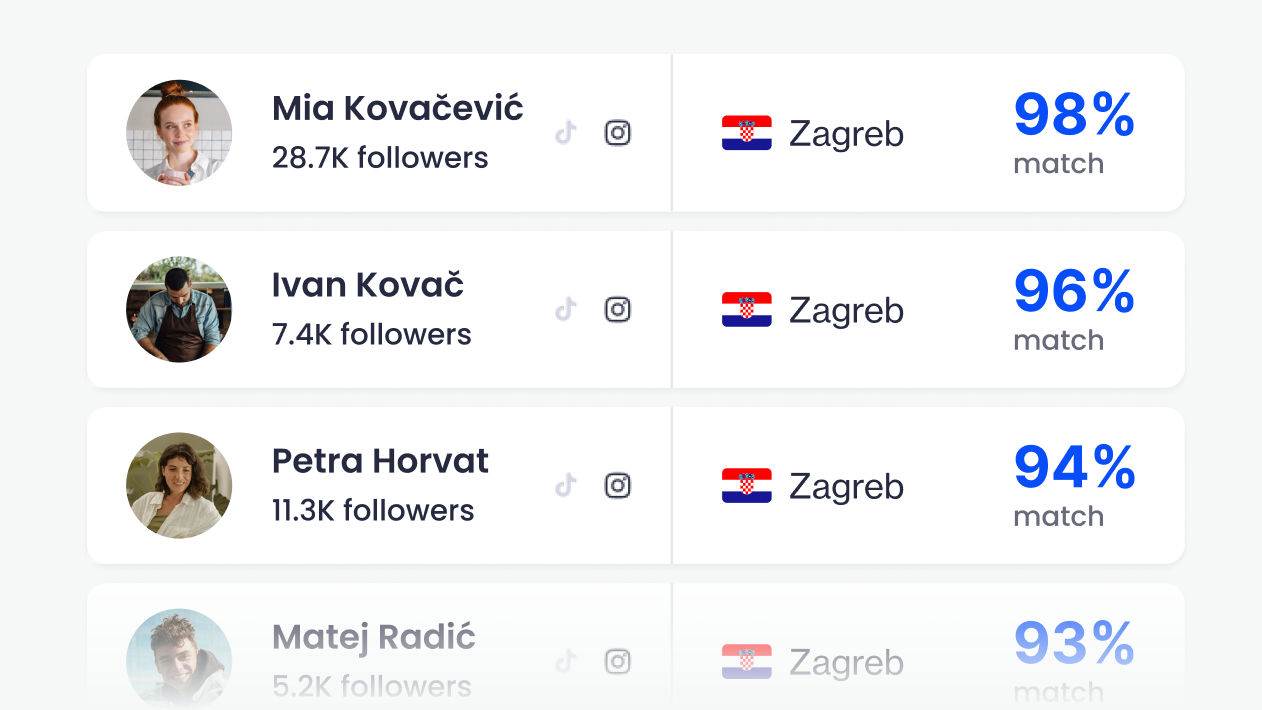
The tool judges which food creators suit the campaign by looking at what they cook or review, who watches, and where those viewers are. Every match is visible before you pick.
Add an email and you'll receive the shortlist.
Your brief decides who appears, and no minimum follower count is applied at any point.
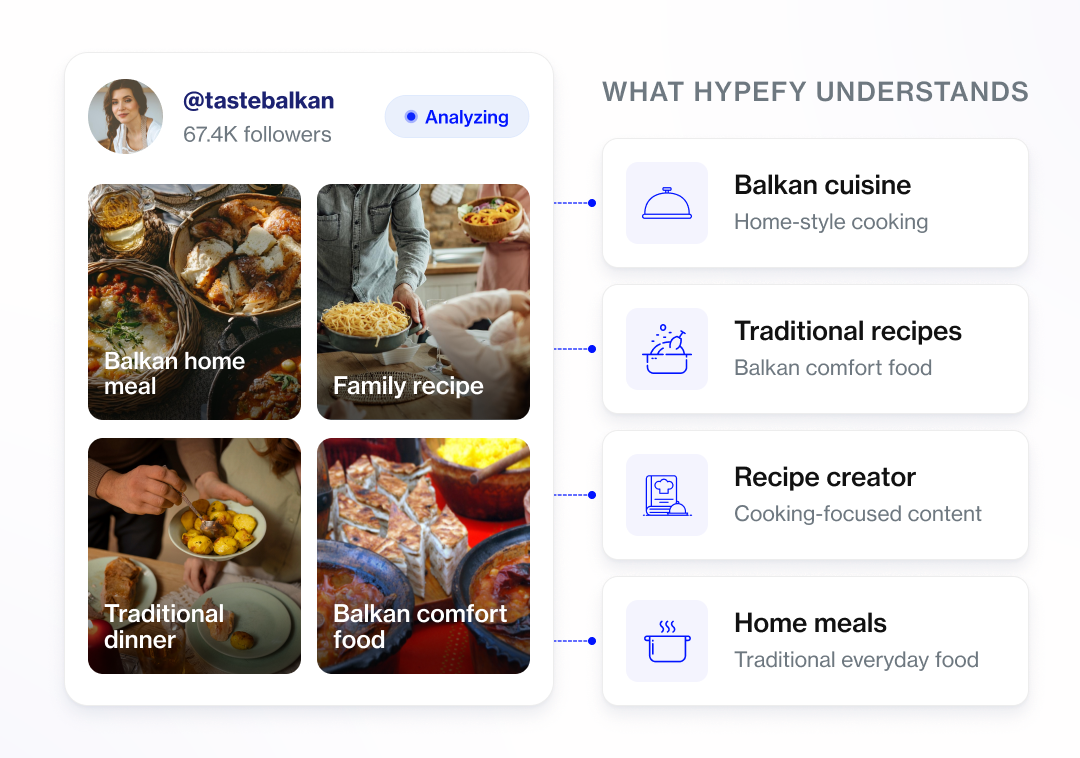
Food carries a geography problem most other categories don't. A restaurant, a delivery service, or a regional grocery chain needs creators whose followers are within reach of the thing being sold. Half a million followers spread across a continent will not fill a dining room in Split. Semantic Selection reads location, cuisine, and audience out of the brief together, so a search for creators cooking Balkan home food for viewers in Slovenia returns exactly that rather than every account tagged under food. It also separates recipe creators from restaurant reviewers, who serve very different purposes for a brand. The shortlist arrives filtered for the market you are selling into.
Food creator quotes drift a long way from what a post returns. A restaurant reviewer with polished photography can ask several times what a home cook with a devoted local following charges, while the home cook drives more orders on the night. Smart Pricing takes the engagement and reach a creator's recent posts brought in and sets the rate from there. Since food campaigns often run across many creators and several cities at once, paying each on delivered performance rather than an asking price keeps the budget on the creators who deliver.
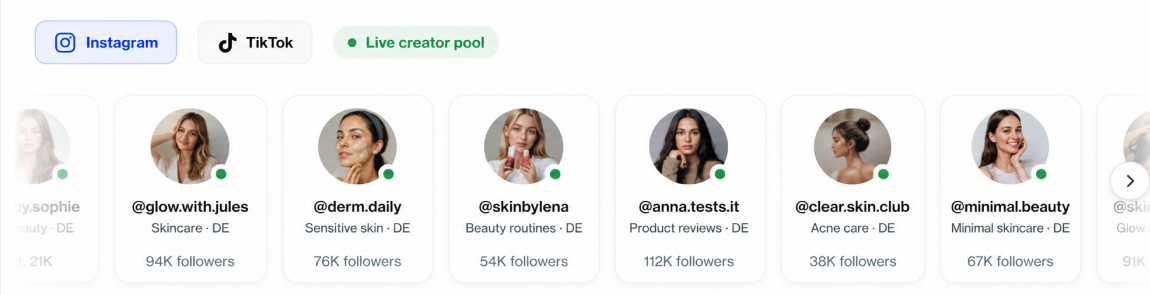
Sign-up databases hold whoever completed a form, which in food leans heavily toward creators in the largest cities. The creator with three thousand devoted followers in a mid-sized town, often the one who decides whether a local campaign works, is almost never on that list. Every search Hypefy runs goes out to Instagram and TikTok at that moment, so smaller and regional food creators surface alongside the recognized names.
Hypefy also covers the outreach, the rate negotiation, the content review before anything publishes, the payment to each creator, and the reporting at the end, with a member of our team reachable throughout.
Food campaigns tend to fragment fast, because a single promotion can mean twenty creators across six cities on two platforms, all needing product delivered or a visit booked before anything gets filmed. Holding all of it in one place is what keeps a campaign that size manageable.
Running the search costs nothing, and no invoice appears until a campaign goes live. At that point you name the budget, and it covers creator fees, getting product to each creator, the approvals, the payments, and the reporting. Hypefy's cut comes out of that fee, so adding another city changes what the budget buys rather than what it costs.
Food engages harder than almost any category, and it's less forgiving when the details are wrong. Four things shape it.
Restaurants, delivery brands, and regional retailers need an audience close enough to act, so a creator's follower geography matters more than their follower count. Brands that skip this end up paying for reach in cities where the product is not sold.
A recipe, a flavour, or a mealtime habit that lands in one market can fall flat in the next, which is why food brands running several countries need local creators and not one set of assets pushed everywhere. Our own multi-market food work bears this out. The strongest program on the platform ran fourteen markets with creators sourced separately in each.
A still photograph shows a finished plate, while video shows the process, the texture, and the moment someone tastes it. Across roughly 1,600 food posts run on Hypefy, TikTok returned a median engagement rate of 5.36% against 1.32% on Instagram, the widest gap of any category we have looked at, and generated more total reach from about 60% of the posts.
Someone watching food content is often deciding what to eat that evening or what to put in the cart that week, which is why food campaigns convert quickly and why food posts run above the platform average for engagement. It also means a mismatch is punished immediately. Audiences trust creators on taste, and a recommendation that reads as bought loses the creator more than it gains the brand.
Kaufland, McDonald's, Argeta, Lidl, burgerme, PepsiCo, and Glovo run their food and beverage campaigns through Hypefy.






Food and beverage campaigns on the platform have together reached more than 50 million people across sixteen markets, working with over 500 creators, at an engagement rate above the platform average.
The pattern across that work is consistent. Creators matched to the right city and the right kind of food outperform larger creators matched only to the category.
Describe what you're promoting and where, then see food creators whose followers are close enough to act on it.
Would you rather map it out with someone? You can also map it out with our team.
To find food influencers for your brand, decide first whether you need someone cooking with the product or someone visiting the place, because those are different creators with different audiences. Then check where their followers are, which matters more in food than in any other category.
The tool at the top of this page covers both cases. Give it the campaign and the market, and a matched set of food creators lands within a couple of minutes.
Name the city in the brief. Searches run live against Instagram and TikTok, so creators with local followings appear, including smaller accounts that never registered on a marketing database.
For restaurants and delivery brands this is usually the single most important filter, and follower count is secondary to it.
That turns on what you are selling. Recipe and home-cooking creators work for packaged food and grocery, since the product appears inside something the viewer wants to make. Restaurant and experience creators work for venues and delivery, where the point is showing the place and the order arriving.
In both cases a credible local following beats a large distant one.
TikTok leads on engagement for food by the widest margin we see in any category, with a median engagement rate roughly four times Instagram's across our campaign data, and it delivered more total reach from fewer posts.
Instagram still holds the saved recipe and the local discovery search, so most food campaigns run on both with the weight on video.
Rates vary with audience size, location, and format, and they track photography quality more closely than they track results.
Smart Pricing works out each rate from what a creator's recent posts returned in engagement and reach, so the fee follows delivery. The search costs nothing.
Smart Pricing reads what a creator's last posts returned and prices from that figure.
On a campaign spanning several cities and dozens of creators, pricing each against measured delivery instead of an asking rate materially changes the total.
On Instagram and TikTok, searched live each time a brief goes in.
Nothing comes from a closed sign-up list, which is how regional and small-city food creators end up in the results alongside the well-known accounts.
No. After the match, Hypefy handles briefing, outreach, rate agreement, content approval, creator payment, and the closing report.
Food campaigns benefit from this more than most, because product samples, delivery vouchers, or restaurant bookings all have to be coordinated per creator before filming can start.
An agency brings the creative idea and a team to deliver it. Hypefy is the operating layer, so a food marketing team can run campaigns with matching, outreach, rates, approvals, payment, and reporting in a single place.
For brands running local or multi-city food campaigns regularly, this usually costs less, since adding another city does not add another fixed fee. Plenty of agencies run their food client work on Hypefy too.
The shortlist is ready in minutes. Going live depends mostly on logistics rather than matching, since product has to reach creators or bookings have to be made, but with outreach and rates handled in one place a food campaign can be filming within a couple of days.
Allow longer for seasonal peaks such as the winter holidays or grilling season, when strong local creators commit early.