A micro-influencer is a creator with 10,000 to 100,000 followers who typically charges $100 to $500 per Instagram feed post.
Brands use them because they cost less per partnership and generate more engagement per follower than larger creators, averaging 1.5 to 3.5% on static Instagram posts and 3 to 5% on Reels.
This guide covers what the tier costs by platform and deliverable type, how micro compares with macro and when macro is the better choice, how to find and vet creators, how to run the campaign step by step, and what tends to go wrong.
What a Micro-Influencer Is
A micro-influencer is a social media creator with 10,000 to 100,000 followers. These tiers are industry conventions rather than official definitions, so sources draw the lines differently, and The Influencer Marketing Factory, for example, caps micro at 50,000.
Check which definition a brand or platform uses before comparing its numbers with yours.
Tier | Followers | Typical Instagram Engagement | Typical TikTok Engagement |
|---|---|---|---|
Nano | 1K to 10K | 3.5 to 6% (Reels 5 to 9%) | 9 to 15% |
Micro | 10K to 100K | 1.5 to 3.5% (Reels 3 to 5%) | 5 to 9% |
Mid-tier | 100K to 500K | 1 to 2.5% (Reels 2 to 4%) | 3 to 6% |
Macro | 500K to 1M | 0.8 to 1.5% (Reels 1.5 to 3%) | 2 to 4% |
Mega | 1M+ | 0.5 to 1% (Reels 1 to 2%) | 1 to 3% |
Source: Nowadays Media, analysis of 15,000+ creator accounts, Q1 2026.
Check whether a creator is actually mid-tier before applying micro benchmarks. A creator with 150,000 followers has different engagement and rate ranges from both micro and macro, so judging them against micro figures sets the wrong expectations for engagement and price.
Micro vs Macro Influencers
The choice between micro and macro is between depth and breadth. Micro brings higher engagement, closer product fit, and a lower cost per partnership, while macro brings more reach per post, faster awareness, and less admin per dollar spent.
Factor | Micro | Macro |
|---|---|---|
Followers | 10K to 100K | 500K to 1M |
Typical Instagram engagement | 1.5 to 3.5% | 0.8 to 1.5% |
Typical per-post cost (Instagram) | $100 to $500 | $5,000 to $10,000 |
Reach per partnership | Smaller, a share of 10K to 100K followers per post | Larger, a share of 500K to 1M followers per post |
Management load | Higher, more partnerships to run | Lower, fewer and larger deals |
Best suited for | Conversion, niche fit, testing, always-on | Launch reach, brand association, paid media |
Pick micro for conversion, testing, and always-on programs if the team can run many partnerships at once, and pick macro for launches and paid media when fast reach matters more than depth or the team only has capacity for a few deals.
Engagement Rates by Tier and What to Expect
Engagement falls as audiences grow, partly because each post reaches a smaller share of followers. Socialinsider's analysis of 872,075 brand posts found that Instagram accounts with 10K to 50K followers reach 5.5% of their followers per post, against 3.5% for accounts with 100K to 1M.
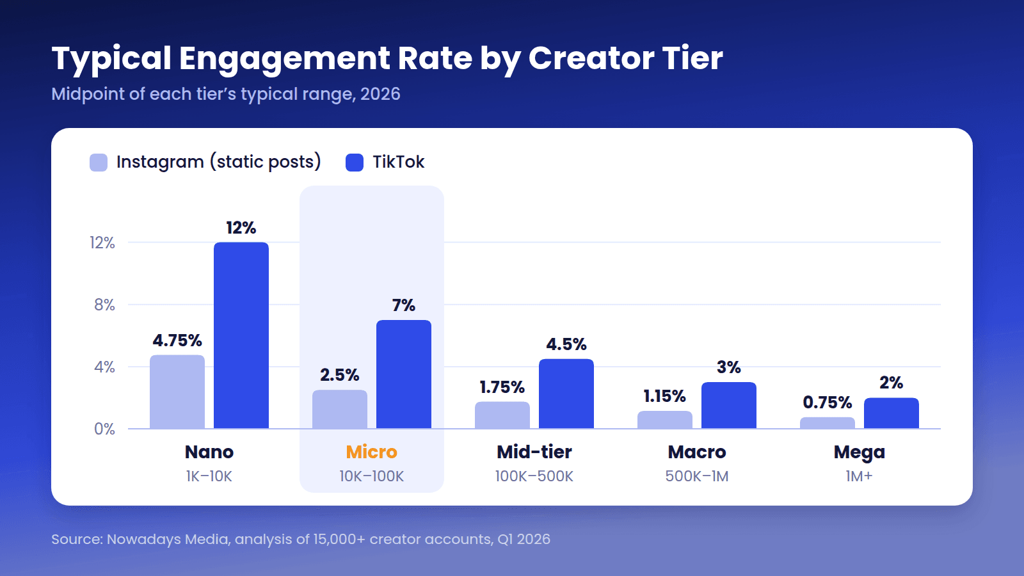
TikTok engagement runs higher than Instagram at every creator tier. At the micro level, Instagram static posts average around 2.5% and TikTok around 7%.
On Instagram, Nowadays Media's Q1 2026 data puts micro creators at 1.5 to 3.5% on static posts and 3 to 5% on Reels, against 3.5 to 6% for nano creators and 0.8 to 1.5% for macro creators.
On TikTok, the median engagement rate is about 8% in 2026 according to The Influencer Marketing Factory, and Nowadays Media puts micro creators at 5 to 9%.
TikTok says follower count isn't a direct factor in its recommendations and gives more weight to signals such as whether a viewer finishes a longer video, so a small creator can still reach a large audience with the right video.
The Influencer Marketing Factory's data shows a much flatter pattern, with TikTok engagement between 7.4% and 8.1% at every tier, so expect a smaller tier gap on TikTok than on Instagram.
Engagement also varies by niche. Nowadays Media's data puts beauty and skincare at 3.8% and fitness and wellness at 3.2% on Instagram, so a 2% creator in those niches sits well below average.
Compare each creator against the benchmark for their tier and niche instead of a platform-wide average. For the full breakdown, the engagement rate benchmarks guide covers benchmarks by platform, industry, and creator size.
Check saves alongside likes and comments when vetting a creator. Nowadays Media ranks saves as the strongest purchase-intent signal, since a viewer who saves a post plans to come back to it.
4 Situations Where a Macro Influencer Is the Better Choice
Macro influencers are still worth it in 2026 when a campaign needs reach fast, a recognizable face, or ready-made ad creative. Book a macro creator in these four situations:
A launch that needs reach fast. Twenty micro partnerships take weeks of outreach, briefing, and staggered posting, while one macro creator reaches a large audience in a single post. Book macro when the launch window is measured in days.
Categories where a recognizable face carries weight. In luxury and entertainment, a well-known name shapes how the product is perceived, and that endorsement weight is something a mid-size creator can't replicate.
Campaigns where the content will run as paid ads. A macro creator's post can be licensed and run as a Meta or TikTok ad, either from the brand's account (known as whitelisting) or from the creator's own handle (Spark Ads on TikTok). Negotiating usage rights once is simpler than doing it twenty times.
Teams without capacity for many partnerships. The admin of twenty micro partnerships adds up fast. Count that admin time as part of the cost when comparing tiers, since for a team running several campaigns at once it can outweigh the higher fee of one macro creator.
What Micro-Influencers Cost
Micro-influencer rates are negotiated deal by deal, and even a published rate card is a starting point. The same creator will quote differently depending on what you ask for, since the number of deliverables, the production involved, and any usage rights or exclusivity all move the price.
Treat the ranges below as typical market rates at the time of writing and use them as your opening position.
Typical Rates by Follower Tier
The table gives Instagram and TikTok separately, since the two platforms price differently at each tier.
Tier | Followers | Instagram per post | TikTok per post | Notes |
|---|---|---|---|---|
Nano | 1K to 10K | $10 to $100 | $50 to $200 | Some accept gifted collaborations |
Micro | 10K to 100K | $100 to $500 | $200 to $800 | Stories priced lower than feed posts |
Mid-tier | 100K to 500K | $500 to $5,000 | $800 to $5,000* | Video content sits toward the upper end |
Macro | 500K to 1M | $5,000 to $10,000 | $800 to $5,000* | Scope, exclusivity, and usage rights move the rate most |
Source: Influencer Marketing Hub, Instagram and TikTok influencer rates, updated August 2026. *IMH groups TikTok creators with 100K to 1M followers into one range.
Ask each creator to itemize the quote, covering the post itself, the number of revision rounds, how long the post stays live, and whether usage rights or exclusivity are included. Price anything missing before you sign.
Across all creator sizes, Instagram and TikTok pay out almost the same on Collabstr, but Later notes that TikTok rates are often tied to expected views rather than follower count. Compare quotes on cost per thousand impressions (CPM) instead of per follower.
The CPM calculator puts Instagram and TikTok quotes on the same scale.
Check a creator's engagement rate before shortlisting with the Instagram engagement rate calculator.
6 Things That Change the Price
1. Deliverable type. A Reel or TikTok video involves scripting, filming, and editing, so it costs more than a static post, while Stories usually cost less and are often bundled. Ask for a bundle price when you need more than one format or more than one post.
2. Usage rights. Agree on usage rights before content is produced, naming the platforms, whether the post will run as a paid ad, and how long the license lasts, since adding rights later means reopening the deal.
3. Exclusivity. Scope exclusivity narrowly, to one competing category and a fixed period, since open-ended exclusivity raises the price for protection you rarely need.
4. Niche. Collabstr's 2026 data puts the average rate for Entrepreneur & Business creators at $295, against $210 for Beauty, so budget more for business audiences.
5. Market. Hypefy's data from 22,571 paid posts across 20 markets puts the median cost per engagement at €1.29 in Western Europe against €0.34 in Central and Eastern Europe (CEE). Budget by market as well as tier for multi-market campaigns.
6. Launch timing. Hypefy's data shows cost per engagement swinging from €0.30 to €0.48 depending on the launch month. Check the costs by month breakdown before fixing a launch date.
How Many Creators Your Budget Buys
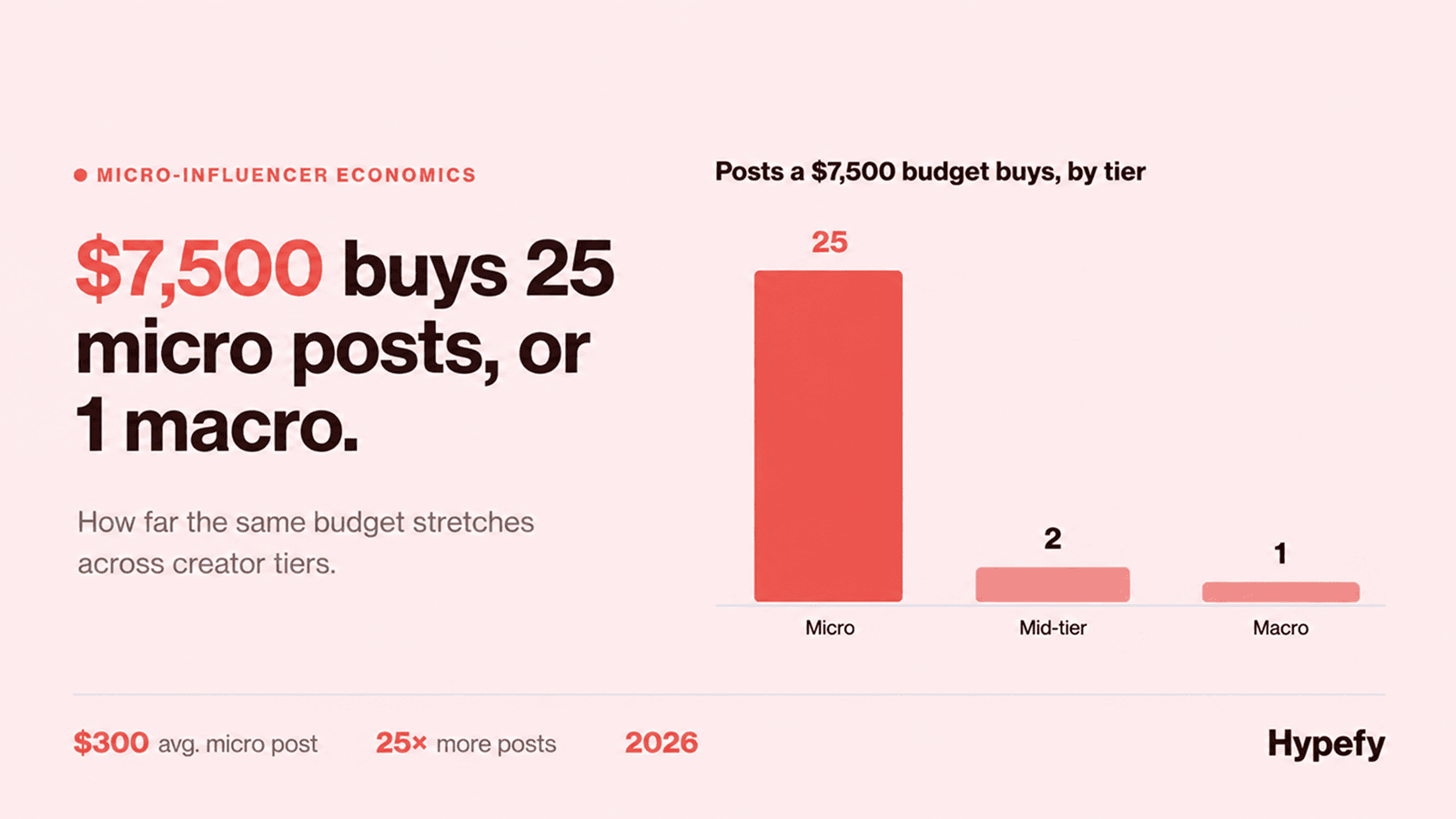
Treat the budget as a pool you split across creators. The table below uses the midpoint of Influencer Marketing Hub's Instagram ranges as a planning rate for each tier, which works out to $300 per micro post, $2,750 per mid-tier post, and $7,500 per macro post.
Budget | Micro posts ($300) | Mid-tier posts ($2,750) | Macro posts ($7,500) |
|---|---|---|---|
$3,000 | About 10 | 1 | 0 |
$7,500 | 25 | 2 | 1 |
$15,000 | 50 | 5 | 2 |
The same $7,500 buys one macro post or about 25 micro posts. Twenty-five micro creators with 40,000 followers each add up to 1 million followers, more than a single macro creator with 750,000, and Socialinsider's data shows smaller accounts reach a larger share of their followers with each post.
Model reach and return for your own budget with the ROI calculator.
Why Micro-Influencers Outperform Their Follower Count
Micro creators deliver more than their follower count suggests because of how their audiences are built. An account with 30,000 followers has usually grown around one area, such as a food niche, a city, a hobby, or a profession, so its followers chose that specific point of view and give its recommendations more weight.
The engagement gap is large. On Instagram, micro creators average 1.5 to 3.5% on static posts against 0.5 to 1% for mega creators, according to Nowadays Media.
Specialized audiences are closer to buying. A food creator with 40,000 followers whose audience cooks at home and buys kitchen equipment is worth more to a food brand than a lifestyle creator with 400,000 followers spread across every interest. Check what the audience buys before you count followers.
Favor creators who haven't run dozens of unrelated sponsorships. A recommendation carries more weight from a feed that isn't a rotation of pet brands, finance apps, and protein powders in the same month, so scroll back through a creator's last 30 days of sponsored posts before shortlisting.
Lower fees make testing possible. At $300 per Instagram post, the midpoint of Influencer Marketing Hub's micro range, nine micro posts cost about the same as one mid-tier post at $2,750, so you can test several creators and put more budget behind the ones that perform.
Spreading the budget reduces single-partnership risk. When one macro post underperforms, the campaign underperforms with it, while ten micro posts still deliver results from the creators who performed and show you which ones to rebook.
Model total campaign cost against creator tiers with the marketing budget calculator.
How to Find Micro-Influencers
Use these four methods to build a shortlist, and add a local layer if the business has a physical location.
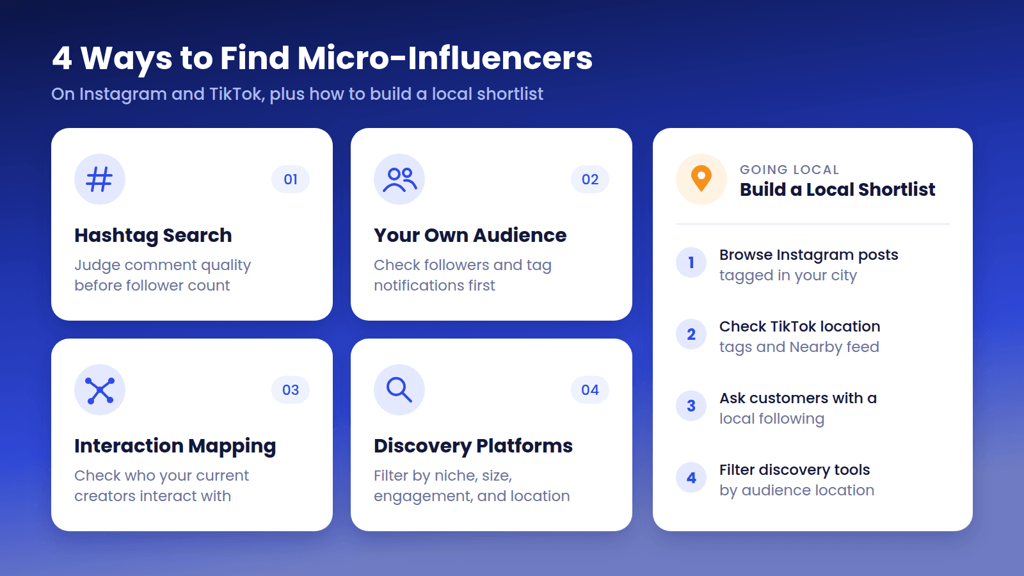
1. Hashtag and keyword search. Search the niche hashtag or product keyword on Instagram and TikTok and look through the creators posting about it. Judge comment quality before follower count, since a creator with 25,000 followers and steady, specific comments is a stronger candidate than one with 80,000 and sparse reactions.
2. Your own followers and customers. A customer who already posts about the product category is a warmer starting point than a cold contact, so check the brand's follower list and tag notifications first.
3. Interaction mapping. Look at who your existing creator partners interact with through comments, Story mentions, and duets and stitches (TikTok formats that reply to or remix another creator's video). Those creators already sit close to your audience and can go on the shortlist before any outreach.
4. Discovery platforms. Use one once the shortlist needs more than a handful of names, since not every creator you approve will accept, and a platform that filters by niche, follower range, engagement rate, and audience location builds a longer list faster.
Hypefy's discovery tool covers Instagram and TikTok and matches creators by what they post, reading captions, formats, and recurring themes, so a creator whose feed is full of home-cooked dinners surfaces for a food brief even if "cooking" never appears in their bio.
For step-by-step methods, see how to find influencers on Instagram and how to find influencers on TikTok.
Finding local micro-influencers. For a business with a physical location, such as a restaurant, a retail store, or a local service, a creator with 15,000 followers in the same city is often a better fit than a national creator with 200,000, since more of the local creator's audience lives within reach of the business. To build a local list:
Search Instagram for your city or neighborhood and browse the posts tagged there.
Check location tags on TikTok videos, and browse TikTok's Nearby feed where it's available in your market.
Ask existing customers with a local following whether they post about the category.
Use a discovery platform that filters by audience location, and confirm the filter exists before you choose a tool.
Hypefy surfaces audience quality signals at the shortlist stage. See how the discovery tool works
How to Run a Micro-Influencer Campaign
Running a micro campaign is a seven-step process, from setting the objective to measuring the results.
Step 1: Set the Objective and Define Success
Pick one primary objective before building the shortlist, since a campaign optimized for sales needs different creators, deliverables, and metrics from one built for content or awareness. Write down the metric that defines success, for example discount-code sales or cost per engagement, and measure every later decision against it.
Step 2: Choose the Tier and Split the Budget
Decide how much of the budget goes to creator fees, whether each deliverable is a single post or a bundle, and how many creators the budget covers at a realistic average rate. Leave room for usage rights and paid amplification if the content will run in ads.
Step 3: Build and Vet the Shortlist
Start with a longer shortlist than you need, since some creators won't reply and others will fail vetting. Check each creator for:
Comments that reference the specific content rather than emoji-only reactions
Follower growth without unexplained spikes
An audience located in your target market
How many sponsored posts they've run recently
The how to spot fake influencers guide covers the vetting signals in full.
Step 4: Brief the Creator
Give context and constraints without scripting every word, so the content still sounds like the creator. Include:
The product and campaign goal
The key message
Required disclosure, such as #ad or the platform's paid-partnership label
Deliverables and posting window
What's off-limits
The influencer brief guide covers what belongs in each section.
Step 5: Put the Terms in Writing
Put the terms in writing before any content is produced. The agreement should cover:
Deliverables and posting dates
Approval rounds
Usage rights and exclusivity
Disclosure requirements
Payment amount and timing
The social media influencer contract guide includes a full template.
Step 6: Review Content Before It Goes Live
Set a fixed review window in the schedule, for example two working days per draft, and agree on the number of revision rounds in advance. Send each creator a unique discount code and tracking link before filming starts, so tracking works from the first post.
Step 7: Measure the Right Things
Measure with more than last-click attribution. Last-click attribution credits a sale to the final link a buyer clicked, so a viewer who sees a creator's post and searches the brand name three days later shows up as direct or organic traffic, and the campaign gets no credit. Track these at the micro tier:
Discount code redemptions per creator
Clicks and sales through UTM links (tags added to a URL so analytics shows where a visit came from)
Post-purchase survey answers ("How did you first hear about us?")
Brand search volume during and after the campaign
Engagement rate per reach, the share of people who saw a post and engaged with it
Where links are tracked, Hypefy's data puts click-through rate (CTR) at 1 to 3%, with strong campaigns at 5% or higher.
Use the ROI calculator to turn these numbers into a return figure, and the influencer marketing ROI guide covers attribution methods in depth.
6 Micro-Influencer Strategies That Work
Micro-influencers work differently from big-name creators, and the strategy that pays off depends on what you're selling and how much budget you're starting with.
These six approaches cover that range, from an always-on roster to turning loyal customers into ambassadors.
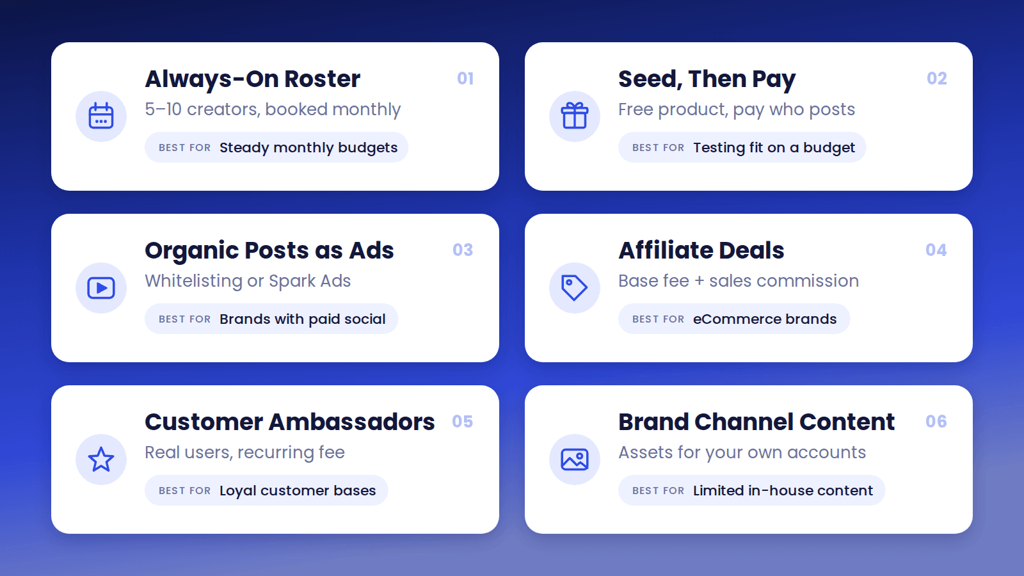
1. Always-on with a small recurring roster. Pick five to ten micro creators who perform consistently and book them for monthly or bi-monthly posts instead of one-off campaigns, so their audiences see the brand featured by the same voice over time.
Best for brands with a regular content calendar and a steady monthly budget.
2. Seeding first, paying later. Send product to a wider group of nano and micro creators with no posting obligation, then pay for more content from those who posted and drew engagement, since they've already shown the product fits their audience.
Best for physical products people enjoy receiving and brands with a small budget that want to test fit before paying.
3. Turning organic posts into paid ads. With the creator's permission, license a micro creator's best-performing organic post and run it as a Meta or TikTok ad, from the brand's account (whitelisting) or the creator's handle (Spark Ads). Write usage rights into the first deal so you don't need to reopen it later.
Best for brands already running paid social, with budget for both the usage fee and the ad spend.
4. Affiliate and discount-code arrangements. Combine a small base fee with a commission on code redemptions or affiliate sales, so the creator earns more when the content sells and each sale traces back to one creator.
Best for eCommerce brands with online checkout and a short path to purchase that prefer paying for results over fixed fees.
5. An ambassador group built from customers. Invite existing customers who already create content in your category into a formal program with product access and a recurring fee, so their posts come from real use of the product.
Best for brands with a loyal customer base and repeat-purchase products, with budget for a long-running program.
6. Commissioning content for brand channels. Pay micro creators to produce content for your own social accounts, ads, and website instead of their feeds.
Best for brands that can't produce enough social content in-house, with a budget per asset instead of per post.
Where Micro-Influencer Campaigns Go Wrong
The admin scales with the number of creators. Fifteen micro partnerships mean fifteen outreach conversations, contracts, content reviews, and payments, and that overhead is the hidden cost of the tier. Run every partnership through one workflow, in a platform or at least a shared tracker, so the fifteenth creator takes the same steps as the first.
Reach per partnership is small. One micro creator rarely moves sales volume alone, so a campaign with a reach goal needs many partnerships running at once. Size the program against the reach goal before committing to the tier.
Inflated followings show up at every tier. SociaVault's analysis of 100,000 Instagram and TikTok accounts classified 37.2% of accounts as showing meaningful signs of inauthentic followers or engagement, with 14.8% scored as likely fraudulent and a further 22.4% as suspicious.
That’s a share of accounts carrying a fraud signal rather than a share of any creator’s followers being fake, and SociaVault notes an estimated 8 to 12% false positive rate.
Vet every micro account for sudden follower spikes, generic comments, and an audience location that doesn't match the creator's. The how to spot fake influencers guide covers the signals in full.
Content quality varies more than with professional creators, since many micro creators make content alongside a day job. Set production expectations in the brief, covering minimum length, lighting, and format, without scripting the content itself.
Measurement is harder when results are spread thinly. Fifteen creators generating 200 code redemptions each is harder to read than one macro creator generating 3,000, because each creator's signal is small. Give every creator a unique code and UTM link and pull the data into one view before judging individual creators.
An Easier Way to Run Micro-Influencer Campaigns
Micro campaigns work, and the admin of running many small partnerships at once is what makes them hard.
Hypefy brings creator matching, outreach, contracts, content review, payments, and reporting into one place across Instagram and TikTok, so running twenty partnerships takes closer to the effort of running one.
The budget works as a pool allocated across creators, invoiced once when the campaign launches, with no monthly subscription between campaigns. Start by finding creators who fit your brief with the discovery tool.
See what your campaign could look like. Book a demo with our team.
Micro Influencer Marketing FAQs
1. What is a micro-influencer?
A micro-influencer is a social media creator with 10,000 to 100,000 followers.
The tiers are industry conventions, so some sources, including The Influencer Marketing Factory, cap micro at 50,000.
Check which definition a platform or vendor uses before comparing numbers.
2. How many followers does a micro-influencer have?
A micro-influencer has 10,000 to 100,000 followers. Nano creators sit below that range (1K to 10K), while mid-tier (100K to 500K), macro (500K to 1M), and mega (1M+) sit above it.
3. How much do micro-influencers charge per post?
Micro-influencers typically charge $100 to $500 per Instagram feed post and $200 to $800 per TikTok video, according to Influencer Marketing Hub.
Usage rights, exclusivity, and paid amplification each add to the base rate, so ask each creator to itemize the quote.
4. Are micro-influencers better than macro-influencers?
Micro-influencers are the better choice for conversion, niche targeting, and testing, while macro-influencers suit launches that need fast reach, categories where a recognizable face matters, and content headed for paid ads.
Pick the tier that fits the campaign goal and your team's capacity to run many partnerships.
5. What engagement rate should a micro-influencer have?
A micro-influencer typically has 1.5 to 3.5% engagement on Instagram static posts, 3 to 5% on Reels, and 5 to 9% on TikTok, according to Nowadays Media's Q1 2026 data.
Take a closer look at audience quality for any micro creator well below these ranges.
6. How many micro-influencers do I need for one campaign?
Divide your reach goal by the average reach per post of the creators you're considering, using the reach figures from their post insights.
Then check the total against your budget with the table above, and start with a longer shortlist than you need, since some creators won't reply and others will fail vetting.
7. Do micro-influencers work for B2B brands?
Yes, though B2B micro-influencers look different.
They're usually practitioners, analysts, and operators with domain expertise, and many are most active on LinkedIn and niche podcasts instead of Instagram and TikTok.
Measure pipeline influence and inbound leads in place of discount codes, and plan for longer sales cycles. The B2B influencer marketing strategy guide covers the model in full.
8. How do I find micro-influencers in my city?
Search Instagram for your city or neighborhood and browse the posts tagged there, check location tags on TikTok videos, and use TikTok's Nearby feed where it's available.
Confirm the creator's audience lives in your city before reaching out, since a creator's location and their audience's location don't always match.
9. Are macro-influencers still worth it in 2026?
Yes, for campaigns that need fast reach at launch, a recognizable face, or content that will run as paid ads.
A macro post costs more, but the total gap narrows once you count the admin of running many micro partnerships.
Choose based on the campaign goal and how many partnerships your team can run.
10. Will micro-influencers accept free product instead of payment?
Some will, mostly at the nano and lower micro level, and Influencer Marketing Hub notes that some nano creators accept gifted collaborations. Larger micro creators generally expect a fee for a defined deliverable, sometimes with product on top.
Micro creators looking for fee-based work can receive paid campaigns for micro influencers on Hypefy, where every proposal comes with a cash fee based on recent post performance and the campaign budget.
Any gifted post still needs a disclosure. The Federal Trade Commission (FTC) in the US says to disclose free products even if the creator wasn't asked to mention them, UK guidance from the Advertising Standards Authority (ASA) covers any incentive, requested or unsolicited, and EU markets follow national consumer-protection rules.