The strongest Modash alternatives are Hypefy, Influencer Hero, Upfluence, GRIN, Influencity, Traackr, CreatorIQ, HypeAuditor, Heepsy, and Collabstr.
The right pick depends on whether you need more than discovery, want predictable pricing without usage caps, or need platform coverage Modash doesn't offer.
This guide covers what Modash costs once you factor in usage limits, why teams move on, a side-by-side comparison of all ten alternatives, and which one fits which kind of team.
Why Brands Look for Alternatives to Modash
Modash does discovery well. Most teams that start comparing alternatives are not unhappy with the discovery engine; they have hit the edges of what the plan allows or what the platform covers.
What Modash Costs
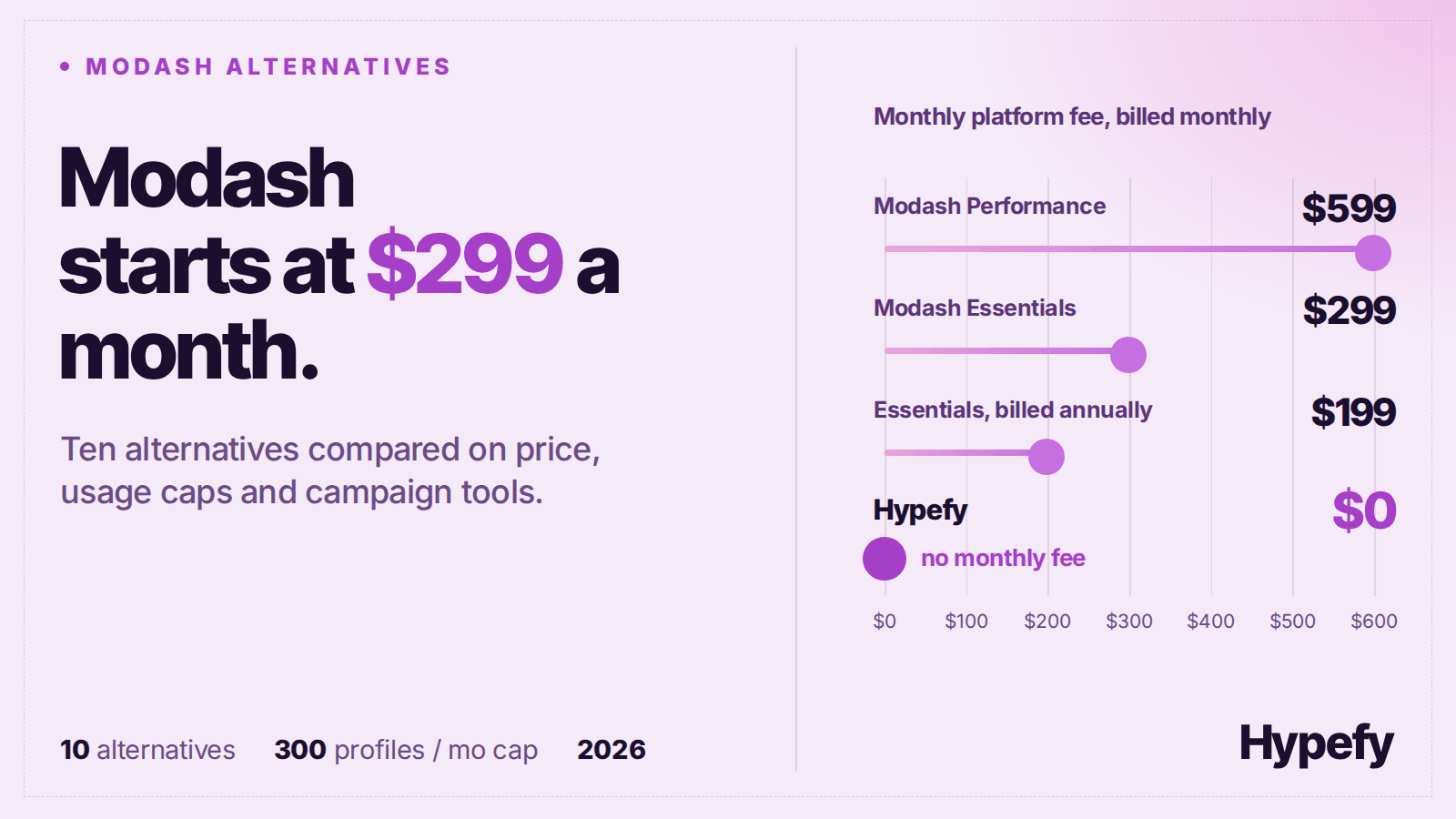
Modash's Essentials plan is $299 per month on monthly billing or $2,388 per year on annual billing, which works out to $199 per month, according to Modash's own pricing page (checked September 2026). The Performance plan is $599 per month or $5,988 per year. Enterprise starts at $14,700 per year.
The headline $199 figure is the annual prepay rate. Committing to annual billing saves $100 per month but requires paying $2,388 upfront for the year. Comparison pages routinely quote the annual rate without flagging it, so the month-to-month cost of $299 on Essentials is frequently understated.
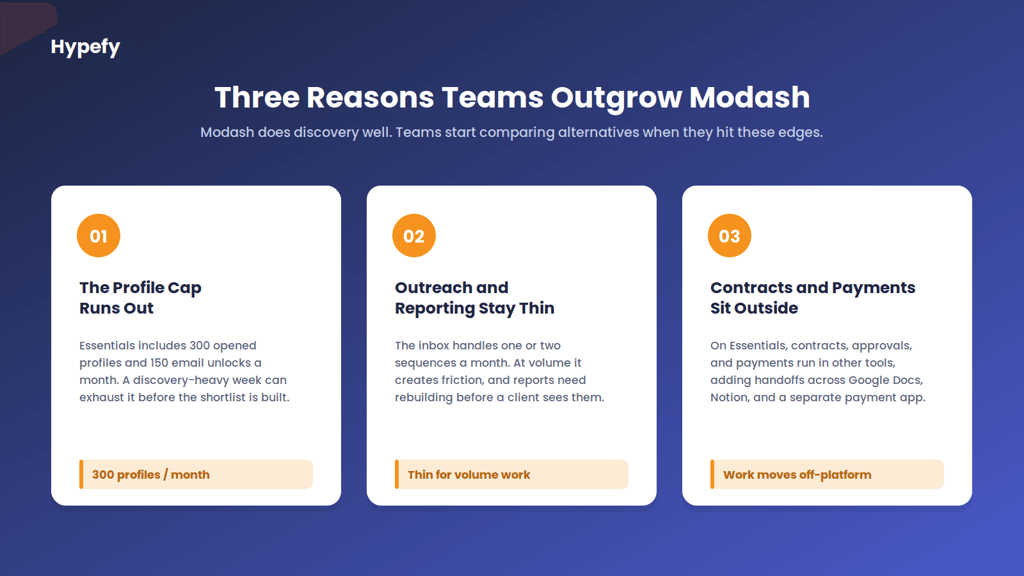
The usage limits behind the subscription are where the real cost picture sits. The Essentials plan includes 300 opened profile analyses per month, 150 unlocked creator emails per month, 100 tracked creators, and 2 team seats.
On a two-person team actively shortlisting for a campaign, 300 opened profiles disappear faster than it sounds, since every profile you open to check audience demographics counts toward the cap, even when it turns out not to be a fit. A discovery-heavy week can exhaust the monthly allowance before you build the shortlist.
The Performance plan at $499 per month annually adds creator payments and affiliate tracking, but carries a 5% payout fee on payments above the included $10,000 per year, a limit that covers payments and affiliate payouts combined.
Most teams miss this commission when budgeting, since it sits on top of the subscription and compounds with campaign volume. Enterprise raises the fee-free band to $100,000 per year, after which the 0% fee continues within further payout tiers, and the 5% applies only above each tier limit. Enterprise starts at $14,700 per year.
The 14-day free trial includes all features with restricted usage, including 20 opened profiles, 6 email unlocks, and 10 tracked creators. Twenty profiles against an Essentials allowance of 300 is less than a tenth of a month, so the trial is enough to test the interface but not enough to see whether the profile cap will bind.
Hypefy handles contracts, content approval, and payments inside the same workflow as discovery. See How Hypefy Works
Discovery Is Where It Stops
Modash is built around finding and vetting creators, and this gap is the single most common reason teams start comparing alternatives. One G2 reviewer noted that "the 'Contracting' phase is still a bit manual.
For teams running gifting workflows, promo code tracking, and basic campaign management, Modash covers the workflow on the Performance plan.
For teams that need a full contract, content licensing terms, and approval flow before a creator posts, the work moves outside the platform.
In practice, a team using Modash for discovery typically manages contracts and licensing terms in Google Docs or DocuSign, tracks content approvals in Notion or Asana, and handles payments through bank transfer or a separate payment tool.
Each handoff between systems is a place where briefing details are lost, approvals are missed, or payments are delayed. That stitching work doesn't show up on the Modash invoice, but it costs the team hours every week in coordination across systems.
Outreach and Reporting Limits
Outreach runs through Modash's built-in inbox on every plan, but the Essentials plan caps email unlocks at 150 a month (400 on Performance), so a team contacting creators at volume can run out of contact details before the month ends.
For teams sending one or two outreach sequences a month, that allowance is workable. For agencies or in-house teams running outreach at volume across multiple campaigns, the email unlock cap becomes a source of friction.
Reporting is the other consistent theme. One Capterra reviewer flagged the reporting presentation directly, saying it's "not yet as visually polished or time-efficient as we'd like."
The reports are functional but not presentation-ready, useful internally, and not polished enough to hand to a client or an executive without rework. Teams that report to stakeholders or agency clients typically export and rebuild the numbers elsewhere.
Platform Coverage Gaps
Modash covers Instagram, TikTok, and YouTube. It does not cover LinkedIn, Twitch, Pinterest, or blog creators. For most consumer brand campaigns, that coverage is sufficient.
For teams running B2B thought-leadership programs on LinkedIn, live-stream partnerships on Twitch, seasonal campaigns with Pinterest placements, or blogger outreach for long-form content, Modash doesn't make the creators they need searchable.
Modash Alternatives at a Glance
The table below covers all ten alternatives on the dimensions that matter most to a team leaving Modash.
Platform | Best for | Platform coverage | Standout strength | Pricing model | Free trial |
|---|---|---|---|---|---|
Hypefy | End-to-end campaigns on Instagram and TikTok, no subscription | Instagram, TikTok | Matching plus full workflow: outreach, contracts, payments, reporting | Campaign-based, no monthly fee | No trial, because there is no subscription to trial |
Influencer Hero | Brands and agencies wanting discovery and campaign execution in one platform | Instagram, TikTok, YouTube | 450M+ creators, AI outreach, trigger-based automations, gifting, affiliate payouts | From $649/month | No public trial; demo available |
Upfluence | eCommerce brands finding creators inside their own customer list | Multi-platform | Live Capture from Shopify, WooCommerce, Klaviyo | Custom pricing (on request) | No public trial |
GRIN | Shopify DTC brands needing revenue attribution per creator | Multi-platform | Shopify order-level revenue reporting per creator | Has a free plan, with paid plans starting at $200/month | Free plan |
Influencity | Brands expanding into new markets, audience overlap analysis | Instagram, TikTok, YouTube | Audience geography and overlap tools across 350M+ profiles | From $168/month | 7-day free trial |
Traackr | Enterprise brands with compliance and governance requirements | Multi-platform | Compliance scoring, benchmark reporting, multi-team workflow | Custom enterprise | No public trial |
CreatorIQ | Large agencies and enterprise brands, complex multi-market programmes | Multi-platform | Creator graph, full CRM, measurement suite | Custom enterprise | No public trial |
HypeAuditor | Teams that need standalone audience quality analytics at depth | Instagram, TikTok, YouTube, X | Audience quality scoring, fraud detection, EMV reporting | From $299/month billed annually | Free tools available |
Heepsy | Small teams needing basic vetting and discovery at low monthly cost | Instagram, TikTok, YouTube | Followers Quality metric, low entry price | From $69/month | 14-day free trial |
Collabstr | Open marketplace with transparent creator pricing and no subscription | Instagram, TikTok, YouTube, UGC | Creator-set prices, escrow payments, nearly 80% of deals under $300 | Free browse; 10% fee (5% on Premium) | Free to browse |
The 10 Best Modash Alternatives in Depth
1. Hypefy
Hypefy is an AI-powered influencer marketing platform that runs the full campaign on Instagram and TikTok, from creator matching through to payment.
Where Modash finds creators and passes the work to whatever the team adds around it, Hypefy handles matching, outreach, briefing, content approval, contracts, and payments in the same workflow.
There are no fees until a campaign launches, which is the clearest structural difference from a subscription with usage caps.
How it compares to Modash: Modash covers Instagram, TikTok, and YouTube; Hypefy covers Instagram and TikTok only. Modash has a larger searchable database and covers the full discovery-to-vetting workflow across three platforms.
Hypefy's advantage is the campaign execution layer, so a small team running Hypefy doesn't need to add tools around discovery to get the campaign across the line.
Good for: Brands and agencies running regular Instagram or TikTok campaigns that want matching and execution in one place, without a monthly subscription between campaigns.
Limitations: No YouTube coverage. Teams whose campaigns depend on YouTube creators should look at Influencity, HypeAuditor, or GRIN instead.
See how Hypefy’s influencer discovery tool works
2. Influencer Hero
Influencer Hero is end-to-end influencer marketing software for eCommerce brands, direct-to-consumer (DTC) teams, and agencies. It pairs a 450M+ creator database with the outreach, gifting, affiliate, and workflow tools needed to turn a shortlist into a running creator program.
Search runs across Instagram, TikTok, and YouTube with 20+ filters and AI lookalike discovery, and a Chrome extension shows demographics, fake follower percentage, and earned media value (EMV) on any profile.
Outreach uses AI-personalized email sequences with a 43% average response rate, with spam score checks before sending. Gifting ships products as $0 orders from Shopify, WooCommerce, Amazon, and other stores.
Campaign Board Automations trigger the next step, from discount codes and affiliate links to contracts and Slack alerts. Every creator post and organic brand mention lands in an AI-scored Content Wall.
How it compares to Modash: Modash is built around discovery depth, while Influencer Hero is built around the full workflow that follows the search. Plans start at $649 a month, above Modash's entry plan, with consultation and training included.
Good for: Brands and agencies that want discovery and campaign execution in one platform.
Limitations: Entry price is higher than Modash's, with a three-month minimum on monthly plans. There's no free trial, so evaluation starts with a demo.
3. Upfluence
Upfluence is an influencer marketing platform built for eCommerce brands, and its standout feature is Live Capture, which identifies creators already in the brand's existing customer base from Shopify, WooCommerce, or Klaviyo, so outreach starts with people who already buy the product rather than cold contacts.
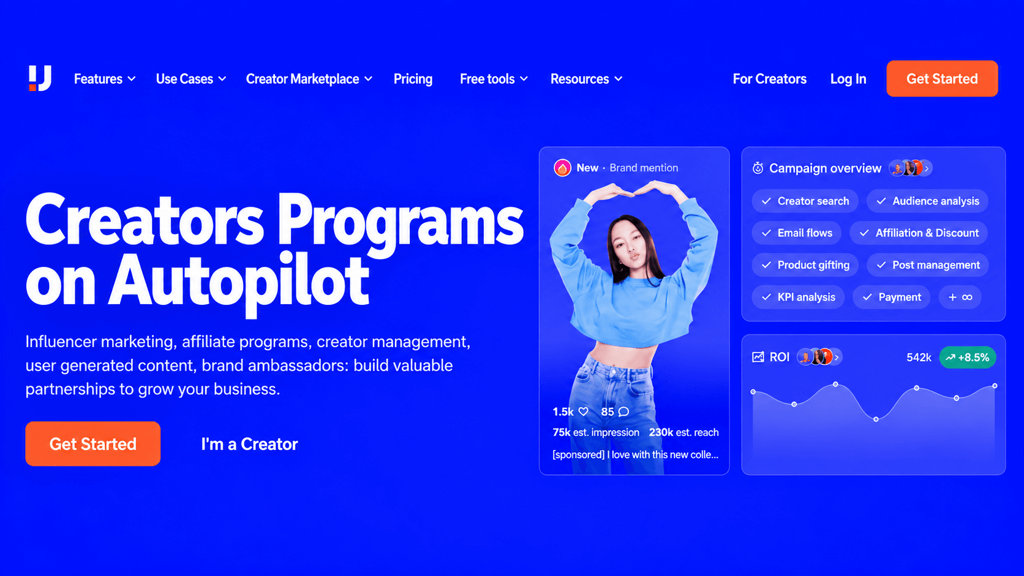
How it compares to Modash: More expensive and requires a 12-month contract with no self-serve trial. Stronger on campaign execution and eCommerce attribution.
Good for: eCommerce brands that want to mine their existing customer list for creator relationships and attribute campaign results to Shopify order data.
Limitations: 12-month contract required. Pricing is not published; expect a custom quote that scales with modules, team size, and program volume.
4. GRIN
GRIN covers the full creator lifecycle for Shopify and DTC brands, including discovery, gifting, content management, creator payments, and revenue reporting tied to Shopify order data at the creator level.
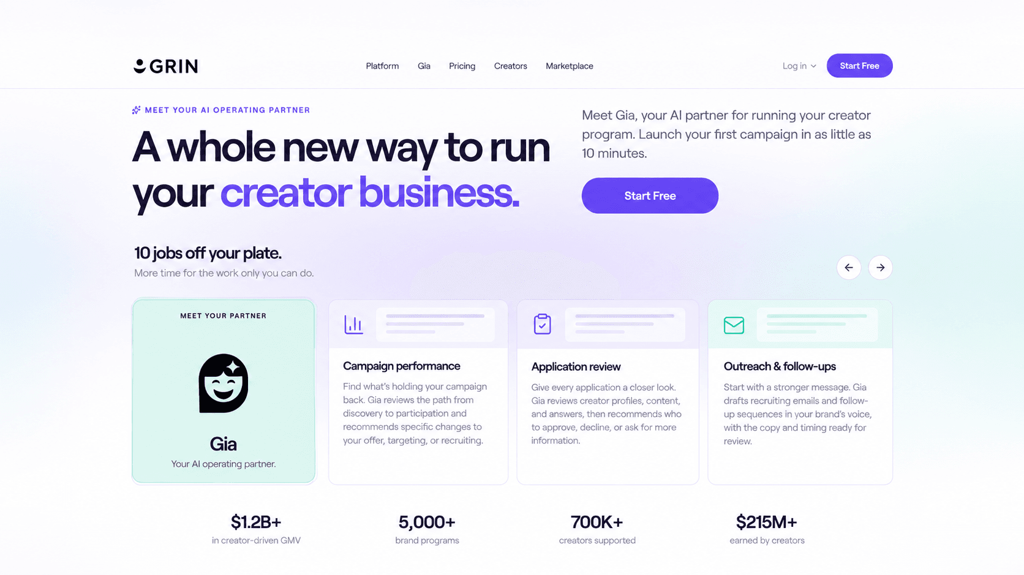
For US creators, GRIN also handles the 1099 tax forms they need to report earnings of $600 or more in a year, and issues 1042-S forms for creators outside the US.
It is the strongest platform on this list for brands where revenue attribution to individual creators is the primary measurement requirement.
How it compares to Modash: Modash has stronger discovery and a larger database. GRIN has stronger post-discovery execution, with a free plan and paid plans from $200 a month on month-to-month billing.
Good for: Shopify DTC brands running influencer programs at scale where tying each creator to a specific order matters more than discovery volume.
Limitations: Discovery lags behind dedicated tools, and costs rise with credit usage once a team goes past its plan's monthly allowance.
5. Influencity
Influencity covers profiles across Instagram, TikTok, and YouTube and is strongest on audience overlap detection, identifying which creators share audiences, which matters for multi-market expansion and for avoiding audience saturation across a campaign roster.
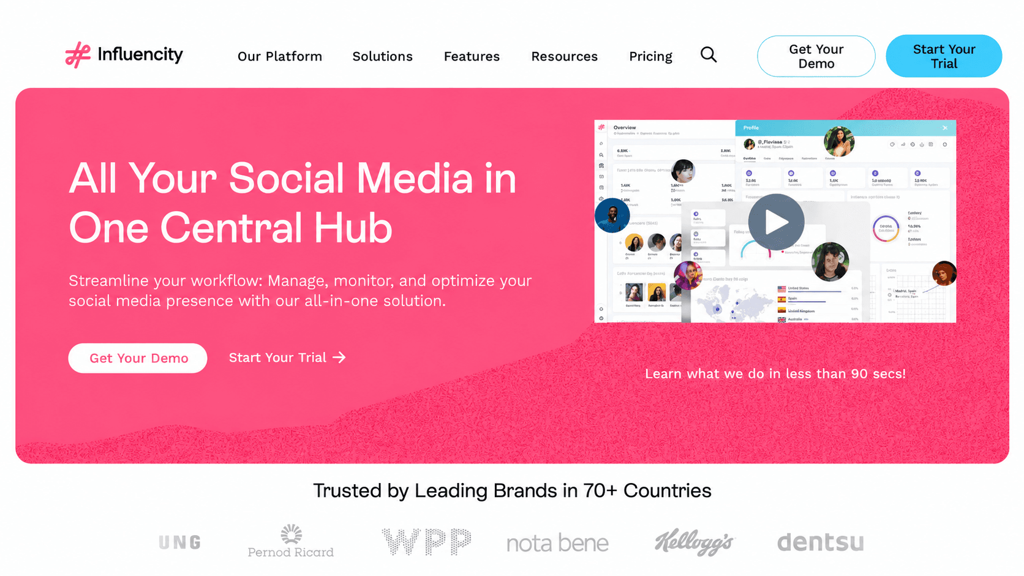
How it compares to Modash: Smaller database but stronger audience overlap tools. Entry pricing starts at $168/month, below Modash's $199 annual rate, while the top Professional tier runs $318/month billed annually or $398/month billed monthly. A credit-based usage model can create similar friction to Modash's profile cap.
Good for: Brands expanding into new markets where understanding audience geography and overlap across the creator roster matters most.
Limitations: Credit-based model can run out mid-campaign. The interface has a steeper learning curve than Modash.
6. Traackr
Traackr is built for enterprise brands with governance requirements, such as compliance scoring, benchmark reporting against industry standards, and multi-team workflow management with role-based permissions.
It is a platform built to run programs across many teams, markets, and stakeholders.
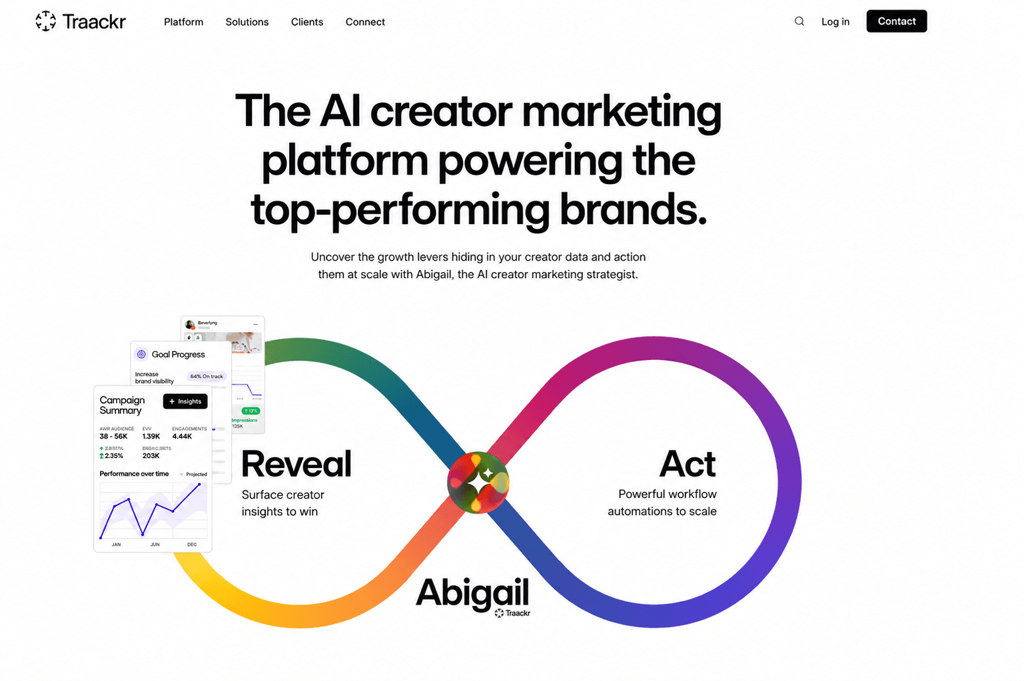
How it compares to Modash: Traackr is not a meaningful comparison for teams at the Modash price point. It solves different problems at a much higher price.
Good for: Enterprise brands with compliance, governance, and multi-team coordination requirements for influencer programs at scale.
Limitations: Enterprise-only pricing and complexity. Not accessible for small- or mid-market teams.
7. CreatorIQ
Large agencies and enterprise brands use CreatorIQ for creator discovery, CRM, measurement, and campaign analytics.
Its creator graph, a proprietary database of creator relationships and audience connections, is the strongest feature for complex multi-creator programs.
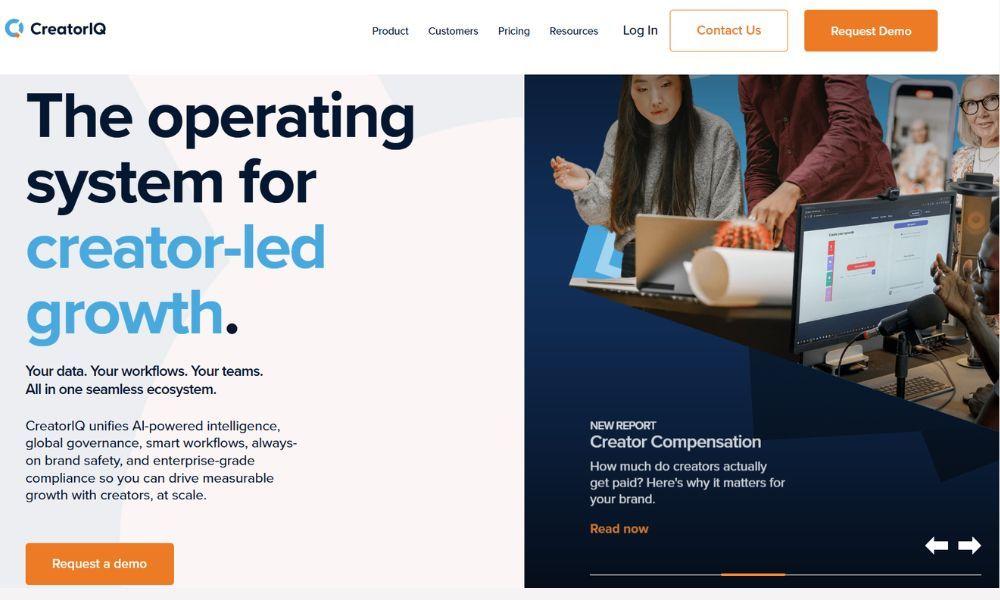
How it compares to Modash: CreatorIQ's pricing is not published and sits in a different category entirely from Modash. It is relevant as a Modash alternative only for enterprise teams for whom Modash has become insufficient.
Good for: Large agencies and enterprise brands running multi-market, multi-team programs that need a comprehensive CRM and measurement suite.
Limitations: Pricing is available on request only, with no published starting figure. Requires a dedicated team to run effectively.
8. HypeAuditor
HypeAuditor is an analytics and vetting platform first.
Its audience quality scoring, fraud detection, geographic audience breakdown, and earned media value reporting go deeper on a per-profile basis than Modash does, across Instagram, TikTok, YouTube, and X.
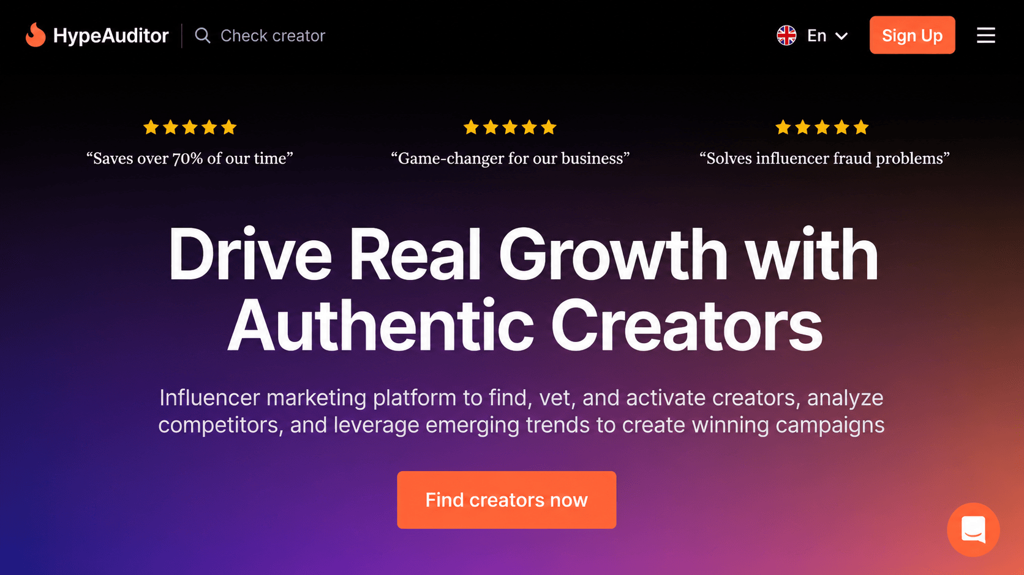
How it compares to Modash: HypeAuditor is a stronger standalone analytics product. Modash has more campaign management capability and a 14-day free trial and is less restrictive to evaluate. Both are discovery-first tools that leave campaign execution to other tools.
Good for: Teams that need the most detailed audience quality data available before committing a budget to a creator, particularly for high-value deals or markets with significant fraud risk.
Limitations: The published Basic plan is $299 a month billed annually, and the tiers above it are quote-only. The full trial is by request only, not self-serve.
9. Heepsy
Heepsy is the most accessible entry point on this list at $69/month billed annually, covering over 4 million creator profiles across Instagram, TikTok, and YouTube.
Its Followers Quality metric flags suspected fake followers before outreach, and its geographic and niche filters are straightforward to navigate.
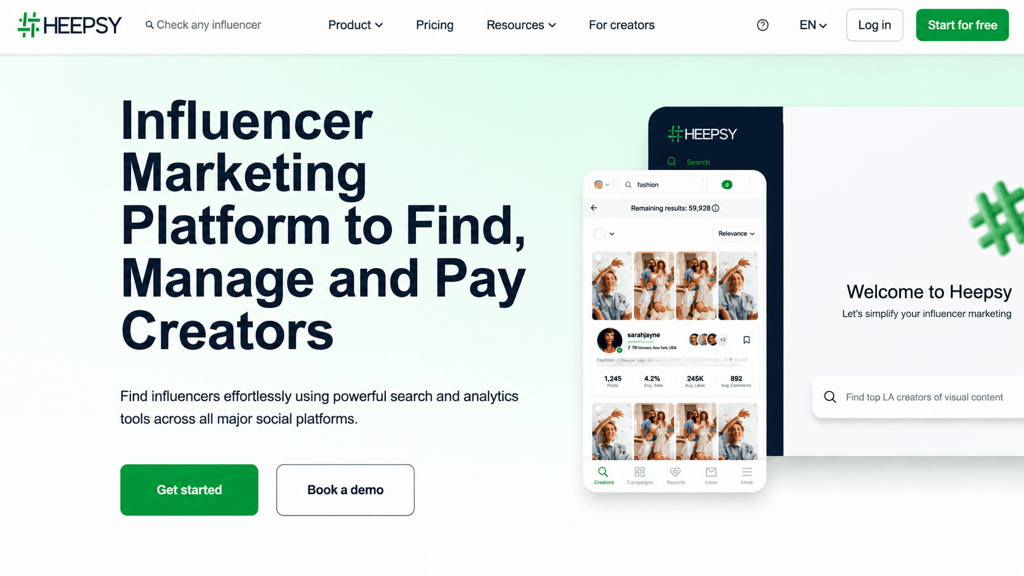
How it compares to Modash: Significantly smaller database. No profile cap friction at the $69 entry level. Lower absolute cost for teams with modest discovery needs. Outreach is included from the entry plan, and creator payments start on the $149/month Plus tier.
Good for: Small teams and solo marketers who need basic discovery and audience vetting without a monthly subscription that scales with usage.
Limitations: A much smaller database than Modash, no contracts, and creator payments only from the $149/month Plus tier.
10. Collabstr
Collabstr is an open creator marketplace where creators set their own prices, payments are held in escrow, so there's no cold outreach or negotiation step.
Based on analysis of more than 21,000 collaborations, nearly 80% of deals cost under $300, making it the most accessible starting point by spend level.
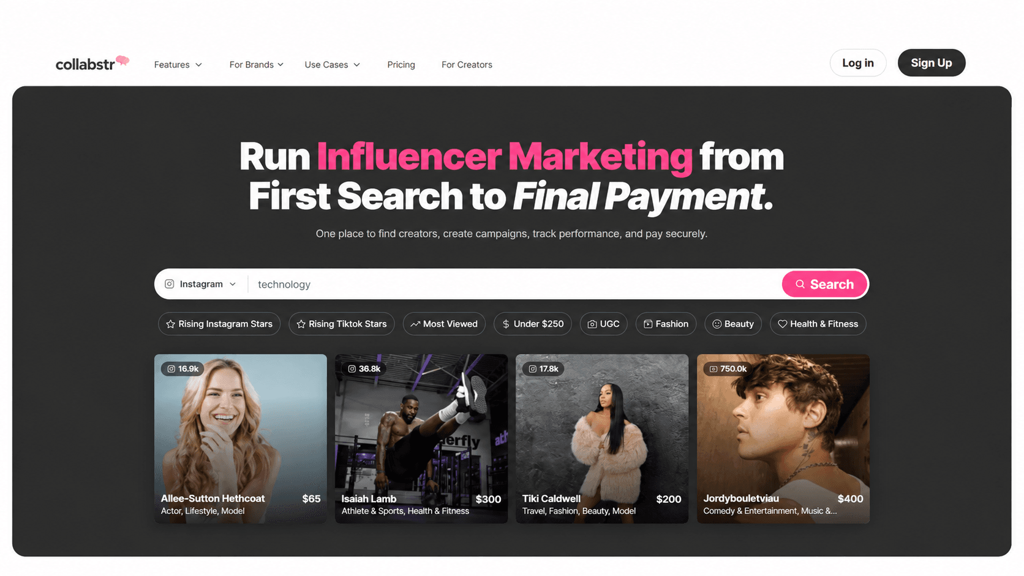
How it compares to Modash: Collabstr is a booking tool, not an analytics tool. No audience quality scoring, fake-follower detection, or outbound search into a large database. The trade-off is no subscription and no profile caps.
Good for: Brands that want to find and book creators at transparent prices for UGC or small-budget campaigns without a subscription or negotiation.
Limitations: No audience-quality data or fake-follower detection. Discovery is limited to creators who opted into the marketplace.
For teams that want discovery plus full campaign execution at no monthly subscription, Hypefy covers both.
Which Modash Alternative Fits Your Team
The right alternative depends on which Modash limit you've hit, so find your gap below and match it to the platform built to close it.
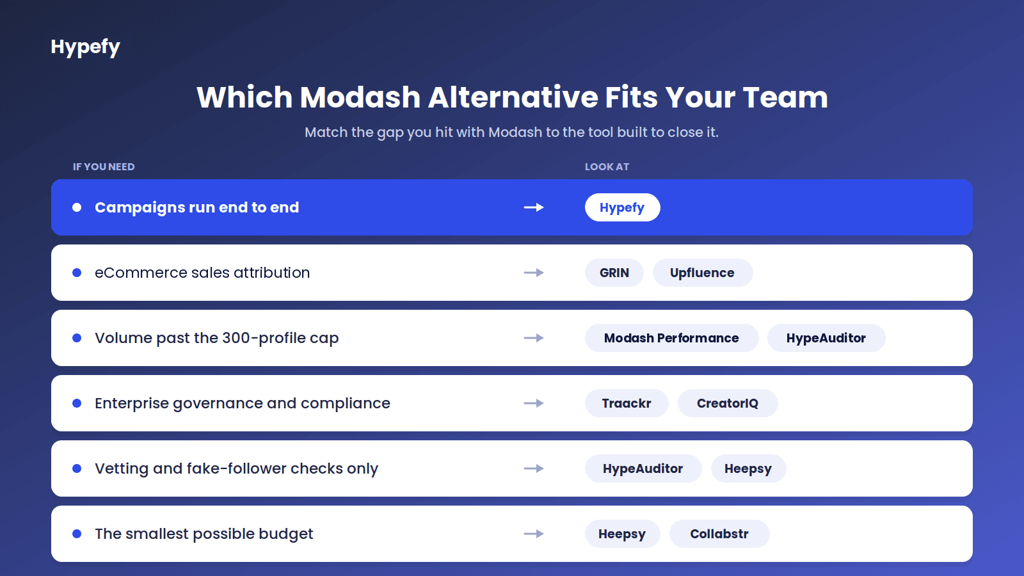
You like Modash discovery but need campaigns run end-to-end. Hypefy covers matching, outreach, contracts, content approval, payments, and reporting in one workflow on Instagram and TikTok. No subscription between campaigns.
The limit is YouTube; if that matters, Influencer Hero or GRIN cover the execution layer with broader platform reach.
You are an eCommerce brand that needs sales attribution. Choose GRIN or Upfluence. Both tie creator activity back to Shopify order data in a way Modash does not. GRIN is the stronger attribution tool, while Upfluence's Live Capture feature finds creators in your existing customer list.
You hit the 300-profile cap and need volume without overage. Modash's Performance plan at $499/month lifts the profile limit to 800 per month. Influencity is not the answer here despite the lower base price.
Its entry plan analyses 30 profiles a month against Modash’s 300, and the 5,000 monthly results it advertises are search rows rather than full analyses. If Performance is still not enough, HypeAuditor has fewer usage-cap concerns for analytics-focused teams.
You need enterprise governance and compliance. Traackr or CreatorIQ. Both are built for multi-team, multi-market programs with role-based controls and compliance scoring. Neither is accessible at Modash's price point.
You only need vetting and fake follower checks. HypeAuditor goes deeper on audience quality per profile than Modash does. Heepsy covers the basics at $69/month billed annually. Both are discovery and vetting tools that, like Modash, leave campaign execution elsewhere.
You have the smallest possible budget. Heepsy at $69/month billed annually, for basic vetting. Collabstr's free browse for marketplace-style discovery.
Where Hypefy Fits
Hypefy isn't the answer for every team leaving Modash, but for brands and agencies running regular Instagram or TikTok campaigns, it's a practical fit.
Modash finds and vets creators, while Hypefy does that and then runs entire campaigns.
Where Modash surfaces a scored shortlist and passes the work to email, Google Docs, and a payment tool, Hypefy handles AI-driven matching on Instagram and TikTok, then runs outreach, contracts, content approvals, payments, and reporting in the same workflow.
A small team running Hypefy doesn't need to build a tool stack around discovery to finish a campaign.
Hypefy works on campaign budgets rather than a subscription. You set the budget for each campaign, Hypefy's fee is part of that budget rather than added on top, and you're only charged once the campaign goes live. The pricing page sets out how it works.
On Modash, the subscription runs whether campaigns are live or not.
Factor | Hypefy | Modash |
|---|---|---|
Platform coverage | Instagram, TikTok | Instagram, TikTok, YouTube |
Discovery database | AI semantic matching across Instagram and TikTok creators | Profiles across Instagram, TikTok, YouTube |
What is built in | Matching, outreach, contracts, content approval, payments, reporting | Discovery, vetting, basic outreach, promo code tracking, basic reporting |
What requires added tools | YouTube campaigns | Contracts, content approval flows, managed payments (on Essentials) |
Pricing structure | Campaign-based, no subscription between campaigns | Modash pricing starts at $199/month annually; usage limits apply |
Built for | Brands and agencies running regular Instagram or TikTok campaigns | Teams that need a large-database discovery and vetting tool |
The YouTube gap is the most important thing to be direct about on this guide. Modash covers YouTube. Hypefy does not.
If YouTube creator campaigns are part of the brief, Hypefy is not the right replacement. Point those campaigns to Influencity, HypeAuditor, or GRIN instead.
See what your campaign could look like. Book a demo with our team.
Modash Alternatives FAQs
1. What are the best Modash alternatives?
The strongest Modash alternatives are:
Hypefy for end-to-end campaign execution without a subscription
Influencer Hero for discovery and campaign execution in one platform
Upfluence and GRIN for eCommerce attribution
HypeAuditor for deeper per-profile analytics
Heepsy for budget entry-level vetting
The right pick depends on whether the gap with Modash is execution, usage limits, or platform coverage.
2. How much does Modash cost?
The Essentials plan is $199 per month billed annually ($2,388 per year) or $299 per month billed monthly.
The Performance plan is $499 per month billed annually or $599 per month billed monthly. Enterprise starts at $14,700 per year.
The Essentials plan includes 300 opened profile analyses, 150 email unlocks, 100 tracked creators, and 2 seats per month.
3. Is there a free Modash alternative?
Collabstr is free to browse, with a 10% fee per collaboration (5% on Premium). HypeAuditor offers more than 40 free tools for individual profile checks.
Influencity and Modash both offer free trials rather than a permanent free tier, Influencity for 7 days, Modash for 14 days with no credit card required.
4. Why do brands switch from Modash?
There are three common reasons brands switch from Modash:
The monthly profile analysis cap runs out before campaigns are fully built.
Contracts and managed payments have to sit in separate tools rather than inside the platform.
The outreach and reporting tools, while workable, are thin for volume work or client-facing reporting.
5. Does Modash detect fake followers, and do the alternatives?
Yes, Modash includes audience quality analysis and fake follower detection as part of its discovery workflow.
HypeAuditor goes deeper on per-profile audience quality scoring, and Heepsy's Followers Quality metric covers the basics at a lower price point.
Hypefy assesses audience quality as part of creator matching rather than as a standalone report.
6. What is the best Modash alternative for a small team?
Hypefy is the best fit if the team needs to run campaigns on Instagram or TikTok without adding tools around discovery.
Heepsy works at $69/month billed annually if the team only needs discovery and basic vetting.
Collabstr suits a team that wants to book creators at transparent prices with no subscription.
7. Which Modash alternatives cover YouTube creators?
Influencer Hero, Upfluence, GRIN, Influencity, HypeAuditor, and Heepsy all cover YouTube in addition to Instagram and TikTok.
If YouTube campaigns are part of the brief, one of those six is the right option.
8. Which alternative handles contracts and creator payments?
Influencer Hero, GRIN, and Upfluence handle both contracts and payments inside the platform, and Hypefy handles both as part of the campaign workflow.
Modash handles payments from the Performance plan up, with a 5% fee on payouts above $10,000 per year on Performance, and the fee-free band rises to $100,000 on Enterprise, continuing in tiers above that.
Modash's Essentials plan does not include managed payments or contract handling.
9. Is Modash worth it in 2026?
Yes, for teams that need a large, affordable discovery and vetting database across Instagram, TikTok, and YouTube, with transparent pricing and a self-serve trial.
The gaps are the execution layer (contracts, managed payments, and polished reporting) and the usage caps on the entry plan.
Stress-test those caps during the free trial before committing to annual billing.