Travel influencer marketing is the practice of partnering with content creators on social platforms to promote destinations, hotels, airlines, tour operators, and travel products to their audiences.
It spans Instagram, TikTok, and YouTube, and shows up in formats like destination reels, hotel reviews, travel vlogs, packing guides, and live trip diaries.
The global influencer marketing industry is now estimated at over $32 billion, and travel sits among its fastest-growing verticals as more tourism brands shift budget away from traditional advertising.
For travel and tourism brands in 2026, this has moved from an experimental line item to a core channel.
What Travel Creators Actually Want from a Brand Partnership
Strong partnerships start when brands understand what creators are actually working with on their side of the table.
Creative freedom matters more than most briefs allow. Travel creators have built audiences by developing a distinct voice, visual style, and editorial point of view. When a brief reads like a press release, the resulting content reads the same way, and it underperforms. The brands that get the best results give clear objectives and brand non-negotiables, then trust the creator with execution.
Fair and transparent payment is the next pillar. Many creators have stories about chasing invoices for months or being told the budget shrank after delivery. Clear payment terms, on-time transfers, and rates that reflect actual market value go a long way. This is one of the areas where smart pricing tools have started to change the conversation.
Logistics matter more in travel than in almost any other vertical. Visa support, accommodation quality, transfer arrangements, dietary needs, weather contingencies, and shoot flexibility all affect the content. A creator who lands at a hotel at 1 a.m. with no airport pickup and a noisy room facing a parking lot will produce different content from one who is treated like a guest.
Long-term relationships outperform one-off posts. A creator who has visited a destination twice in two years can tell a more layered story than one parachuting in for a three-day shoot. Ambassador models and repeat collaborations build that depth.
Finally, a clear brief is appreciated. Not a 40-page deck, but a one-page document that covers objectives, audience, key messages, content formats, posting dates, content rights, and approval timelines.
The State of Travel Influencer Marketing in 2026
The market has scaled fast. According to Influencer Marketing Hub’s 2026 benchmark, global influencer marketing spend reached $32.55 billion in 2025 and is projected to pass $34 billion in 2026, with travel and tourism among the verticals seeing the most consistent year-over-year growth.
Tourism boards, hotel groups, and online travel agencies have shifted meaningful portions of their digital budgets into creator partnerships, often at the direct expense of traditional display and print.
The performance comparison is hard to ignore. Industry research from Influencer Marketing Hub shows that brands now earn an average of $5.78 in revenue for every dollar invested in influencer marketing, with travel campaigns frequently reporting figures in this range or higher when measured against booking lift, content output, and earned media value combined. The content asset library that comes out of these campaigns is part of the value, and increasingly it is priced into the deal.
Platform behavior is also splitting in interesting ways.
Instagram remains the workhorse for travel content, with Reels driving most of the reach.
The global Instagram influencer market was estimated to surpass $22 billion in 2025 for the first time, according to Statista.
TikTok has become a major destination research tool for younger travelers. According to TikTok for Business, 71% of European users say they are likely to book a holiday based on recommendations they have seen on the platform, and views of travel content have grown by 410% since 2021.
YouTube continues to dominate longer-form travel content, where viewers commit to 10 or 20-minute hotel reviews and itinerary breakdowns that influence higher-value bookings.
The tier story has clarified, too. Macro and mega influencers still play a role in awareness campaigns, but micro influencers consistently deliver the strongest engagement rates and the best conversion economics in travel.
Nano influencers, the under-10,000-follower group, are now showing up in destination campaigns at scale, often bundled into cohorts of 20 to 50 creators per program.
Travel Influencer Marketing Trends Shaping 2026
Slow travel content is reshaping brief formats. Audiences are gravitating toward longer, more reflective content that highlights one destination in depth rather than a six-city sprint.
Brands are responding with longer engagement windows, multi-day shoots, and content calendars that release one campaign over weeks rather than a single post.
AI-assisted creator selection is now standard at the larger end of the market. Brands are using audience analysis tools to find creators whose followers actually match the brand’s ideal customer profile, not just creators who happen to post travel content. This shifts the question from “is this creator on brand” to “is this creator’s audience our audience.”
Campaigns are getting more multi-format. A typical brief in 2026 includes a primary Reel or TikTok, supporting stories, a longer-form YouTube or blog piece, and full content rights for paid social and email. Single-post deals are becoming rare outside nano campaigns.
Niche travel verticals are outperforming broad travel accounts. Solo female travel, accessible travel, sustainable travel, family travel, and adventure travel each have engaged communities with clear purchase intent. Creators in these niches often command higher engagement and lower CPMs than general lifestyle accounts.
TikTok search behavior is changing destination marketing. A growing share of travelers research destinations on TikTok before they touch Google or a travel agency. This is pushing brands to invest in evergreen, search-optimized TikTok content rather than purely viral plays.
Finally, content rights and usage have become a central part of negotiation. Brands now expect 6 to 12 months of paid usage rights on creator content by default, which has changed how creators price their work and how brands evaluate campaign value.
Who Is a Travel Influencer? Niches, Tiers, and What They Actually Do
A travel influencer is a content creator who builds an audience by sharing travel experiences, destinations, accommodations, and tips across social platforms. They differ from general lifestyle creators in that travel is the primary subject of their content, not an occasional theme.
Travel creators tend to specialize. Common niches include:
- Luxury travel creators serve high-end hotels, resorts, and premium tour operators.
- Budget and backpacker creators serve hostels, budget airlines, travel insurance, and gear brands.
- Adventure travel creators serve outdoor gear, expedition operators, and adventure-led destinations.
- Family travel creators serve family resorts, theme parks, family-friendly destinations, and travel products for kids.
- Solo travel creators, often with a strong solo female travel focus, serve safety products, group tours, and destinations marketing themselves as solo-friendly.
- Sustainable travel creators serve eco-lodges, certified operators, and destinations with strong sustainability credentials.
- Business travel creators serve airlines, premium loyalty programs, lounges, and travel tech.
- Foodie travel creators serve culinary destinations, food tours, restaurants, and food-focused tour operators.
The tier system in travel works similarly to other verticals, but with some category-specific patterns. Nano and micro creators tend to outperform on engagement and trust. Macro creators are useful for awareness pushes. Mega creators are mostly reserved for tourism boards with large brand campaigns.
| Tier | Follower Range | Avg. Engagement Rate | Best Use Cases | Typical Cost Per Post |
|---|---|---|---|---|
| Nano | 1K to 10K | 4% to 8% | Local tourism, gifted stays, niche destinations, UGC programs | $50 to $500 |
| Micro | 10K to 100K | 3% to 6% | Hotel reviews, regional tourism, mid-tier travel brands, ambassador programs | $250 to $2,500 |
| Macro | 100K to 1M | 0.8% to 1.5% | National tourism boards, large hotel groups, airline route launches | $2,500 to $15,000 |
| Mega | 1M+ | 0.5% to 1% | Major brand campaigns, awareness pushes, integrated multi-market launches | $15,000 to $150,000+ |
These ranges are directional. Actual pricing depends on platform, content format, exclusivity, usage rights, posting volume, and the creator’s track record in the travel niche.
Engagement rate and cost-per-post ranges were compiled from the Sprout Social Influencer Marketing Benchmarks Report, Shopify’s 2026 Influencer Pricing Guide, and Statista’s influencer marketing data. Travel-specific niches may vary by 10 to 30 percent against these benchmarks.
How to Find the Right Travel Influencer for Your Campaign
Start with the destination and audience, not the platform. A campaign for a Greek island resort targeting affluent couples in their 40s leads to a different creator profile than a campaign for a budget hostel chain targeting students. Defining the ideal traveler first makes every later decision easier.
Evaluate content quality independent of follower count. Travel photography and video are some of the easiest content types to fake or borrow. Look at consistency of voice, original captions, behind-the-scenes content, and whether the creator’s audience comments suggest genuine engagement or thin generic responses.
Use engagement benchmarks that are realistic for travel. A 2-4% engagement rate is healthy for a macro travel account. Micro accounts should sit in the 3-6% range, and nano accounts often run higher. Anything significantly outside these bands deserves a closer look.
Audit for fake followers and inflated metrics. Sudden follower spikes, audience locations that do not match the creator’s content, comment pods, and engagement bots are all common in the travel niche. A basic audit using one of the standard audience analysis tools takes minutes and saves a lot of money.
Decide whether you want a travel-first creator or a lifestyle creator who also posts travel. Travel-first creators bring deeper destination expertise and an audience that is actively planning trips. Lifestyle creators bring broader reach and a more diverse audience, which can be useful for awareness work but converts less reliably for bookings.
When weighing a single macro influencer against a cohort of micro influencers for the same budget, the cohort usually wins on engagement, content volume, audience diversity, and risk distribution. The single macro deal wins when you need a hero moment, a high-profile name attached to a launch, or a single creative anchor for a wider campaign.
Tools and platforms make this process significantly faster, especially when you are running multiple campaigns a year or operating in markets where you do not have on-the-ground creator relationships.
How to Build a Travel Influencer Campaign That Works
A travel influencer campaign runs through six clear phases.
Each one produces something the next phase depends on, which is why campaigns that skip steps tend to underperform.
The table below shows the full lifecycle at a glance.
| Step | Phase | What It Produces | Typical Timeframe |
|---|---|---|---|
| 1 | Goal setting | Measurable campaign objectives tied to business outcomes | 3 to 5 days |
| 2 | Creator profile | A clear definition of the ideal creator and audience match | 2 to 3 days |
| 3 | Brief creation | A one-page brief with deliverables, rights, and approval flow | 3 to 5 days |
| 4 | Outreach and contracting | Signed agreements with selected creators | 1 to 3 weeks |
| 5 | Content production and approval | Approved content ready for posting | 2 to 4 weeks |
| 6 | Measurement and reporting | Final performance report against the goals set in step 1 | 1 to 2 weeks post-campaign |
1. Set clear campaign goals. “Build awareness” is not a goal. “Drive a 10% lift in branded search in our top three feeder markets” is. Common goals in travel include direct bookings, content asset production, social follower growth, email signups, and earned media value. Pick two or three at most, and make sure each one has a number attached.
2. Define the creator profile. Before searching for names, get specific on niche, audience demographics, platform mix, content style, prior travel work, and brand safety criteria. A clear profile turns creator selection from a subjective exercise into a filtering one, which is what makes the difference between a 10-day search and a 2-day search.
3. Write a brief that gives direction without killing storytelling. A good brief covers the campaign objective, target audience, key messages, brand non-negotiables, content formats, deliverables, posting schedule, content rights, and approval process. One page is usually enough. Anything longer starts to feel like a press release, and the content tends to read that way too.
4. Manage outreach and negotiation with discipline. Templated outreach with real personalization, clear timelines, transparent budgets, and contracts that protect both sides reduce friction and speed up signing. The brands that move fastest here have a standard contract template, a clear payment schedule, and a single point of contact for the creator.
5. Run content approval without creating a bottleneck. One approver on the brand side, two revision rounds, a 48-hour turnaround window, and a clear standard for what does and does not need changing. Most approval delays come from too many people having an opinion on too many small details. Limiting the loop protects the timeline and the relationship with the creator.
6. Measure performance against the goals you set at the start. Reach, engagement, saves, shares, link clicks, bookings, code redemptions, content output, and earned media value should all live in one place, not spread across spreadsheets and screenshots. The report should answer one question directly: did the campaign hit the goals defined in step 1, and what would you change next time?
The Real Challenges of Running Travel Influencer Campaigns
Travel campaigns come with a set of practical problems that other influencer verticals do not face in the same way. Most of them are solvable, but only if you go in knowing they exist. The six challenges that derail travel campaigns most often are:
Logistical Complexity
Travel campaigns are heavier than almost any other vertical on the operations side. Flights, accommodation, ground transfers, weather windows, visa support, and on-property timing all need to line up. A single missed connection or a noisy room can affect the quality of the content you receive. Build a 10-15% buffer into your timeline and confirm every logistical detail in writing before content production starts.
Vetting Creator Quality at Scale
Manually reviewing 50 creator profiles takes days. Travel content is also one of the easiest categories to fake, since visuals travel well and inflated metrics are common. An audience analysis platform that filters by audience demographics, engagement quality, and brand safety reduces the work from days to hours and surfaces issues that a manual scroll through a feed will miss.
Pricing Without Market Benchmarks
Negotiating creator rates without reliable benchmarks leads to overpaying on one side and underpaying on the other. Both outcomes hurt the campaign. A smart pricing tool that analyzes content performance, audience quality, and historical data gives you a defensible number to anchor on before outreach starts, which changes the negotiation from a guess to a conversation.
Content Approval Across Time Zones
A creator in Bali, a brand team in New York, and an agency in London can easily turn a 24-hour approval into a 72-hour one. Stalled approvals delay posting dates, which then push back paid amplification, reporting, and the next campaign in the pipeline. Agree on review windows upfront, name a single approver on the brand side, and cap revision rounds at two.
Measuring ROI Beyond Impressions
Impressions and engagement are easy to report and rarely tell the full story. The real ROI of a travel campaign sits in bookings, branded search lift, content asset value, and earned media. Agree on a small set of clear KPIs at campaign start, instrument tracking links and discount codes where appropriate, and budget for content asset value as part of the final ROI calculation.
Fake Followers and Inflated Metrics
The fake follower problem is particularly acute in travel, where attractive visuals make follower growth easy to manufacture. Audience location mismatches, sudden follower spikes, comment pods, and engagement bots are all common. Always audit audience authenticity before signing a contract, and walk away from creators whose audience location data does not match their content footprint.
What Does It Cost to Work with a Travel Influencer?
Travel influencer pricing varies more than most categories because of the bundled value involved. A hotel stay, flights, content rights, and a posting fee all factor in. To make sense of a quoted rate, it helps to look at pricing through three lenses: the creator’s tier, the platform and content format, and the campaign type.
Pricing by Tier
Tier is the first variable that shapes pricing.
Nano creators typically charge $50 to $500 per piece of content and often accept gifted-only deals.
Micro creators sit in the $250 to $2,500 range and usually expect a fee on top of any gifted travel.
Macro creators run $2,500 to $15,000, and mega creators start at $15,000 and can reach six figures for a single integrated post.
These numbers shift based on niche, audience quality, and track record.
Ranges are compiled from Sprout Social Influencer Marketing Benchmarks Report, Shopify’s 2026 Influencer Pricing Guide, and Statista’s influencer marketing data.
Pricing by Platform and Content Format
The same creator will quote different rates across platforms and formats.
Reels and TikTok videos sit at the top of the format pricing because they drive the most reach and demand more production effort. Instagram feed posts come next, followed by story sets, which are usually priced as a bundle of three to five frames.
YouTube videos are priced separately and tend to command the highest single-asset fees because of the production time, longer shelf life, and depth of audience attention.
The full range matrix is in the table at the end of this section.
Pricing by Campaign Type
Campaign structure also drives what you pay. The three most common models in travel are:
- Gifted stays. The brand covers travel and accommodation, no fee paid. Works for nano and some micro creators in destinations they would have visited anyway. Rarely works above the micro tier.
- Paid posts. A flat fee per piece of content, with travel either gifted or covered separately. Standard structure for one-off campaigns at the micro tier and above.
- Ambassador programs. A retainer paid over 6 to 12 months in exchange for ongoing content, exclusivity in the category, and usage rights across channels. Per-piece cost is usually the lowest of the three models, but the total contract value is the highest.
A hybrid of gifted plus a reduced fee is also common, especially at the micro tier. It gives the brand a real content commitment without paying full market rate.
What Drives Pricing Up
Several factors push a quoted rate above the base range.
- Exclusivity clauses that prevent the creator from working with competing brands for a set period add a premium.
- Broad usage rights across paid social, websites, email, and out-of-home campaigns can double a base post fee.
- Multi-platform posting that requires the same content adapted for Instagram, TikTok, and YouTube increases production work.
- Whitelisting for paid amplification, where the brand runs ads through the creator’s handle, is another upcharge.
- Tight turnaround timelines that compress production into a week or less also push fees up.
What Keeps Pricing Down
The same logic works in reverse.
- Gifted-plus-fee hybrid deals reduce cash outlay while still giving the brand a real content commitment.
- Focusing on micro and nano creators delivers more content per dollar, especially when bundled into cohorts of 10 to 30 creators.
- Off-peak timing for both the destination and the creator’s content calendar tends to bring rates down.
- Longer lead times give creators flexibility, which they often price in.
- Repeat collaborations with the same creators over a year typically lower per-piece pricing as the working relationship deepens.
How to Evaluate Whether a Quoted Rate is Fair
Without benchmarks, brands default to either accepting the creator’s first ask or countering with a number that feels intuitively reasonable.
Neither is reliable.
A fair evaluation looks at three things: the creator’s actual content performance, the audience quality and match with the brand’s target traveler, and historical pricing data from comparable campaigns.
Smart pricing tools that analyze these data points automatically are the fastest way to get to a defensible number before outreach begins.
Travel influencer cost breakdown:
| Tier | Instagram Post | Instagram Reel | Instagram Story Set | TikTok Video | YouTube Video |
|---|---|---|---|---|---|
| Nano 1K to 10K | $50 to $250 | $100 to $500 | $50 to $250 | $100 to $500 | $250 to $1,000 |
| Micro 10K to 100K | $250 to $1,500 | $500 to $2,500 | $250 to $1,000 | $500 to $2,500 | $1,000 to $5,000 |
| Macro 100K to 1M | $1,500 to $10,000 | $2,500 to $15,000 | $1,000 to $5,000 | $2,500 to $15,000 | $5,000 to $30,000 |
| Mega 1M+ | $10,000+ | $15,000+ | $5,000+ | $15,000+ | $30,000 to $150,000+ |
These ranges are directional. Actual pricing depends on niche, audience quality, exclusivity, usage rights, posting volume, and the creator’s track record in the travel category.
Travel Influencer Campaigns That Got It Right: Real-World Examples
The strongest travel influencer campaigns share a pattern.
They use the right creator tier for the goal, set a measurable objective, and produce content that keeps working after the campaign window closes.
Four examples illustrate how this plays out in practice.
1. Tourism Australia, “Come and Say G’Day”
Tourism Australia launched “Come and Say G’Day” in October 2022 with a $130 million two-year budget, then expanded it into Chapter Two in 2025.
The campaign pairs an animated brand mascot, Ruby the Kangaroo, with culturally relevant celebrity ambassadors and influencer talent tailored to each market: Robert Irwin in the US, Nigella Lawson in the UK, Sara Tendulkar in India, Yosh Yu in China, and Abareru-kun in Japan.
The objective was to lift consideration for Australia as a holiday destination in key feeder markets.
Documented results from the first chapter include a 36 percent lift in US consideration, a 22 percent jump in flight searches, and over 117,000 incremental arrivals above forecast between 2022 and 2023.
Takeaway: market-specific creators consistently outperform a single global face, especially when the brand needs to convert across very different cultural contexts.
Sources: https://global.hsmai.org/insight/hsmai-adrian-awards-best-practice-tourism-australia-come-and-say-gday-campaign/; https://www.adforum.com/news/tourism-australia-taps-robert-irwin-in-its-refreshed-come-and-say-gday-campaign; https://www.trademinister.gov.au/minister/don-farrell/media-release/travellers-invited-come-and-say-gday; https://ami.org.au/knowledge-hub/compounding-creative-with-a-star-studded-cultural-twist-whats-behind-chapter-two-of-tourism-australias-130m-come-and-say-gday-campaign/; https://www.tourism.australia.com/en/news-and-events/news/come-and-say-gday-next-chapter-launched.html
2. Marriott Bonvoy, “Where Can We Take You?” on TikTok
For its 2023 portfolio campaign, Marriott Bonvoy hypothesized that TikTok-first creators would outperform repurposed brand creative on TikTok.
The target audience was Gen Z and younger Millennial travelers who associated Marriott with corporate or parents’ generation hotels.
Marriott briefed creators on the perception gap and asked them to address it directly, producing videos like “three hotels I couldn’t believe were part of Marriott Bonvoy.”
Across all major campaign KPIs, creator content outperformed brand creative, brand lift study results improved when creator assets ran, and one creator video from Jonathan Bennett earned 1.1 million organic views without paid amplification.
Takeaway: native, platform-first creator content beats adapted brand content on platforms like TikTok, and the brand lift gains are measurable in a controlled test.
Sources: https://shortyawards.com/16th/portfolio-campaign-tiktok-creators; https://www.marketingdive.com/news/marriott-seeks-tiktok-creators-to-drive-content-around-loyalty-program/617260/
3. Expedia x IShowSpeed
In April 2026, Expedia named livestream creator IShowSpeed its official travel partner in a year-long, multi-phase global partnership aimed at Gen Z travelers, structured around the creator’s actual content rather than a traditional endorsement deal.
The campaign launched with a 12-hour livestream simulcast across YouTube and Twitch, following IShowSpeed across four Caribbean islands in a single day. Expedia branded the transport, built a dedicated booking hub at speed.expedia.com, and launched the @Exspeedia social handles to extend the storyline beyond individual streams.
The model treats the creator as a year-long content channel, not a one-off campaign. As one industry analyst told Digiday: “A year isn’t a campaign, it’s a content property. One-off deals get you a spike. A year builds association.”
Performance data from Jamaica Observer tracking IShowSpeed’s tour shows the Caribbean leg generated tens of millions of views across destinations, with the Dominican Republic stream alone hitting 7.04 million views and a 3.82% engagement rate. Stream Charts data on his earlier Africa tour, cited in industry coverage, recorded 16 million hours watched across 118 hours of streaming.
Takeaway: for Gen Z audiences, a long-term partnership with a single mega-creator can outperform multi-creator cohort campaigns by turning the creator into a destination discovery channel that runs continuously, not just during a campaign window.
Sources: https://www.jamaicaobserver.com/2026/05/13/ishowspeed-recapping-numbers-caribbean-tour/; https://digiday.com/media/inside-expedias-year-long-partnership-with-mega-creator-ishowspeed/; https://travel.yahoo.com/guides/articles/ishowspeed-goes-live-across-caribbean-204540562.html; https://www.marketingdive.com/news/expedia-bets-on-creator-led-marketing-with-ishowspeed-partnership/818792/
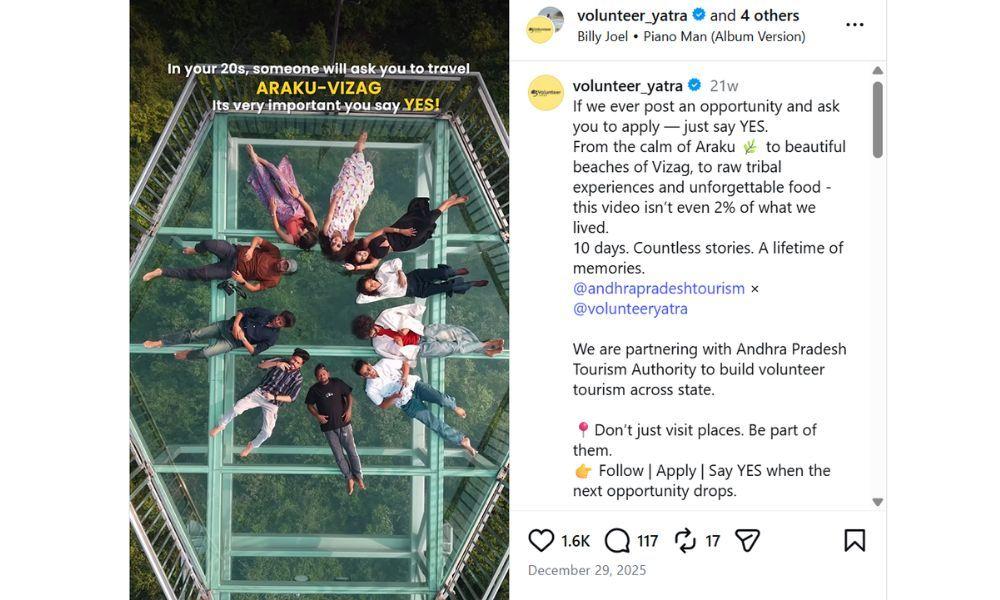
4. Andhra Pradesh Tourism, “Hidden Wonders”
The Andhra Pradesh Tourism Department, in partnership with Volunteer Yatra, ran the “Hidden Wonders” campaign across late 2025 and early 2026 to promote lesser-known destinations in the state.
The campaign worked in phases.
Phase one ran from December 13 to 20, 2025, with eleven influencers from across India touring Visakhapatnam, Araku Valley, and Lambasingi, producing 80 to 100 cinematic travel videos, drone shots, and reels that reached over four million viewers.
Phase two coincided with Sankranti celebrations in Konaseema in January 2026, where additional creators produced 30 reels generating nearly five million views.
Eleven key videos from the campaign have together passed nine million views, and the department has announced plans to expand the model across more destinations.
Takeaway: mid-tier regional creators with audiences in the right domestic market can put low-awareness destinations on the map faster than a single high-budget campaign with a global name.
Why Most Travel Brands Are Running This the Wrong Way
Most travel brands are still running influencer marketing as a gamble.
They either overpay for creator posts without the data to justify the spend, or they underpay and end up with content that does not perform.
The process of finding, vetting, briefing, contracting, and paying creators manually is slow, inconsistent, and full of risk. Anyone who has run a few campaigns knows this pain firsthand.
The shift happening across the industry is from influencer-first thinking to audience-first thinking.
The old approach starts with a big name and works forward.
The new approach starts with a clear definition of the ideal traveler and works backward to the creators whose audiences actually match that profile.
The creator with 500,000 followers might be a worse fit than the one with 25,000, because audience match beats audience size every time in a conversion-focused campaign.
The catch is that doing this manually, at scale, with reliable data, is what trips most brands up.
It is one thing to agree with the principle. It is another to operationalize it across dozens of creators, markets, and campaigns a year.
How does Hypefy approach it? Hypefy is built around this problem. The platform combines three pieces into a single workflow.
1. AI-Powered Brief. You describe your campaign in a prompt. Hypefy generates a complete brief with objectives, audience, content formats, deliverables, and approval flow. You can edit anything, but you start from a usable draft rather than a blank page.
2. Audience Matching. The AI engine finds creators whose followers actually match your ideal travel customer, not just creators who happen to post travel content. This is the audience-first principle applied at scale.
3. Auto-Management. Outreach, contracts, content approval, and payments all live in one place. No more chasing creators across DMs, email threads, and shared folders.
On top of these three, Smart Pricing picks up the fair-rate evaluation discussed earlier in the pricing section. Hypefy’s AI analyzes content performance and audience data to generate fair market rates before outreach, so you stop overpaying and stop getting quotes back that feel like guesses.
The outcome? More content, less risk, better results. Campaigns set up in minutes rather than weeks, with the data to back every decision along the way.
If you would rather have a team run the campaign for you, the Hypefy influencer marketing agency handles everything end-to-end. If you want to browse creators directly, the influencer marketplace is open to explore.
Travel Influencer Marketing FAQs
1) What is travel influencer marketing?
Travel influencer marketing is the practice of partnering with content creators on social platforms to promote destinations, hotels, airlines, tour operators, and travel products to their engaged audiences. It typically runs across Instagram, TikTok, and YouTube.
2) How does travel influencer marketing work?
A travel brand defines a campaign goal and target audience, identifies creators whose audience matches that profile, briefs them on objectives and deliverables, agrees on payment and content rights, manages content approval, and measures the resulting performance.
3) What is the difference between a travel blogger and a travel influencer?
A travel blogger primarily publishes long-form written content on a website. A travel influencer primarily publishes social content on platforms like Instagram, TikTok, and YouTube. Many creators are both, but the platform mix and content format differ.
4) How do I find travel influencers for my brand?
Start by defining your ideal traveler, then use an influencer marketing platform to filter creators by niche, audience demographics, engagement quality, and prior travel work. Manual searches on Instagram and TikTok work for small campaigns but become impractical at scale.
5) How much do travel influencers charge per post?
Pricing depends on tier, platform, and content format. Nano creators typically charge $50 to $500 per post, micro creators $250 to $2,500, macro creators $2,500 to $15,000, and mega creators $15,000 and up. Reels and YouTube videos tend to sit at the higher end of each band.
6) Do travel influencers get paid or just receive free trips?
Both, depending on the deal. Nano and some micro creators will accept gifted-only deals for destinations they would visit anyway. Most macro and mega creators expect a fee on top of gifted travel, especially when content rights are part of the agreement.
7) What platforms are best for travel influencer marketing?
Instagram remains the workhorse for travel content, with Reels driving most reach. TikTok is the fastest-growing platform for travel research, especially among audiences under-35. YouTube dominates long-form travel content and high-consideration purchases.
8) How do I measure the ROI of a travel influencer campaign?
Combine direct metrics like trackable bookings, code redemptions, and link clicks with secondary metrics like reach, engagement, branded search lift, and earned media value. Account for the value of content assets produced, which often outweighs the posting fee on its own.
9) What is the best type of travel influencer for a hotel?
For most hotels, a cohort of 5 to 15 micro-influencers in the relevant travel niche outperforms a single macro-influencer deal on content volume, engagement, and conversion. Luxury properties may add one or two macro creators for hero content.
10) How many followers does a travel influencer need to be effective?
Effectiveness is about audience match and engagement, not raw follower count. A nano creator with 5,000 highly engaged followers in your target market can outperform a macro creator with 500,000 followers across mismatched geographies.
11) What should a travel influencer brief include?
Objectives, target audience, key messages, brand non-negotiables, content formats and deliverables, posting schedule, content rights, approval process, and payment terms. One page is usually enough.
12) Is travel influencer marketing worth it for small tourism brands?
Yes, if you focus on nano and micro creators, accept that results compound over time, and build a content library you can reuse across paid social, email, and your website. Small brands often see better economics here than in paid search or display.
13) What’s the difference between a travel influencer marketing agency and a platform?
An agency runs campaigns for you with a human team, typically at a higher fee. A platform gives you the tools to run campaigns yourself, often with AI assistance, at lower cost and higher speed. Some brands use both, with platforms handling volume work and agencies handling flagship campaigns.
14) How do I avoid fake travel influencers?
Audit audience authenticity with a standard analysis tool before signing any contract. Check for sudden follower spikes, audience locations that do not match the creator’s content, generic comments, and engagement that looks bot-driven. If anything looks off, walk away.