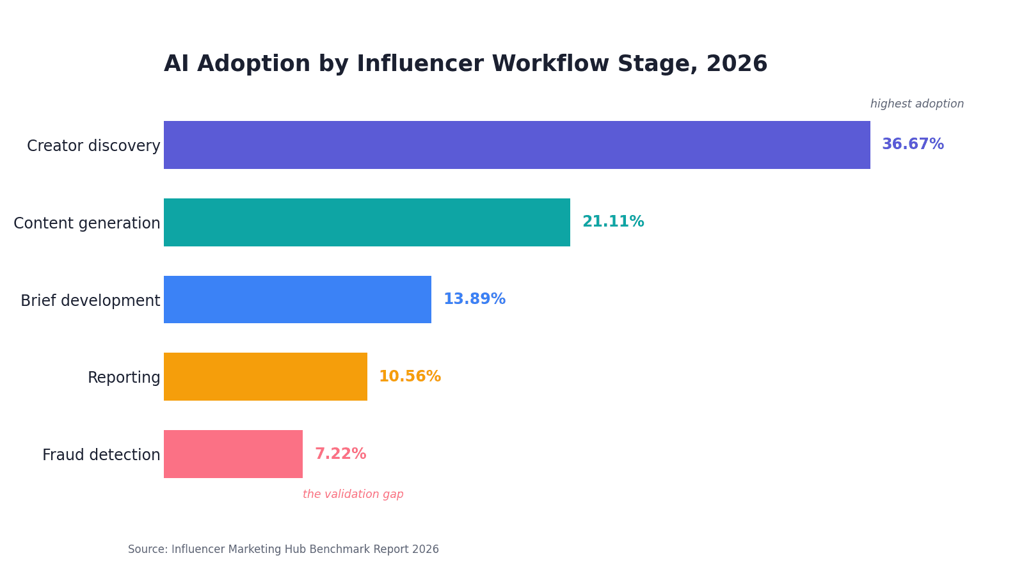
AI has moved from a feature bolted onto influencer platforms to the engine running entire campaigns. Creator discovery now leads to AI adoption at 36.67%, the highest of any workflow stage, and only 10.56% of marketers report no AI use in their influencer programs at all.
That is not a niche shift. Most of the industry is now running a workflow that looked completely different three years ago.
Before you decide where AI fits into your influencer strategy, it is worth understanding what it can and cannot do, and where the line between the two sits in 2026.
What Is AI Influencer Marketing?
AI influencer marketing is the use of artificial intelligence, machine learning, large language models, and agentic systems to automate or augment parts of the influencer marketing workflow.
It is a different category from AI-generated virtual influencers like Lil Miquela or Aitana López, which are AI-created personas that function as creators in their own right, not tools that help brands find or manage human creators.
In 2026, AI shows up in this workflow at three levels. Assistive AI helps a human complete a task faster; think of autocomplete for outreach messages. Generative AI produces content like briefs, reports, or content guidelines from a prompt.
Agentic AI executes multi-step tasks autonomously; discover, qualify, and brief, with human checkpoints at key decisions rather than full automation.
Most tools on the market today sit in the first two categories. The shift toward the third is what defines 2026.
Influencer Marketing in the AI Era: What Changed Between 2023 and 2026
The influencer marketing workflow looked nearly identical in 2015 and 2022: a brand finds a creator, briefs them, the creator posts, and the brand measures results.
Each step was manual, and each step took time. Between 2023 and 2026, AI compressed most of that workflow from weeks to days, not by replacing steps but by removing manual labor from each step.
Discovery Moved From Manual Scrolling to AI-Led Matching
This is the biggest single shift in the entire workflow. Brands used to spend 10 to 20 hours per campaign scrolling Instagram and TikTok to build a shortlist of 20 to 30 creators.
AI now scores millions of creator profiles against a campaign brief in seconds, surfacing matches based on audience fit, engagement quality, niche alignment, and prior partnership history.
Many marketers now use AI specifically for influencer discovery, which has become the most adopted AI use case in the category for a simple reason: it was the most time-consuming manual task before AI existed.
Vetting Got Both Faster and Harder
Vetting is now faster because AI can flag fake followers, engagement pod activity, and audience geography mismatches in seconds rather than the 30 to 60 minutes a manual check used to take. Harder, because creators and bad actors now use AI too.
AI-generated comments, artificially inflated engagement, and AI-edited audience demographics are problems that did not exist at scale in 2022.
Despite this, just 7.22% of marketing teams currently apply AI to fraud detection, the lowest adoption rate of any workflow stage. Vetting has become a back-and-forth between AI tools rather than a one-time check, and most teams have not caught up to that reality yet.
Brief Generation Moved From Blank-Page Work to Template Plus Edit
Generative AI now drafts campaign briefs in under a minute based on the goal, product, target audience, and the creator’s profile.
The human still owns the final brief, but the starting point is no longer an empty document.
Content generation has become a mainstream AI use case, with brief development close behind, reflecting how much of the creative groundwork has shifted from drafting to editing.
Reporting Compressed From Days to Minutes
Pulling content, screenshots, engagement metrics, and cost math into a campaign report used to take a junior marketer a full day per campaign.
AI now does the same thing in minutes by reading platform APIs and structuring the output automatically.
This is the stage where time savings compound hardest across a full year of campaigns, because reporting happens after every single one. Yet only 10.56% of teams have adopted AI here, which makes reporting the clearest gap between where the savings are and where the tooling has actually landed.
Agentic AI Is Starting to Handle Multi-Step Campaign Legs
The 2026 inflection point. Instead of AI helping a human complete one task faster, agentic platforms now execute sequences: discover, qualify, outreach, follow up, and contract, with humans approving at checkpoints rather than performing each step manually.
This is the structural shift that separates 2026 tools from 2023 tools, and it is the direction the entire category is moving.
AI Use Cases in Influencer Marketing
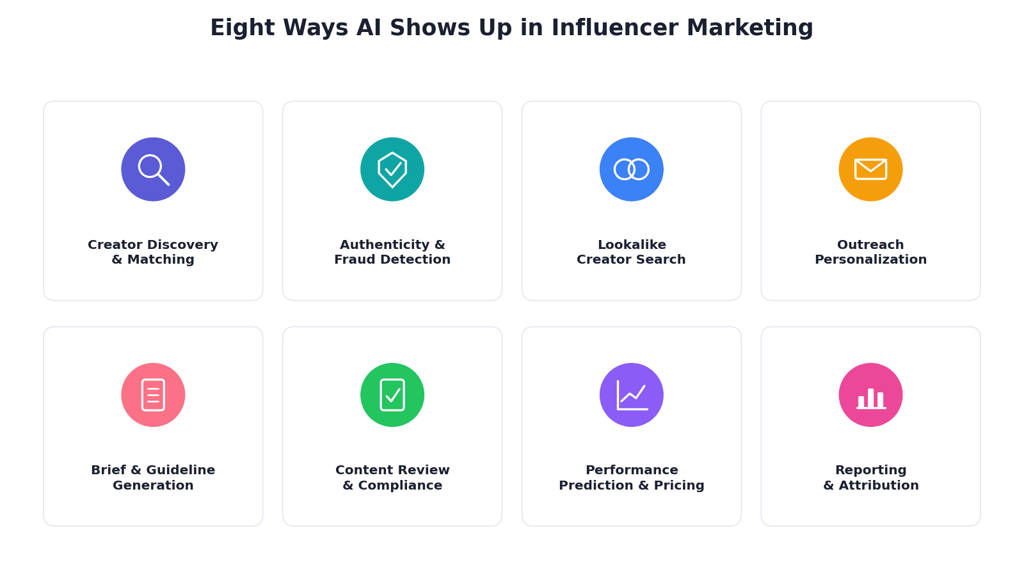
AI shows up in influencer marketing in eight specific places in 2026.
Being clear about which is which matters because a tool that does one of these well rarely does all eight, and buying a discovery tool expecting reporting automation, or vice versa, is a common source of disappointment.
Creator Discovery and Matching
AI scans millions of creator profiles, scores them against a brief, and returns ranked shortlists in seconds.
The strongest implementations score on engagement quality, audience authenticity, niche alignment, and lookalike-to-prior success, not just keyword matching against bio text.
Audience Authenticity and Fraud Detection
AI checks follower-to-engagement ratios, comment quality patterns, audience geography, and engagement velocity to flag fake followers, engagement pods, and bought metrics.
This is the layer that catches what a manual review would miss, particularly as fraud tactics themselves become AI-assisted.
Lookalike Creator Search
After a campaign delivers, AI finds creators with similar audience overlap, content style, and engagement patterns to the ones that performed.
Lookalike search is the highest-ROI discovery method once a brand has at least one successful campaign on record because it works backward from a proven result rather than forward from a hypothesis.
Outreach Personalization and Follow-Up
Generative AI drafts personalized first-message outreach using creator-specific data: recent posts, niche, and prior brand partnerships, then handles follow-up sequences automatically.
The brand approves the message before it goes out. The AI handles typing, timing, and persistence.
Brief and Content Guideline Generation
LLMs draft campaign briefs from a brand profile and a campaign goal in under a minute. Human edits sharpen the voice – the AI handles the structure.
The same applies to content guidelines, disclosure requirements, and creative direction documents.
Content Review and Compliance Checks
AI reviews submitted creator content against brand guidelines, disclosure requirements, and brand safety flags.
It catches missing #ad tags, off-brand language, or competitor mentions before a human reviewer ever opens the post.
Performance Prediction and Pricing
AI models predict expected reach, engagement, and conversion for a given creator before the campaign launches, and benchmark creator rate cards against the market.
Useful for budget planning before a campaign starts and for negotiation once a creator’s rate card is on the table.
Teams mapping spend before launch can start with Hypefy’s marketing budget calculator.
Reporting and Attribution
AI pulls performance data, structures it across the three measurement layers, campaign, business, and brand, and generates reports automatically.
This is where time savings add up, especially if you run a lot of campaigns in a year, because every campaign needs this step.
The workflow changed. The platforms that power it should too. Hypefy is built on every shift described above.
Who Should Use AI for Influencer Marketing?
AI for influencer marketing is not one-size-fits-all. The value depends on team size, campaign volume, and how much of the current workflow still lives in spreadsheets.
Mid-Size Brands Running 5+ Campaigns Per Year
The clearest fit. With five or more campaigns annually, manual workflows start breaking down.
Discovery takes too long, tracking across campaigns gets messy, and reporting eats up the time the team does not have left.
AI pays back the fastest at this volume because the same manual cost is incurred in every campaign.
Retailers and Distributors Managing Multiple Brands
If a marketing team runs influencer campaigns for several brands under one roof, AI becomes close to essential.
Multi-brand coordination in spreadsheets does not scale past two or three brands without losing data or dropping campaigns entirely.
Brands Expanding Across Multiple Markets
This is where AI values compounds hardest.
Localizing briefs, finding region-specific creators, translating outreach, and tracking results across countries in spreadsheets is effectively a part-time job per market.
AI collapses that into a single workflow.
Marketing Agencies Serving Multiple Clients
Agencies running influencer marketing for clients are a strong fit because workflow repetition is high, and time savings translate directly into margin.
The same logic applies to full-service agencies adding influencer marketing as a new service line.
Brands New to Influencer Marketing
Less obvious, but genuinely useful. AI lowers the skill floor. A marketer running their first campaign can produce a vetted shortlist and a sound brief in an afternoon, rather than needing a senior influencer marketer to do it manually from scratch.
Real Example of AI in Influencer Marketing
The easiest way to understand what AI actually does in this space is to look at real campaigns rather than feature lists.
The example below covers discovery, vetting and full campaign execution using Hypefy’s platform.
Jaffa Crvenka: New Product Launch Across Croatia
Jaffa, a CEE confectionery brand best known for its Jaffa Cakes, needed to launch a new product, Buttons, a bite-sized chocolate cookie with a peanut butter filling, and create genuine buzz around it on Instagram and TikTok.
The brand used Hypefy’s AI discovery to identify 16 creators whose audiences matched a 24-40 demographic across major Croatian cities, balancing reach across a 61/39 female-to-male split.
The campaign generated 1.8M reach and 2.6M impressions from 41 pieces of content. The best-performing single piece of content accounted for nearly 30% of the campaign’s total reach. Every KPI was exceeded.
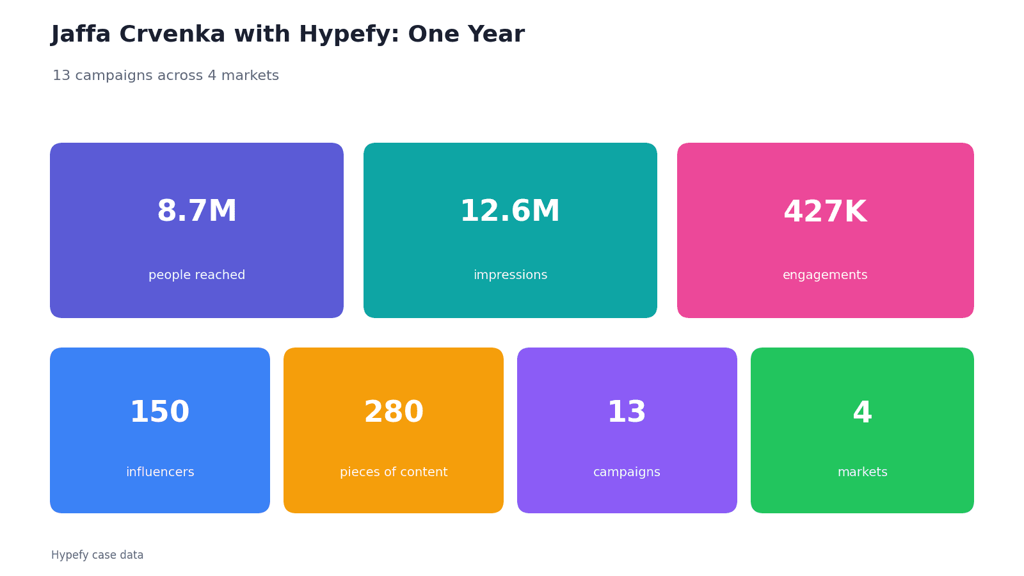
Over a full year across 13 campaigns and 4 markets, Jaffa reached 8.7M people and 150 influencers, generating 427K engagements and 12.6M impressions from 280 pieces of content.
Mina Gradić, Brand Manager at Jaffa Crvenka, put it directly: the platform matched influencers to the brand better than their previous selection process had, the process was faster, and the end content exceeded targets.
That is the operational case for AI-led discovery within a single campaign.
Advantages and Limitations of AI in Influencer Marketing
AI in this space delivers real, measurable advantages. The limits matter just as much as the wins, and brands that ignore them end up with campaigns that look efficient on paper but underperform in the market.
Where AI Wins
- Discovery time drops from days to minutes. What took 10 to 20 hours of manual scrolling now produces a ranked, scored shortlist before the coffee gets cold.
- Fraud detection catches what manual review misses. Follower-to-engagement ratio anomalies, comment pattern irregularities, and geography mismatches surface automatically rather than requiring a researcher to notice them.
- Lookalike search compounds value across campaigns. Each successful campaign makes the next one’s discovery faster and more accurate, which manual research never did.
- Multimarket coordination becomes practical instead of impossible. Translation, localization, and parallel tracking across countries no longer require a dedicated person per market.
- Reporting time drops by 80-90%. A task that used to take a full day per campaign now takes minutes, and the output is more consistent than manually assembled reports.
- The skill floor for running a competent first campaign falls significantly. A marketer with no prior influencer experience can produce a defensible shortlist and brief without years of accumulated judgment.
Where AI Still Falls Short
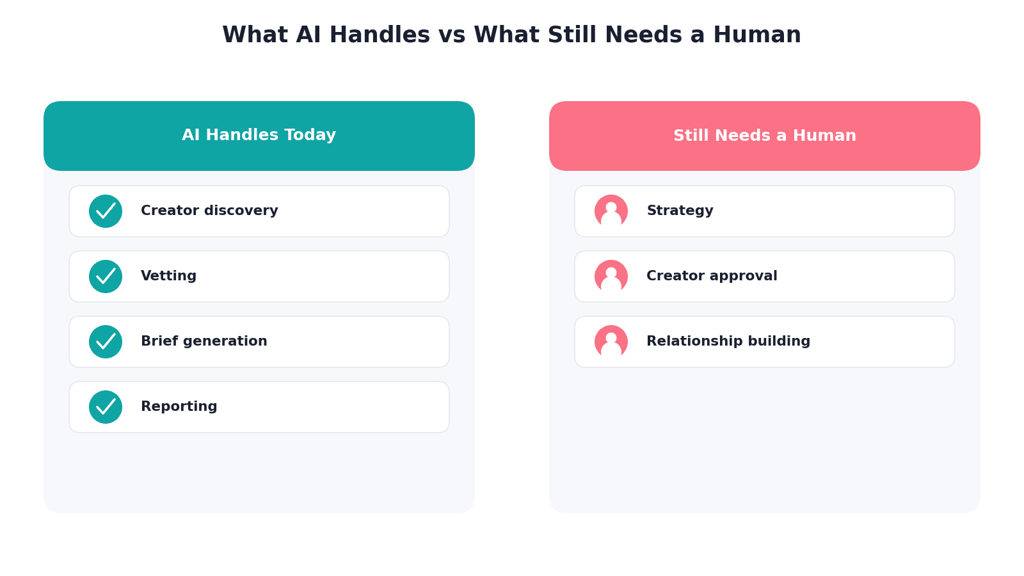
- AI does not build creator relationships. The trust that makes a creator push harder for a brand or recommend it to other creators is still human work.
- Brand voice and creative direction still need a human eye. AI-generated briefs need editing to sound like the brand rather than like a generic template.
- AI can match patterns from past campaigns, but cannot invent a campaign concept from scratch. Creative strategy is still a human function.
- AI scoring is only as good as the data it is trained on. Smaller or less-documented markets, including much of CEE, benefit disproportionately from platforms with genuine regional coverage rather than global averages.
- Generated briefs still need a review pass before they go out. Treating AI output as final rather than a draft is where quality drops off.
- AI does not replace strategic judgment about which campaigns to run in the first place. It can execute a plan faster. It cannot decide whether the plan is the right one.
How to Implement AI Influencer Marketing Successfully
Adoption goes wrong in predictable ways. A brand buys a tool, drops it into the existing workflow with no process changes, and concludes that AI does not work.
The framework below is how to avoid that outcome.
Start With the Part of the Workflow That Hurts Most
Do not try to AI-ify the whole pipeline at once. Pick the slowest, most painful part, usually discovery or reporting, and replace it first.
A clear win in one stage builds the internal credibility needed to expand AI use into other parts of the workflow.
Pick a Platform That Fits Your Campaign Volume
Single-feature AI tools fit teams running a handful of campaigns a year. Full-platform agentic systems fit teams running monthly or multimarket campaigns.
Buying the wrong tier wastes money in both directions: overpaying for capability that goes unused, or underbuying a tool that cannot keep pace with volume.
Keep Humans on Strategy and Creator Approval
The teams that get this right keep humans in the decisions that affect brand voice and creator relationships and let AI handle the repetitive operational work underneath those decisions.
The teams that get it wrong let AI make creative or relationship calls and watch trust erode, both internally and with creators.
Train Your Team on AI-Augmented Workflows, Not Just Tools
The tool is not the implementation. The workflow is.
Build documented playbooks for how the team uses AI at each step, what the approval checkpoints are, and what gets escalated to a human.
Without that documentation, AI usage varies by person, and quality varies by accident.
Measure the Right Outcome: Campaign Quality, Not Just Time Saved
Most teams measure AI success by time saved. That is necessary but not sufficient.
The bigger metric is whether campaign performance improves over time as the AI learns from each campaign’s results.
If performance is flat while time savings are real, the AI is saving labor without compounding value, and that gap is worth investigating.
Trends to Watch in AI Influencer Marketing
The AI influencer marketing space is moving fast, and the 2026 trends are not the same as the 2024 trends.
The five below have the most impact on how brands will run campaigns 12 months from now.
Agentic AI Taking Over Multi-Step Campaign Legs
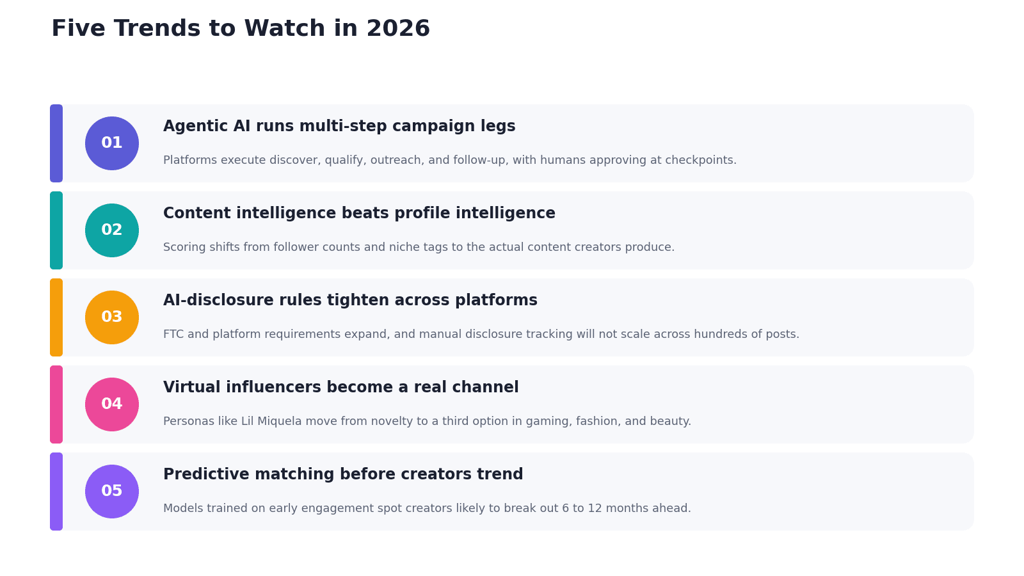
The biggest shift. Instead of AI assisting a human at one step, agentic platforms now execute multi-step sequences, discover, qualify, brief, outreach, and follow up, with humans approving at checkpoints.
This is the trend Hypefy is built on and the direction the entire category is moving.
Content Intelligence Beating Profile Intelligence
Most AI tools today analyze creator metadata, such as follower count, engagement rate, and niche tags.
The 2026 edge is analyzing the actual video and image content creators produce, tone, hooks, product positioning, and comment patterns.
Brands that score creators on content fit will consistently out-pick brands scoring on profile fit alone.
AI-Disclosure Rules Tightening Across Major Platforms
Regulators are tightening disclosure requirements for AI-involved content.
Paid sponsorships and AI-generated content must both be clearly and conspicuously disclosed under current FTC guidance, and expect that standard to extend further across Instagram, TikTok, and Meta properties through 2026.
Brands will need tracking systems that ensure creator compliance across hundreds of posts. Manual tracking will not survive this at scale.
AI-Generated Virtual Influencers Becoming a Real Channel
Virtual influencers like Lil Miquela and Aitana López are moving from novelty to a third option alongside human creators.
Still niche in 2026, but worth watching for categories where a consistent, always-on brand ambassador makes sense: gaming, fashion, and beauty.
Predictive Matching Before Creators Trend
The most ambitious capability in development. AI models trained on early engagement patterns can identify creators likely to break out 6 to 12 months before they trend.
Brands that book these creators lock in early, lower rates and longer relationships before demand catches up. Still experimental, but it’s the direction the leading platforms are heading.
The Hypefy Difference: Agentic AI for the Brands That Run Real Campaigns
Hypefy is built as an agentic AI platform for brands that already run influencer marketing seriously, retailers, distributors, and established consumer brands across CEE, not for crypto projects, affiliate programs, or pure SaaS marketing plays.
The platform searches creators globally on Instagram and TikTok, not just those who joined a marketplace, and scores them on engagement quality and audience authenticity rather than follower count alone.
It runs across multiple markets at once with built-in translation and handles discovery, outreach, contracts, content review, payments, and reporting in one place. Hypefy works on the influencer budget brands already have. There is no separate SaaS line sitting on top of the campaign spend.
AI Influencer Marketing FAQs
The use of AI and agentic systems to automate parts of the influencer workflow: discovery, vetting, briefing, outreach, and reporting. Not to be confused with AI-generated virtual influencers, which are a creator category, not a tool category.
AI tools help brands find and manage human creators. Virtual influencers like Lil Miquela or Aitana López are themselves the creators, AI-generated personas that post content and sign brand deals.
No. AI handles the operational layer. Strategy, creator relationships, brand voice, and final approvals still need a human.
Depends on volume. Single-feature discovery tools work for a few campaigns a year. Full agentic platforms fit teams running monthly or multi-market campaigns. The category matters more than the brand name.
Hypefy is built specifically for that tier: AI-led discovery, automated outreach, contracts, content review, payments, and reporting in one place, with no subscription on top of campaign spend.
It scores millions of creator profiles against a brief, evaluating audience fit, engagement quality, and authenticity, then returns a ranked shortlist in seconds.
Most of the coordination work, the scrolling, screenshotting, and report assembly, compresses to a fraction of the manual time. Strategy work sees little change, because it was never the bottleneck.
Yes. For small brands, the value is a lower skill floor: a first campaign can be run without years of accumulated experience. At 5+ campaigns a year, the value shifts to time savings.