Enterprises now earn between $5.20 and $5.78 for every dollar they put into influencer marketing, and the best programs return $11 to $18. The channel has made its own case, and budgets are following.
The operating model, however, hasn’t kept up.
The tools built for a single DTC brand in a single market can’t answer what enterprise CMOs and CFOs are now asking: how to standardize brand safety across 12 markets, roll four brands up into one board-level report, or run 300 creator campaigns a year without tripling headcount.
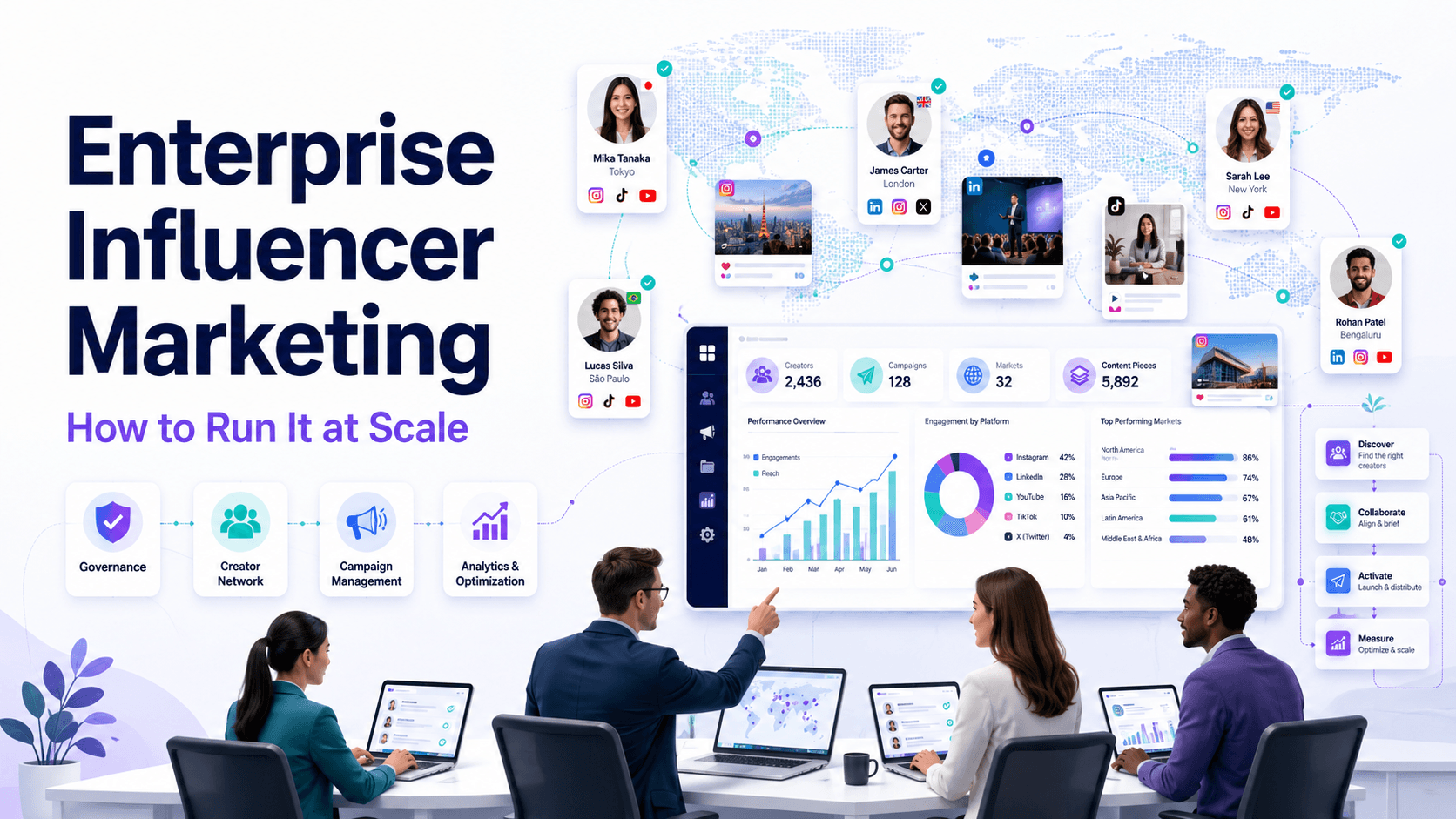
This guide covers what makes enterprise influencer marketing different from the regular kind, the three available execution models and where each breaks down, and what a platform needs before it earns the enterprise label.
Why Enterprise Brands Are Doubling Down on Influencer Marketing in 2026
The returns settled the budget argument. The more useful question for an enterprise is what changed underneath them, because no one reorganizes a channel around a single ROI number.
Three shifts moved influencer marketing from a social-team experiment into the same budget conversation as paid social, retail media, and traditional advertising.
The data finally became enterprise-grade, the cost of waiting became visible, and AI made operational scale affordable.
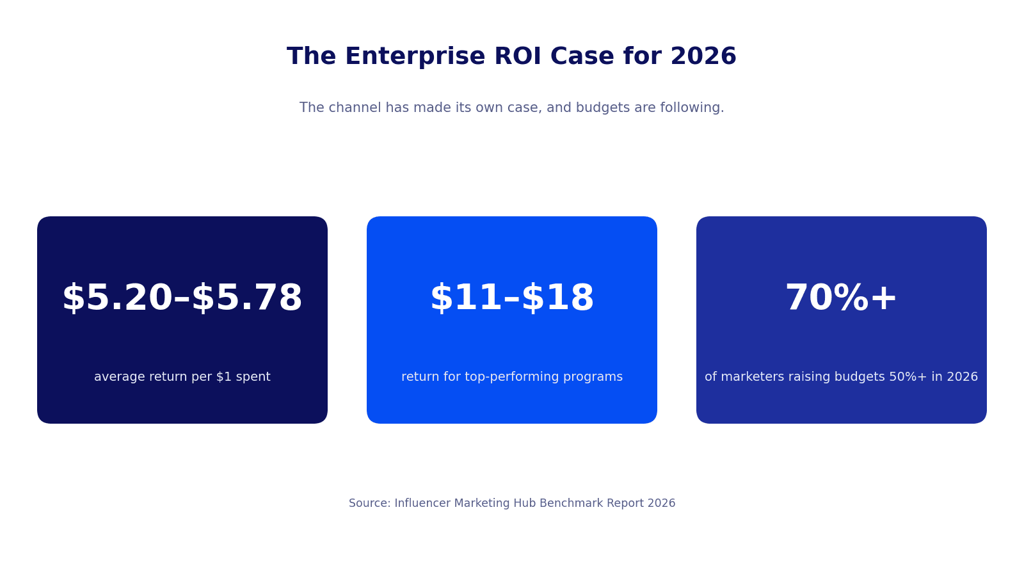
See what top-tier ROI actually looks like with the ROI calculator.
The Channel Finally Produces Enterprise-Grade Data
Attribution, brand lift, audience overlap with paid media, and creator-specific revenue tracking are real now. Many brands now track influencer-driven sales directly, a meaningful increase from prior years.
CFOs and CMOs can finally discuss influencer marketing using the same vocabulary they use for the rest of the marketing mix, which is what moved it from a line item the marketing team defended to one finance actively wants to understand.
Mid-Market Competitors Are Pulling Ahead
The brands punching above their weight in 2026 are the ones running structured influencer programs while enterprise competitors are still treating the channel as an experiment.
Only 5.55% of marketers expect to cut influencer budgets in 2026, indicating the competitive gap between structured and ad-hoc programs is widening each quarter.
Enterprises that wait another 18 months are watching share move to smaller brands with better creator strategies.
AI Made Operational Scale Finally Possible
Until recently, the operational overhead of running influencer marketing at enterprise scale ate the ROI.
Discovery, vetting, contracts, content review, and reporting across hundreds of creators a year required a headcount most enterprises would not approve.
AI collapsed that overhead enough that influencer marketing started paying back at scale. The cost structure changed; the program became viable at volumes that were previously just aspirational.
What Makes Enterprise Influencer Marketing Different
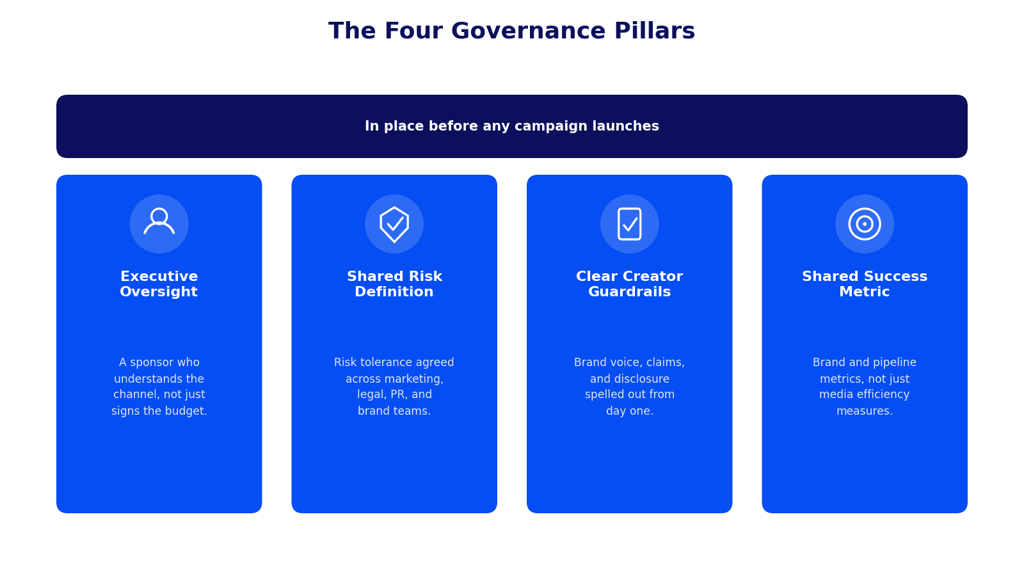
The difference between enterprise influencer marketing and regular influencer marketing is not the budget. The four governance pillars must be in place before any campaign launches.
Enterprises that skip any of them end up with campaigns that look efficient on paper and create brand or compliance problems later.
1. Executive Oversight and Real Buy-In
The channel needs an executive sponsor who understands how it works, not just one who signs the budget.
Without senior buy-in, the first brand-safety incident or negative press cycle involving a creator becomes a reason to pull back the entire program.
With it, those incidents become normal operational events that get handled rather than escalated.
Real buy-in shows up in three places: the CMO understanding the creator selection criteria, legal being looped in early on contracts, and PR having a playbook for creator-related issues before they happen rather than after.
2. A Shared Definition of Acceptable Risk
Risk tolerance has to be defined upfront and shared across marketing, legal, PR, and brand teams.
What is acceptable for a beauty brand is not acceptable for a pharma brand. What works for a regional campaign does not work for a global one.
Enterprise programs that do not define risk tolerance early end up with creator selection processes that grind to a halt because every choice triggers internal debate.
Define the risk envelope once and creator decisions become operational instead of political.
3 .Clear Guardrails for Creators From the Start
Guardrails are not constraints. They are the difference between creators who deliver and creators who go off-brief.
Brand voice limits, claims that can and cannot be made, products that cannot be promoted alongside competitors, content that requires legal review, disclosure requirements per market.
Spell these out in the brief and the contract. Creators respect guardrails when they are clear and consistent from day one. They resent guardrails that appear mid-campaign as new feedback.
4. A Shared Definition of Success
Most enterprise marketing teams default to media efficiency metrics, CPM, CPE, cost per view, because that is the vocabulary the rest of the organization speaks.
For influencer marketing specifically, leading with media efficiency understates the channel. The real success metrics are brand-level (branded search lift, sentiment, repeat purchase) and pipeline-level (creator-attributed conversion, CRM tagging).
With the success definition agreed up front, the finance conversation becomes a partnership rather than a budget defense.
Agency, In-House, or Platform: Choosing the Right Enterprise Model
Every enterprise running influencer marketing is choosing between three execution models, and most are choosing badly.
The right model depends on campaign volume, multi-market complexity, data ownership requirements, and the extent of creative direction the brand needs to keep in-house.
Hiring an Influencer Marketing Agency
Agencies bring senior strategic counsel, established creator relationships, and the ability to handle creative campaigns end-to-end without internal headcount.
The tradeoffs are real: fixed retainers, less visibility into creator fees, longer turnaround, and limited data ownership. The brand sees the report at the end. The raw data and the creator relationships usually stay with the service provider.
Agencies still win for one-off tentpole campaigns, high-touch celebrity work, and brands that need senior strategic firepower they lack in-house.
They lose for ongoing, multi-market, multi-brand execution where the operational overhead they charge for becomes the largest line item in the campaign budget.
Building an In-House Influencer Marketing Team
In-house teams give brands full data ownership, direct creator relationships, brand voice consistency, and institutional knowledge that compounds across campaigns. The tradeoffs are headcount cost and scaling friction.
A team of two can run a strong program for one brand in one market. The same team trying to cover three brands across five markets becomes a bottleneck within a quarter.
In-house wins for single-brand enterprises in mature markets with deep creator pools. It loses out in multi-brand or multi-market operations, where the headcount math stops working before the program reaches the scale the business needs.
Running on an Enterprise Influencer Marketing Platform
Platforms collapse operational overhead, discovery, outreach, contracts, content review, payments, and reporting into a single system that the brand owns and operates.
The tradeoff enterprise buyers care about is real. A platform does not replace senior strategic counsel, and a platform without the right governance features does not replace agency-level brand safety either.
The platforms that work for enterprise are the ones built for multi-brand and multi-market complexity from the start, with AI-led discovery, automated compliance, and executive-grade reporting.
Platforms win on scale, data ownership, multi-market coordination, and cost predictability. They lose on senior creative direction, which still benefits from a human with category expertise.
The Hybrid Model
In practice, most enterprises do not pick one of the three.
They end up with a hybrid: a platform for ongoing execution and data ownership, an in-house team for strategy and brand-voice oversight, and agency relationships for one or two tentpole campaigns a year where senior creative direction matters most.
This is the model that scales without overpaying for any single component. The brands that structure this hybrid deliberately outperform the ones that arrived at it by accident.
What an Enterprise Influencer Marketing Platform Should Include
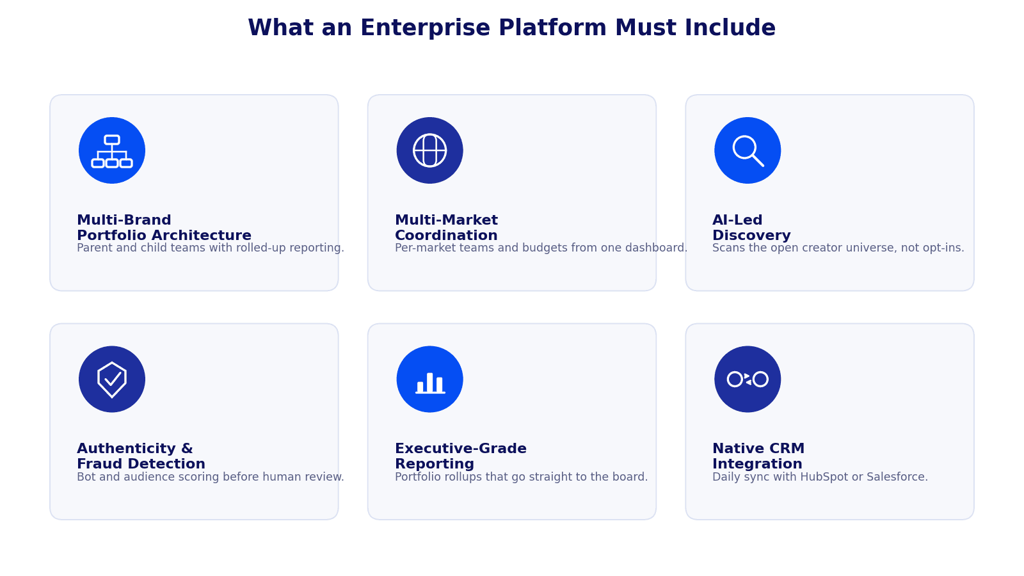
“Enterprise platform” is a label that half of the influencer software industry applies to mid-market tools with higher price points. Real enterprise capability shows up in six specific features.
A platform that lacks any of them creates an operational or governance gap that leads to enterprise programs being paused after the first incident.
Multi-Brand Portfolio Architecture
A real enterprise platform handles multi-brand and multi-business-unit complexity at the data model level, not as a workaround.
That means a parent organization with multiple child teams, one per brand, market, or business unit, each running its own campaigns, with rolled-up reporting at the parent level.
Without this architecture, every brand ends up on its own platform instance and the consolidated portfolio view that procurement and finance actually need never exists.
Multi-Market Coordination From One Dashboard
Global and regional enterprises run campaigns across multiple countries, languages, and creator pools.
The platform has to handle per-market teams, budgets, and reporting, and support creator discovery across all relevant geographies, all coordinated from one account.
Tools designed for single-market brands force enterprises to use a separate instance per country, which eliminates the rollup view that made the platform attractive in the first place.
AI-Led Discovery Across the Open Creator Landscape
The discovery layer matters more for enterprises than for mid-market companies because the creator pool is larger and filtering is more complex.
Platforms that rely on creators opting in show enterprise buyers only a small fraction of the creator pool that actually exists. Platforms that scan the open creator universe with AI surface the full set. For the enterprise, only the second one is viable.
Audience Authenticity Scoring and Fraud Detection at Scale
Manual brand safety at enterprise scale is not actually possible. The platform has to do it.
That means AI-scored audience authenticity for every creator, bot detection running by default, fraud-signal flagging, and audience-match scoring against the brand’s ICP before a human reviewer ever sees a shortlist.
Enterprises running campaigns with hundreds of creators per year cannot afford a manual vetting layer. The platform handling this is what makes scale possible without scaling headcount.
Executive-Grade Reporting With Portfolio Rollups
Reports that aggregate across brands, markets, and time periods, with the ability to drill down to single-campaign or single-creator performance.
The most useful platforms show annualized spending at both the team and parent-organization levels, automatically segment performance, and export reports that marketing leadership can take to a board meeting without reformatting.
Real-time dashboards are table stakes. The rollup view is what separates enterprise platforms from mid-market ones.
Native CRM Integration
This is where most influencer platforms quietly fail. Real enterprise capability includes a daily sync between the influencer platform and the brand’s CRM, whether that is HubSpot or Salesforce, covering campaigns, contacts, spending, and status changes, so influencer marketing data does not live in a silo.
Without CRM integration, influencer campaign data cannot be evaluated against the rest of the marketing mix, attributed to the pipeline, or reviewed alongside paid social in the same QBR.
The platforms that win enterprise deals are the ones that show up natively in the systems the rest of the marketing organization already uses.
How to Scale Influencer Marketing Enterprise-Wide
Scaling from one or two campaigns a quarter to a continuous, multi-brand, multi-market program is a structural shift, not a budget increase.
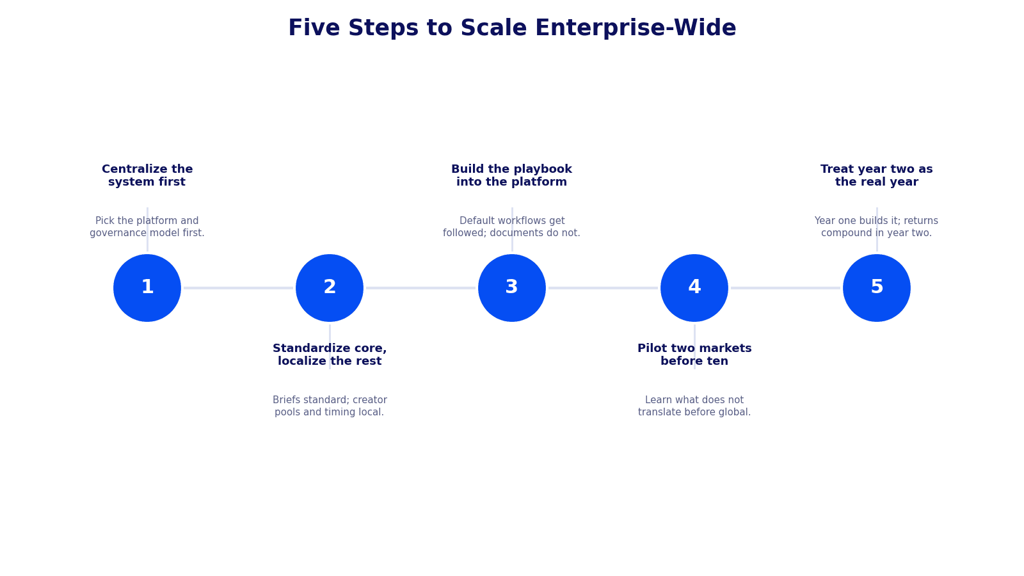
The five steps below show how enterprises that have done this successfully have scaled without breaking the program in the process.
Centralize the Operating System Before Centralizing the Campaigns
Most enterprises try to centralize creator campaigns before they have centralized the system that runs them. That is backwards.
Pick the platform, define the governance model, train the team on the workflow, and then move existing campaigns onto the system. Trying to do both at once is how programs stall for six months while the team works around itself.
Model your rollout budget across markets with the marketing budget calculator
Standardize What Should Be Standard, Localize What Should Not
Briefs, contracts, approval workflows, compliance language, and reporting templates standardize across the organization.
Creator pools, content style, and campaign timing localize per market. Enterprises that try to standardize everything kill local relevance.
Enterprises that localize everything lose efficiency. The line between the two has to be drawn explicitly before the program goes live.
Build the Playbook in the Platform, Not in a Document
Operating playbooks living in shared documents go stale within a quarter and do not get followed at scale.
Playbooks built into the platform, as default workflows, default briefs, and default approval steps, get followed because they are how the system works, not because someone remembers to read a document last updated eight months ago.
Run the Same Campaign in Two Markets Before Running It in Ten
The instinct at enterprise scale is to launch globally on day one. The instinct that produces better outcomes is to pilot in two markets, learn what does not translate, and only then expand.
A two-market pilot costs almost nothing extra and protects the brand from the kind of multi-market mistake that becomes a board-level conversation.
Treat the Second Year as the Real Year
The first year of an enterprise influencer marketing program is the build year: system, governance, creator pool, internal alignment.
The compounding returns show up in year two and beyond, when the platform has data on which creators worked, the team has a playbook that holds across campaigns, and the program produces consistent results instead of one-off wins.
Enterprises that evaluate the program after year one and pull back miss the actual payoff.
The Brands With Prebuilt Systems Are the Ones Winning
Across every category, retail, FMCG, beauty, and consumer electronics, the enterprises pulling ahead in 2026 share one structural advantage.
They have built an operating system for influencer marketing, not just a list of creators and a budget. The brands still running ad-hoc campaigns at the same budget level are losing share to them quarter over quarter.
A System Means the Same Campaign Type Can Run Anywhere
When the brief structure, approval workflow, contract template, and reporting schema are all standardized, the same campaign type can launch in a new market in days instead of weeks.
The local team is not reinventing the operational layer. They are plugging local creators into a system that already works.
A System Compounds Learnings Across Campaigns
Every campaign that runs through a real system contributes data: which creators worked, which content formats converted, which messages landed.
Over 12 months, that data becomes a model. Brands without a system run their hundredth campaign with the same uncertainty they ran their first.
A System Makes the Channel Defensible Internally
When influencer marketing has a documented system with clear metrics and an audit trail, it stops being the hardest-to-defend marketing channel in budget meetings.
Finance gets the reports they need. Legal gets the compliance trail they need. PR gets the brand safety controls they need. The channel goes from “the one we cannot measure” to “the one we measure best”.
Why Hypefy Works for Enterprise
Hypefy is built around the governance pillars and platform features above, not a mid-market tool repackaged for enterprise buyers.
The platform handles discovery, outreach, contracts, content review, payments, and reporting in one place, runs across multiple global markets simultaneously with built-in translation, and searches creators around the world on Instagram and TikTok rather than depending on who joined a marketplace.
It is used by enterprise retailers and established consumer brands worldwide, offering multi-brand and multi-location capabilities that single-market platforms cannot match.
Hypefy runs on the influencer budget the brand already has. No separate SaaS line on top of campaign spend.
Enterprise Influencer Marketing FAQs
What is enterprise influencer marketing?
Influencer marketing runs at the scale of a large organization: multiple brands, markets, and hundreds of creators per year, with governance, brand safety, and executive reporting on top of the campaign itself.
What’s the difference between enterprise influencer marketing and regular influencer marketing?
The difference lies in governance, multi-brand coordination, data ownership, and the reporting depth executives and finance teams actually require.
Should an enterprise hire an influencer marketing agency or use a platform? Often both. Agencies bring creative counsel for high-touch campaigns. Platforms like Hypefy handle ongoing execution at scale and are used by both brands and agencies running multimarket programs. The two work better together than in competition.
What features does an enterprise influencer marketing platform need?
Multi-brand architecture, multi-market coordination from one dashboard, AI-led discovery, audience authenticity scoring at scale, executive-grade rollup reporting, and native CRM integration.
How much does enterprise influencer marketing cost in 2026?
It varies widely by program scope, number of brands, and number of markets. The more useful number is cost per campaign outcome, which requires attribution infrastructure in place before the first campaign launches.
Can AI handle influencer marketing at enterprise scale?
The operational layer, yes: discovery, vetting, outreach, compliance, and reporting. Strategy, brand voice, and final approvals still need a human.
How long does it take to scale an enterprise influencer marketing program?
Year one is the build: system, governance, team, and creator pool. Compounding returns show up in year two. Enterprises that evaluate at 12 months and pull back are measuring the wrong year.