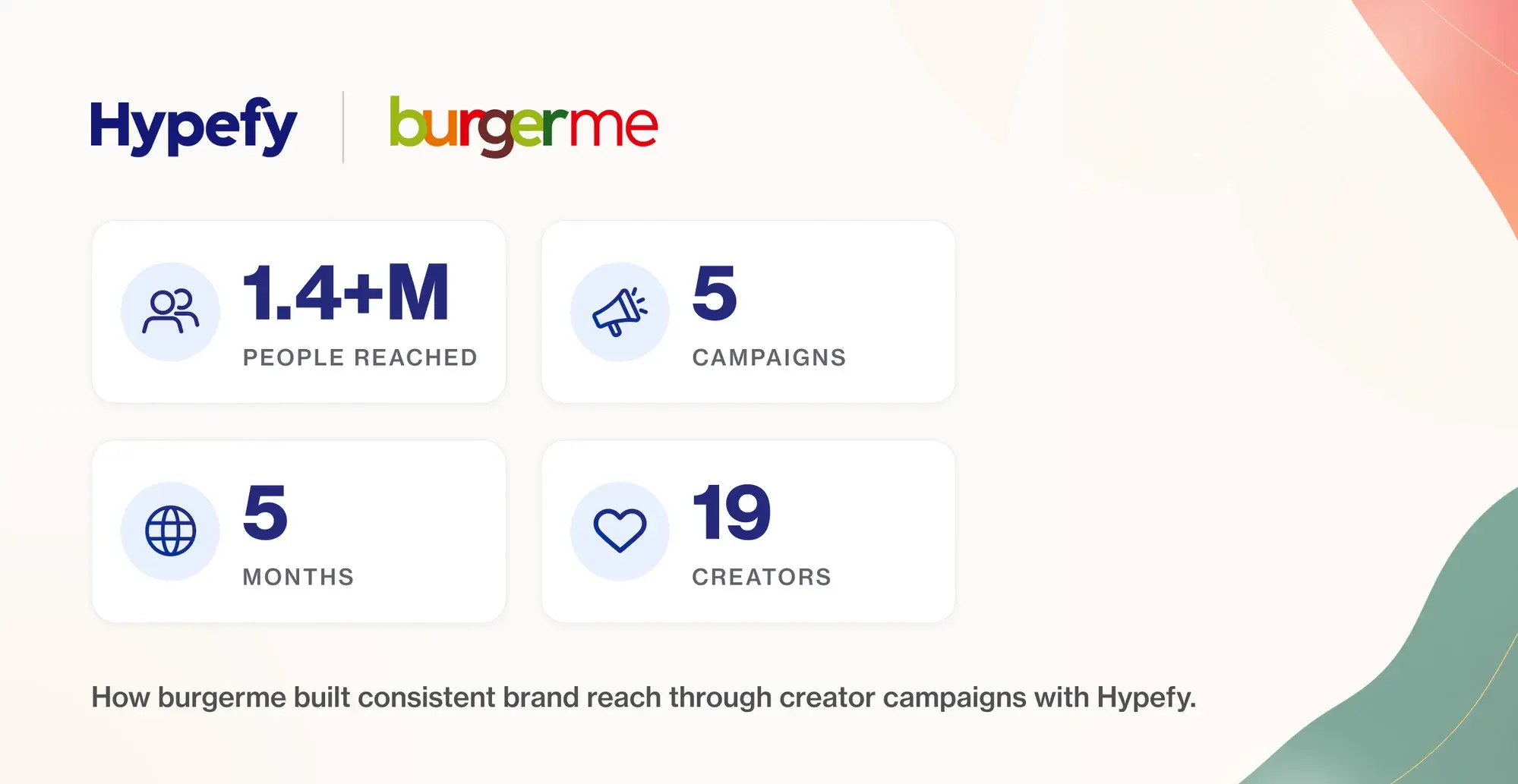
In five months, burgerme ran five influencer marketing campaigns with Hypefy, the AI-powered influencer marketing platform, and reached over 1.4 million people across Germany.
This is what happens when a brand stops playing favorites and decides every burger deserves the spotlight.
Key takeaways
Meet burgerme
burgerme makes crave-worthy burgers. The kitchens are delivery-only, the network is German, and the menu never sits still.
There's always a new chicken bundle, a surprise lunch deal, a meat-free masterpiece, a regional twist, or a premium burger with star power waiting in the wings.
That kind of menu is a marketing problem as much as it is a kitchen one.
There is always something new to tell people about, and never quite enough budget for a full influencer campaign behind every launch. And so, most of the menu goes out without a campaign, and the brand hopes the regulars are paying attention.
This keeps the lights on, but it doesn't bring any fresh faces to the party.
The Old Playbook: Cross Your Fingers and Pick a Favorite
Brands usually pick one hero, save up the whole budget, launch one blockbuster campaign a year, and hope the rest of the menu doesn't feel left out.
That's just math.
Retainers start the clock the minute you sign, and minimums make small briefs a non-starter. So, the lunch deal gets left behind, the regional special goes unnoticed, and the veggie burger debuts to crickets.
burgerme's menu has eleven products. The old playbook had room for one.
burgerme's Order: Five Campaigns, No Sides
burgerme decided to stop picking favorites.
When the veggie burger hit the menu, it got its own campaign.
When the countryside special rolled out, same deal.
And when the lunch deal popped up, a brief most brands would've tossed in the bin as too small to matter, burgerme gave it the spotlight anyway.
Every burger, every promo, every time, front and center.
Five products in five months, each one treated like it deserved to be there. Which, it turned out, it did.
None of the creators from one campaign showed up in the next. Each brought in a fresh crew of German food and lifestyle creators, custom-matched to the burger and the crowd who'd crave it most.
burgerme didn't pay to join Hypefy, to browse, nor to write a brief. The first invoice arrived when the first campaign launched. Between launches, the tab was closed. The next campaign started when the next product was ready.
Nineteen creators in total, 48 pieces of content, one platform. And because Hypefy negotiates at the scale of a thousand campaigns a year, the per-creator cost came out better than what burgerme would have paid going direct.
The Veggie Burger: The Underdog That Found Its Crowd
The Veggie Burger ran from mid-December into February, the longest stretch of the program.
Four creators, eight pieces of content, and a brief that was always going to be the trickiest one to get right.
A meat-free burger from a delivery-burger brand is a harder sell than it sounds. The people who already order burgerme regularly are, almost by definition, not the people this product is for.
You need the ones who opened the app, saw the veggie option, thought about it for a second, and closed it again. That's a different room entirely, and finding it without a platform doing the heavy lifting would have meant guessing at the right creators.
What the 2.37% engagement rate tells you is that the room got found.
The matching surfaced German creators whose audiences were already interested in meat-free food, not burgerme regulars being polite about a product they'd never order. The content landed with people who were in the market for it.
burgerme didn't need a roster of plant-curious creators on standby. It needed the right ones for this campaign, and then it needed to move on to the next brief.
The Countryside Burger: The One That Made Sure Everybody Saw It
The Countryside Aktionsburger ran from late January through February. Five creators, 13 pieces of content, and the biggest reach of the entire program.
A 1.35% engagement rate per reach is the number a brand points at and says “we can do better.” But this wasn't about getting a standing ovation. This campaign was about making sure no one missed the show.
This was a regional promotion with a short window and one job: make sure people in Germany knew it existed.
Not start a conversation about it, not build a community around it, not generate saves and shares. Just get it in front of as many eyes as possible before the window closed.
Half a million people saw the Countryside Aktionsburger on their feed who would have just kept scrolling otherwise.
Some campaigns are built to spark something, but this one was built to cover ground, and half a million people is a lot of ground.
The Cheesy Chicken Bundle: Served Hot, Gone Fast
The Cheesy Chicken Bundle launched in March 2026 with the most ambitious creator set of the program.
Five creators, 11 pieces of content, Reels doing the heavy lifting with story sets, and a TikTok piece filling in around the edges.
3.00% engagement per reach in the German food market. Right at the median for food campaigns on the platform, which sounds underwhelming until you remember that most brands running influencer campaigns in Germany never get close to it.
A 3.00% engagement rate means people didn't just see the Cheesy Chicken Bundle. They stopped for it, watched it, saved it, sent it to someone, and then probably opened the burgerme app. That's the way a purchase funnel is supposed to work.
The matching is why.
Anyone can find a German food creator with a decent following. Hypefy's matching found the ones whose audiences would care about this specific burger, on this specific week, at this specific price point. Those are not the same list.
Lunch Deals, the Side That Outperformed the Main
Nobody bets big on the humble lunch deal. It's the underdog of the menu.
It's too small, the window is too tight, and by the time a traditional onboarding process is finished, the promotion is already over.
That's why most brands skip it. The lunch deal goes live anyway, and the people who see it are the ones who were already going to order.
Three creators, eight pieces of content, and a 2.68% engagement rate that came in almost level with the Cheesy Chicken Bundle, which had five creators and considerably more fanfare.
It's a lunch deal, so nobody expected much, but that's usually how the best results happen.
The Big Angus Review: The Burger We Sent Back but Still Learned From
The Big Angus Burger Review campaign ran from early March through early May. Four creators, eight pieces of content, all of it review-led.
A 1.08% engagement rate is the number that makes a brand pause and ask what happened.
Here's what happened.
Review content is a different animal. People watch a review the way they read a menu, quietly and without making a fuss about it. They don't double-tap, they don't share it with their group chat, they just absorb it and move on. Story sets contributed impressions without engagements, which is what story sets do, and the numbers reflect that.
So, no, this wasn't a Cheesy Chicken Bundle moment. It was never going to be.
The Big Angus did exactly what a review campaign should. It informed rather than excited, reached rather than sparked, and put the product in front of 153k people who hadn't heard of it before.
It's the kind of campaign you only learn from by running it.
Why the Order Came Out Right
Three things made the whole run possible. The matching is the one that did the most work.
Big Followers vs. Right Followers
Most platforms can tell you who has a large following. Hypefy's AI matching tells you who has the right following for a specific product and a specific market.
For the Veggie Burger, that meant German creators whose audiences had already shown they engage with meat-free content, not just any food creator with a big follower count.
For the Cheesy Chicken Bundle, it meant mainstream German food creators whose audiences convert on promo content.
For the Countryside Aktionsburger, it meant a wider net designed for reach rather than depth.
Nineteen creators, five campaigns, zero overlap. The matching pulled from a wide enough pool that burgerme never had to choose between the right creator and the available one.
Pay on Launch, Not on Signup
The reason burgerme could run a campaign for a lunch deal is the same reason it could run one for the flagship bundle. There was nothing to pay until the campaign launched, and nothing to pay after it finished.
Hypefy's fee comes out of the campaign budget. It's not added to it. The number burgerme agreed to spend was the number burgerme spent. There were no surprises on the invoice and no additional costs appearing after the fact.
For a brand with eleven products on the menu and a new promotion every few weeks, that's a different way of thinking about the calendar entirely.
One Platform for Every Brief
Every campaign ran on a different format mix.
Reels for the ones that needed reach and engagement, story sets for the ones that needed coverage, TikTok where the audience called for it. Different creators each time, different briefs, different objectives.
burgerme's team didn't manage five separate creator networks to make that happen. They wrote five briefs. Everything else lived in one place, from creator matching and communication through to approvals and reporting.
That's the operational argument for running more campaigns rather than fewer.
When the workflow doesn't multiply with the number of briefs, there's nothing stopping a brand from running one every time something new goes on the menu. Which is exactly what burgerme did.
The Receipt
“Managing influencer campaigns has been greatly simplified. Thanks to AI support, the briefing is created quickly. Hypefy finds suitable influencers for the campaign who just need to be confirmed, and handles the price negotiations. All communication and content approval runs through the platform.”
See how Hypefy would run for your brand.
Book a 30-minute walkthrough. We'll show you the creator shortlist, the projected reach, and what it would cost to run.