For years, finding influencers meant picking the platform with the biggest database, stacking filters, and hoping the results fit. Most of the time, they did not.
Brands ended up with long lists of creators who looked right on paper but had the wrong audience, outdated engagement, or no real connection to the category. The platforms were built to deliver volume, and match quality was left for the brand to sort out.
That is changing in 2026. Influencer marketing reached an estimated $32.55 billion in 2025, and the brands seeing the best returns are the ones being matched to the right creators.
Shortlist length and match quality are meaningfully different.
This guide explains what makes a platform genuinely good at finding the right influencers, why Hypefy takes a different approach, and how it compares to the platforms most brands are already evaluating.
What Makes a Platform Good at Finding the Right Influencers
The instinct most brands have when evaluating discovery platforms is to ask how many creators the platform has. It is a reasonable starting point, but the wrong question to anchor on.
A database with millions of profiles includes millions of creators who are inactive, have inflated follower counts, operate in markets you do not sell in, or simply have no connection to your category. Size and usability are different things.
Match quality is the number that matters. A platform that returns ten creators who fit your brand, audience, and brief is more useful than one that returns ten thousand who technically match a filter.
The platforms worth paying for build toward match quality, while weaker ones keep optimizing for database size and leave the filtering to you.
Data accuracy and fraud detection determine whether the match means anything. A creator profile showing a high engagement rate built on bot activity or engagement pods is a liability.
The platform should surface whether the engagement is real, so you do not have to audit it separately.
What happens after discovery is what determines whether the campaign runs. Finding a creator is step one. Reaching them, agreeing on terms, reviewing content, paying them, and tracking what happened are steps two through six.
Most platforms stop at step one. The brands that lose the most time in influencer marketing are the ones that discover this after they have already committed to a tool.
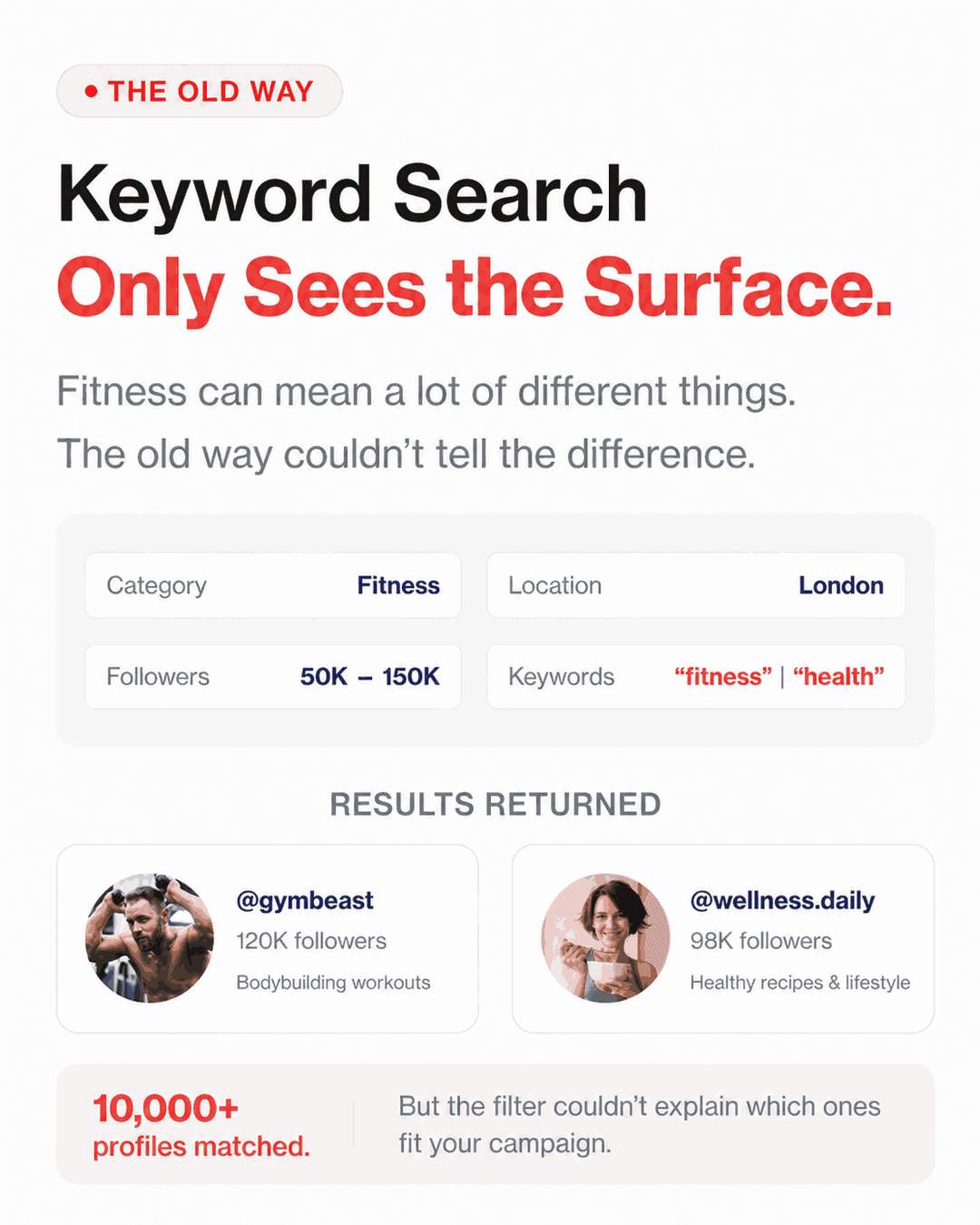
Niche and specific searches reveal a platform’s real capability. Any tool can surface fitness influencers in Germany.
The platforms that earn their price are the ones that can find creators whose content centers on young parents cooking for picky eaters, or urban cyclists who also cover sustainable fashion, or micro-creators posting about mid-century interior design in CEE markets.
Those specific matches come from reading content meaning.
Set up tracking before your first post with the CPM calculator and ROI calculator.
Why Hypefy Is the Best Platform to Find Influencers
Most platforms ask you to do the filtering. You set the parameters, such as niche, follower range, engagement rate, location, and the database returns whoever fits.
If you are looking for the best platform to find influencers that genuinely match your brief, Hypefy works the other way around. You describe the campaign and the audience, and the platform finds the creators whose content fits. That difference is what the rest of this section explains.
Semantic Selection: Matching by What Creators Post
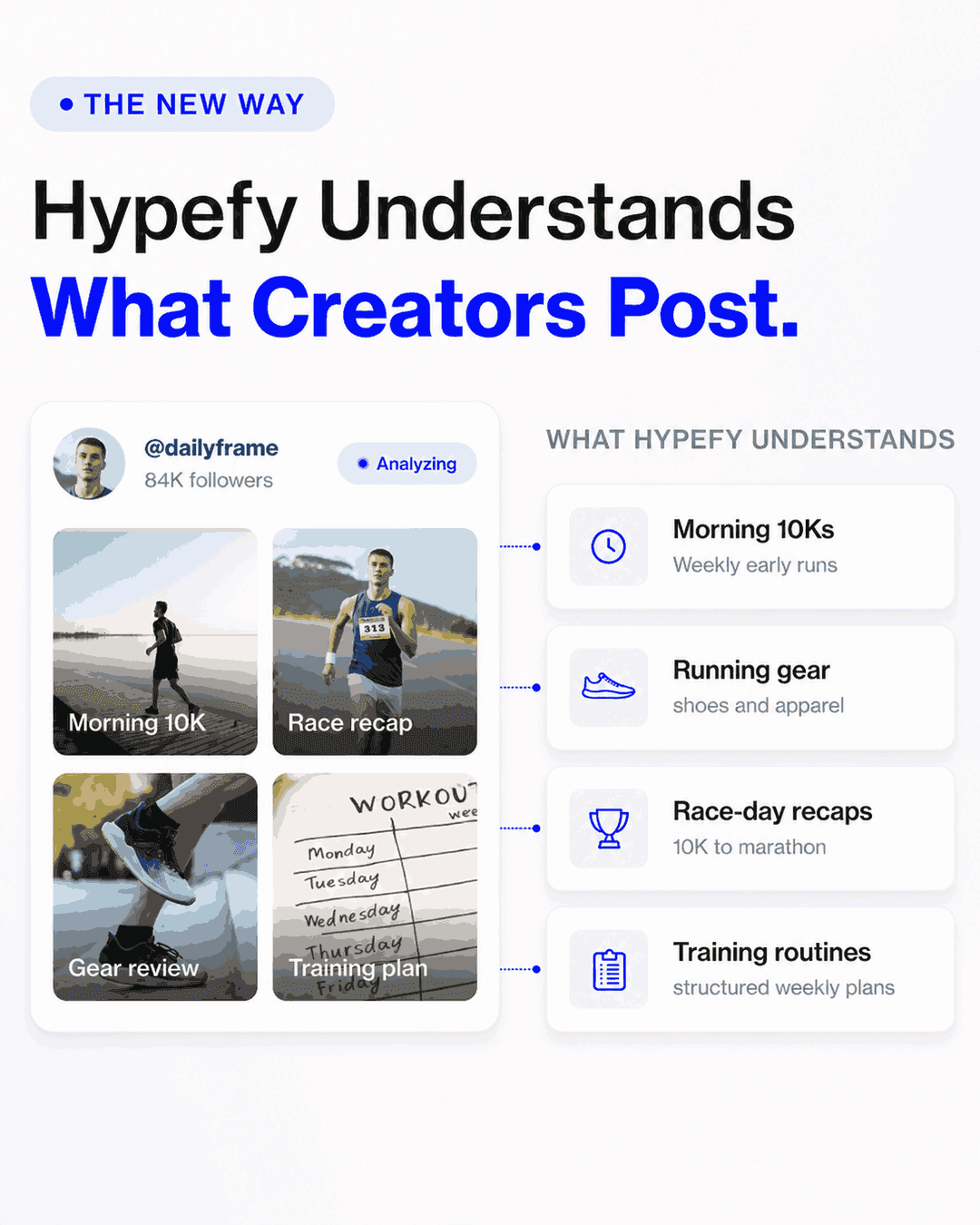
From the end of July 2026, matching on Hypefy goes a step further. The AI reads what a creator posts, their captions, and the themes they keep coming back to, and decides the fit from the content itself.
A creator who never writes “cooking” in their profile can still match a cooking brief if they keep posting home-cooked family dinners.
This is what makes niche matching genuinely work. When a brand is looking for creators who specifically speak to young families navigating screen-time decisions, or runners training for their first marathon, or home cooks trying to reduce food waste, those creators rarely use those exact phrases in their bios.
They just post that content, consistently, for the audience that follows them for it. Semantic search surfaces these creators where keyword filters pass over them.
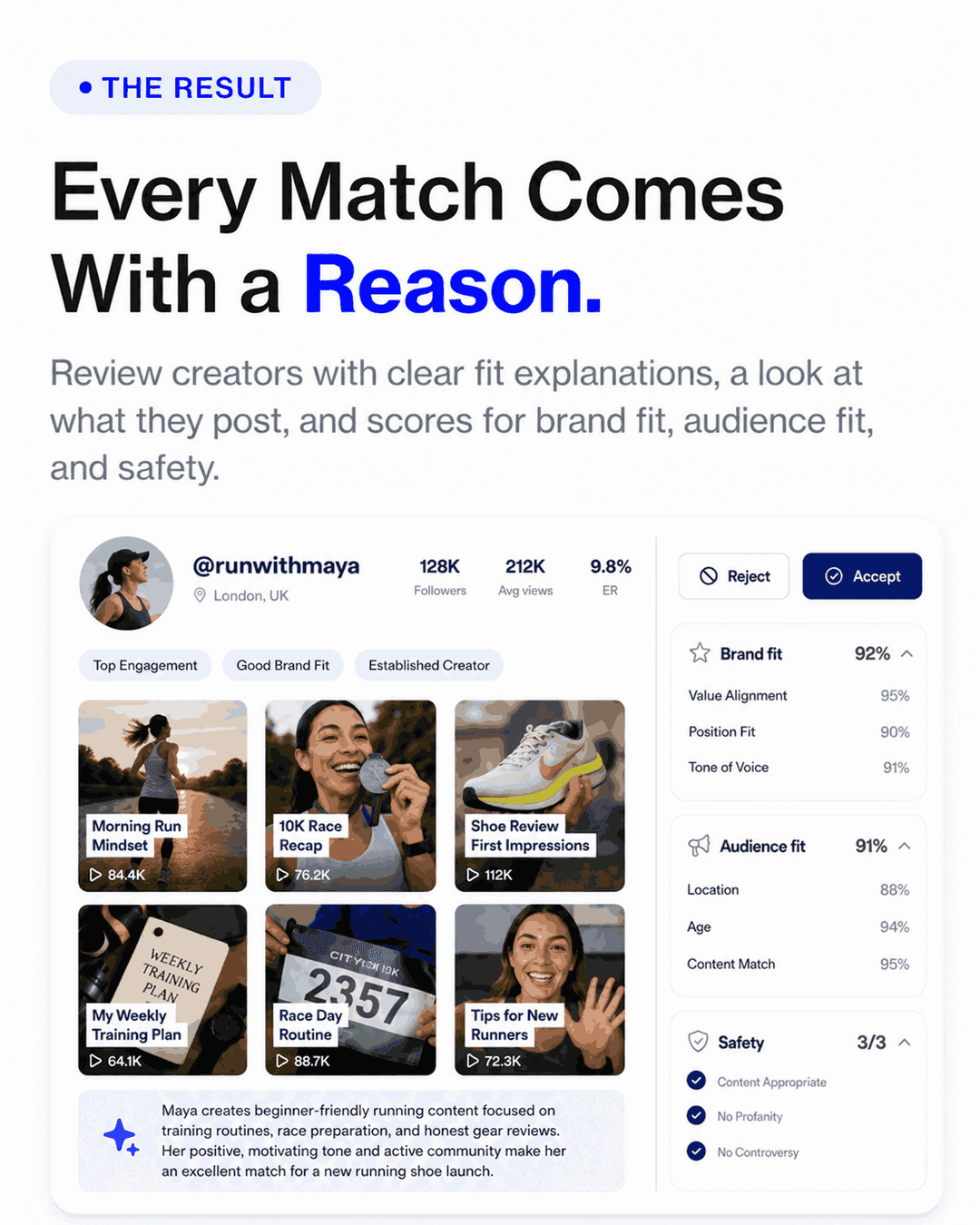
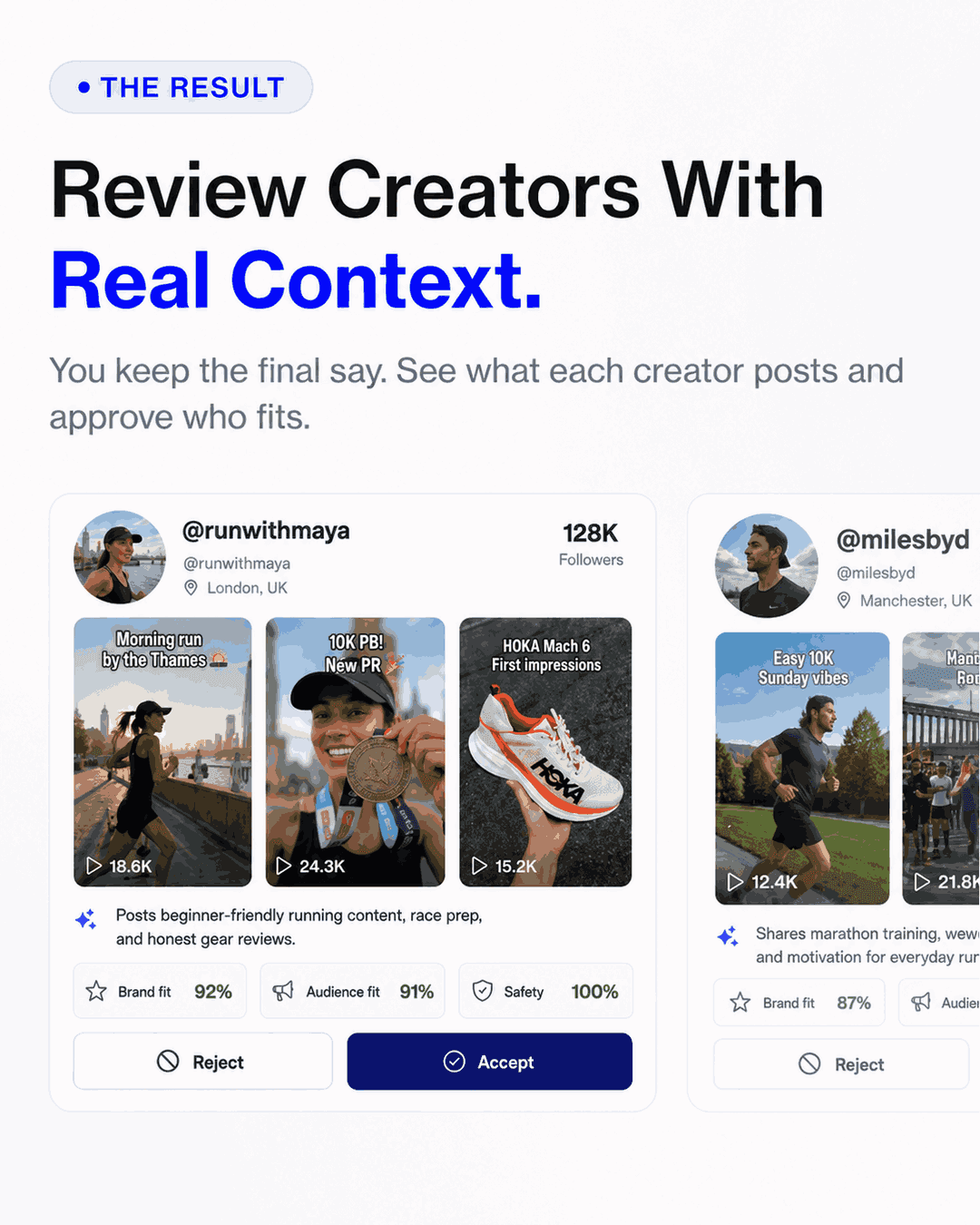
Every name on the resulting list comes back with a reason for the fit and a brand match score. The more specific the brief, the sharper the list.
How Matching Works
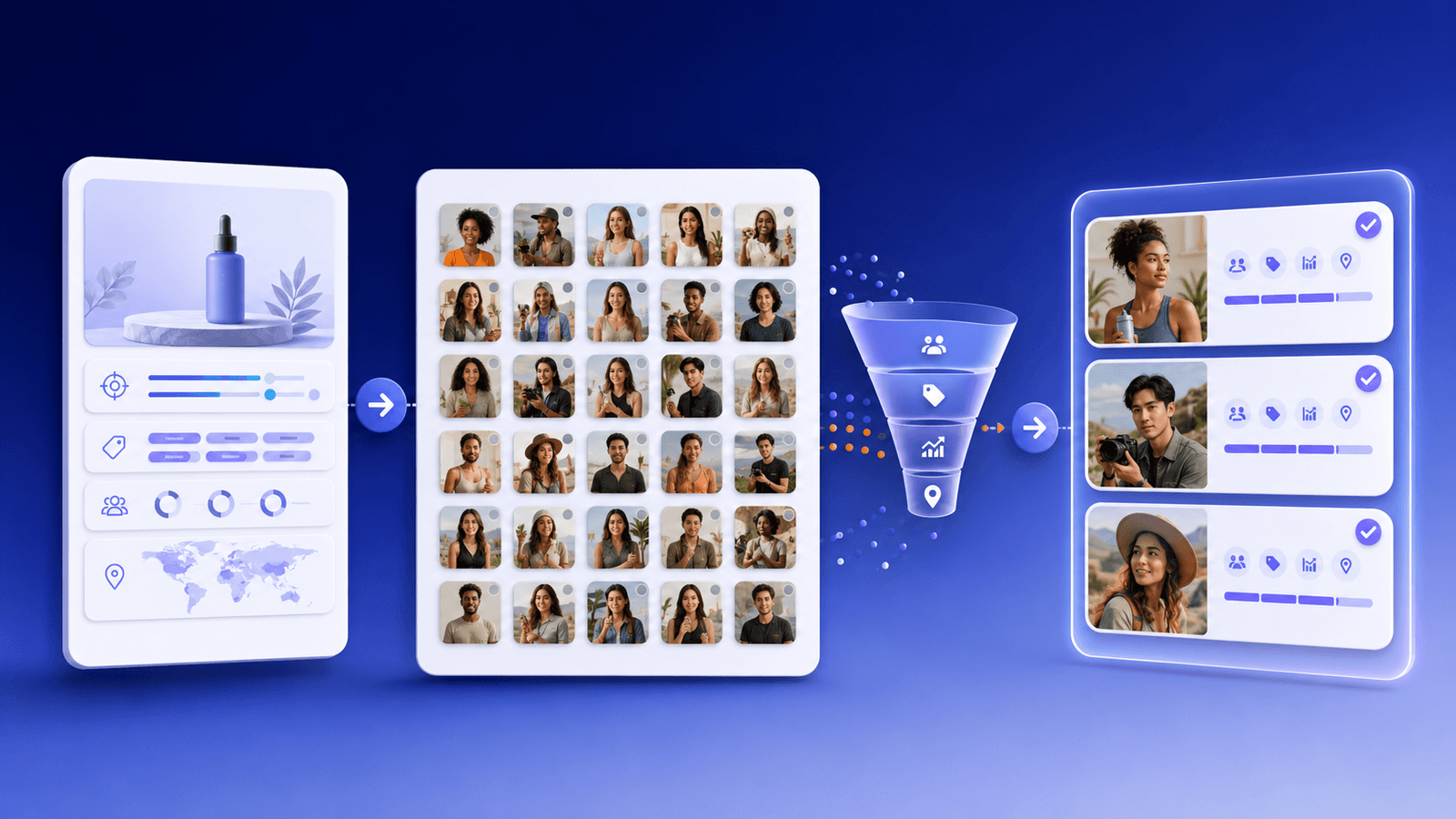
The process starts with a brief. You describe the campaign, the product, and the audience you want to reach.
Hypefy’s AI uses that brief to group matching creators into persona types of creators that fit the campaign, and you can turn those personas on or off based on what makes sense for the brief.
You can also add your own personas if you have a specific creator type in mind.
From there, individual profiles are matched to those personas with both a fit score and a brand-safety score shown for each. You approve or reject creators quickly, with the reasoning visible, so each decision takes seconds.
A budget gauge tells you how many creators to approve based on your budget, your target creator count, real acceptance rates from Hypefy’s data, and a projected results estimate. You can see what you are likely to get before committing.
See how Semantic Selection works.
Smart Pricing: Fair Rates Based on Real Performance
Most platforms surface a creator’s follower count and leave rate negotiation to you. Hypefy sets a fair rate for each creator based on a creator’s real, recent engagement, measured from the posts they have published recently.
This matters because creator pricing in influencer marketing is notoriously inconsistent. A creator with an inflated following and a declining engagement rate can charge the same as one with a smaller, more active audience.
Smart Pricing closes that gap by anchoring rates to what the creator’s content is delivering right now, so your budget goes toward reach that actually exists.
End to End, in One Place
Based on your approved brief, Hypefy recommends a curated list of influencers sourced directly from Instagram and TikTok. Each proposed creator is selected to match your campaign goals and audience.
You choose who you want to work with, and from there, Hypefy handles all outreach, communication, and coordination. You can review submitted content before it goes live, keeping you in full control without the manual effort.
Finding the right creator is the start of the job. The outreach, the negotiation, the content review, the payment, and the performance reporting are the rest of it. Hypefy covers all of it in one place, with a team behind it, so the campaign keeps moving between steps.
How Hypefy Compares to Other Platforms
Most platforms brands evaluate are discovery tools. They help you find and filter creators, surface audience data, and produce a shortlist. The outreach, negotiation, contracts, payments, and tracking that follow are left to the brand’s team to handle separately.
Hypefy sits in a different category. It matches creators to your brief by the meaning of their content, then runs the campaign through to reporting, with a team operating the workflow behind the platform. The table below is a quick orientation. The dedicated comparison pages do the deep work.
| Platform | Main focus | Matches by | Runs the full workflow |
|---|---|---|---|
| Hypefy | End-to-end campaigns, brief in and campaign out | The meaning of a creator’s content, matched to AI-built personas | Yes, with a team operating the workflow behind the platform |
| HypeAuditor | A database and analytics, with audience quality and fraud checks | Filters you apply yourself to search and shortlist | No, your team handles outreach, contracts, payments, and tracking |
| Aspire | Self-serve software with database search and an inbound marketplace | Filters you apply yourself, plus creators who apply to you | No, your team runs every step |
| Modash | A creator database and analytics, with Shopify tracking and payments | Filters you set yourself, with deep audience and authenticity data | No, discovery and tracking only, your team runs the outreach and campaign |
| Upfluence | Full-lifecycle software built around e-commerce attribution and affiliate tools | Filters and AI matching, with Live Capture to spot creators already shopping with you | No, the software covers the steps but your team runs them, on an annual contract |
To see the full breakdown on how Hypefy compares to some of these platforms, check out Hypefy vs HypeAuditor and Hypefy vs Aspire pages.
How the Right Creator Match Drove Results
Argeta’s Launch Across Fourteen European Markets
Argeta, the Slovenian pâté brand owned by Atlantic Grupa, is the category leader across the Balkans and close to unknown in Western Europe. It used Hypefy to test unfamiliar markets without setting up a separate operation in each one.
Hypefy data records the scale: 21 campaigns across 14 European markets in 18 months, 4.6 million people reached, 254,000 engagements, and 160+ pieces of content from 90+ creators, all managed on one platform.
The Slovakia campaign shows why the match mattered. Argeta had never operated there, so the first job was finding creators with a genuinely Slovak audience instead of a regional one. Hypefy’s AI matching surfaced creators whose followers were actually Slovak, and the campaign reached 1.37 million people at a 7.63% engagement rate per reach, the strongest result of the entire run.
The same logic carried the diaspora work. Across three Ramadan campaigns in the Netherlands, Belgium, and Sweden, Hypefy matched creators whose audiences already knew Argeta from home, reaching 418,000 people at a 3.92% engagement rate where the largest mainstream accounts would have missed the target.
Read the full Argeta case study
Find the Right Influencers With Hypefy
Describe the creators and campaign you want in plain language. Hypefy matches you to creators who fit by content meaning, audience quality, and real performance, then handles discovery, outreach, pricing, content review, payments, and tracking in one place.
Best Platform to Find Influencers for Your Brand FAQs
1. What is the best platform to find influencers?
The best platform is the one that matches you to creators who genuinely fit your brand and brief, handles the workflow beyond discovery, and gives you accurate performance data rather than inflated follower counts.
Hypefy matches by content meaning, using semantic search, and runs the full campaign discovery, outreach, payments, and tracking in one place.
2. What is the best platform to find niche influencers?
Niche influencer discovery requires reading what creators post, not just matching category tags or bio keywords. Semantic search is what makes it work.
Hypefy’s AI reads creator content and matches by theme and meaning, which is how it surfaces creators who consistently post about specific topics, such as parenting, sustainable living, and niche hobbies, even when those topics never appear in their bio.
3. What is the best platform to find B2B influencers?
B2B influencer discovery is about finding practitioners, analysts, and niche experts with specific professional audiences, people who never describe themselves as “influencers” but consistently share insights in their categories.
Semantic search handles this better than filter-based discovery because it reads what people post, not what they call themselves. Hypefy surfaces these creators on Instagram and TikTok.
4. How is Hypefy different from a database like Modash?
Modash is a discovery and vetting database. It surfaces creator profiles based on filters, provides robust audience demographic data, and produces a shortlist. Outreach, negotiation, contracts, payments, and reporting happen outside the platform.
Hypefy matches creators to your brief based on content meaning, handles rate negotiation through Smart Pricing, and manages the full campaign in one place. Discovery is where the platform starts rather than the extent of what it does.
5. Does the biggest influencer database find the best creators?
Larger databases include more inactive profiles, more creators outside your target markets, and more accounts with inflated metrics. The size of the pool is less useful than the quality of the match.
A platform that returns fewer but more genuinely fitting creators produces better campaigns than one that surfaces millions of technically eligible profiles and leaves the filtering entirely to you.
6. How does semantic search find influencers?
Semantic search reads the meaning of what a creator posts, captions, recurring themes, and content topics, rather than matching keywords in bios or category tags.
A creator whose content consistently shows home-cooked family meals matches a food campaign even if their bio says nothing about cooking.
Hypefy’s AI applies this reading to your brief and scores each creator on how well their actual content matches what the campaign needs.