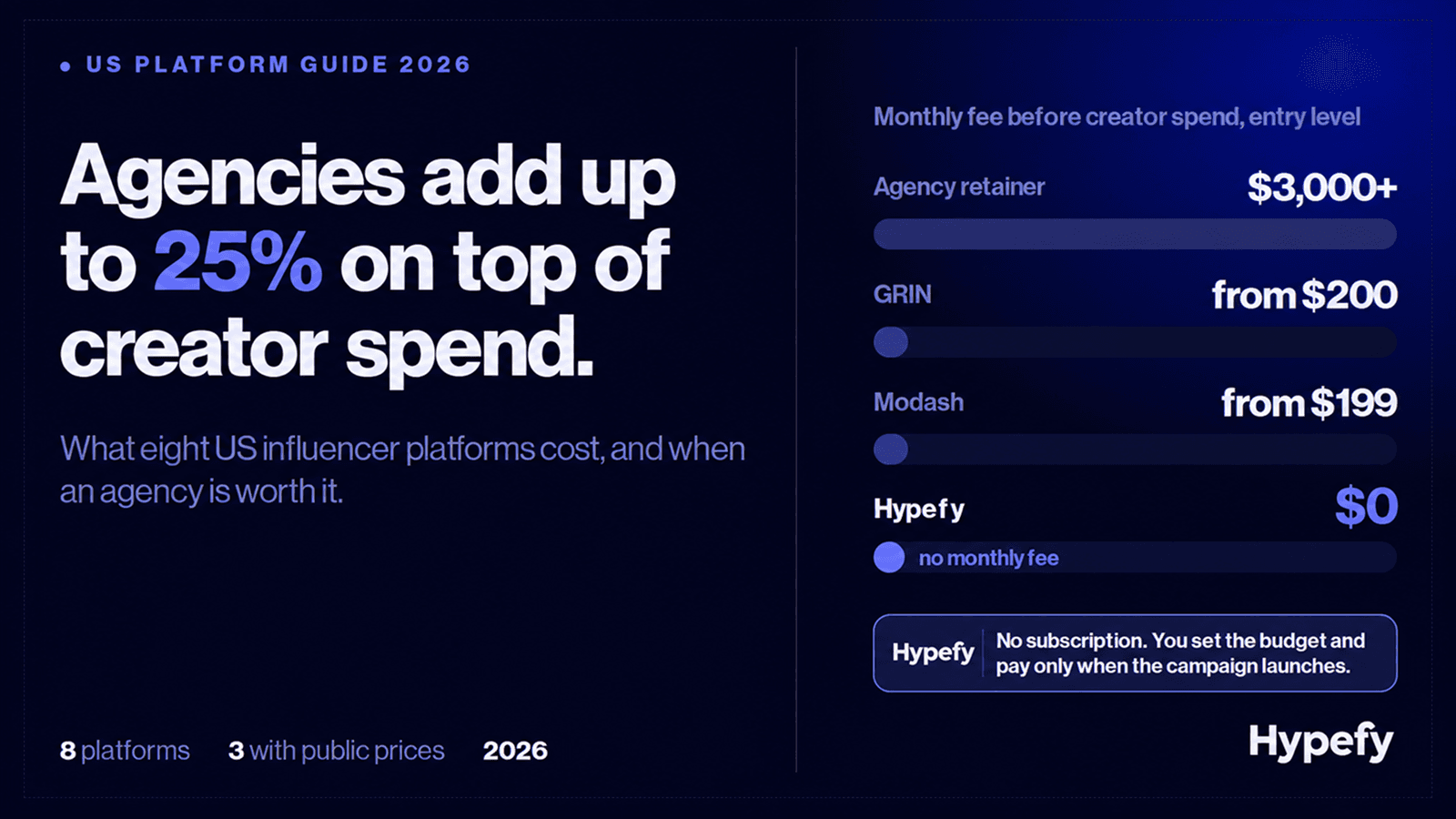
The best influencer marketing platform for a US brand depends on company size, whether campaigns are tied to eCommerce revenue, and how the brand prefers to pay. The leading options are:
GRIN, for Shopify DTC brands that need revenue attributed to individual creators
Upfluence, for eCommerce brands that want to find creators inside their existing customer list
Aspire, for DTC brands building a long-term creator community with inbound and outbound discovery combined
CreatorIQ, for enterprise teams managing multi-region, multi-team influencer programs
Modash, for a large discovery database without an annual contract
HypeAuditor, for deep standalone audience quality analysis and fraud detection
Collabstr, for booking creators at transparent prices with no subscription
Hypefy, for end-to-end campaigns without a monthly fee on Instagram and TikTok
The Best Influencer Marketing Platforms for US Brands at a Glance
Platform | Best for | Entry pricing posture | Platform coverage |
|---|---|---|---|
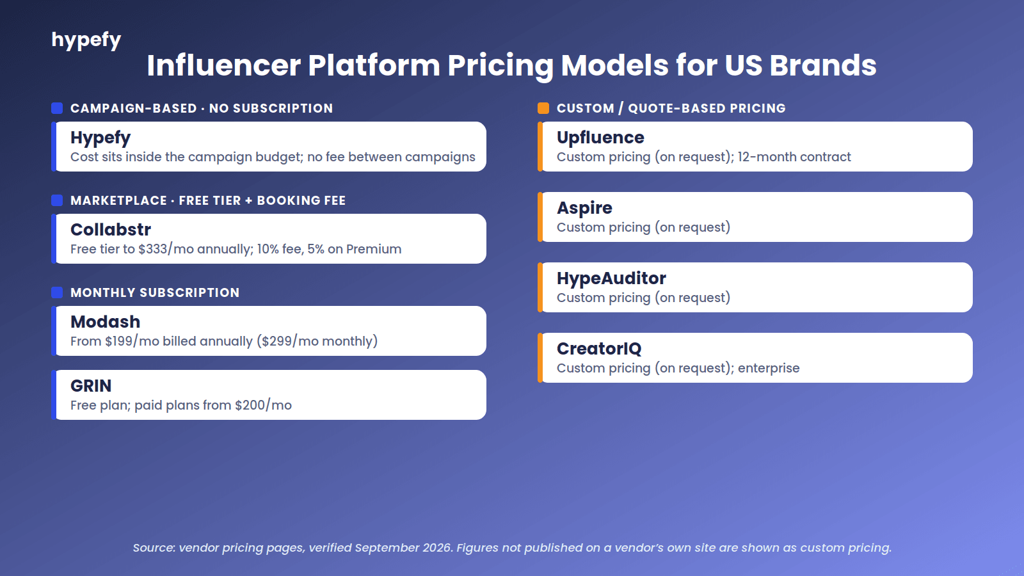
GRIN | Shopify DTC brands needing revenue attribution | Free plan; paid plans from $200/month | Instagram, TikTok, YouTube, Pinterest, multi-platform |
Upfluence | E-commerce brands finding creators in their own customer base | Custom pricing (on request) | Multi-platform |
Aspire | DTC brands building creator communities, inbound + outbound | Custom pricing (on request) | Instagram, TikTok, Pinterest, YouTube |
CreatorIQ | Enterprise teams managing global programs | Custom pricing (on request) | Multi-platform |
Modash | Discovery at scale on a flat monthly fee, no long-term contract | From $199/month billed annually ($299 monthly) | Instagram, TikTok, YouTube |
Collabstr | Marketplace booking at creator-set rates, free tier available | Free to $333/month billed annually; 10% booking fee, 5% on Premium | Instagram, TikTok, YouTube, UGC |
HypeAuditor | Standalone audience quality analysis and fraud detection | From $299/month billed annually; higher tiers on request | Instagram, TikTok, YouTube, X |
Hypefy | End-to-end campaign execution, no subscription | Campaign-based, no monthly fee | Instagram, TikTok |
What US Brands Should Look For in an Influencer Platform
For a US brand, the deciding factors are US creator coverage on the platforms you use, how the platform handles creator payments and tax paperwork, whether it connects to the storefront, and whether the pricing model matches how often campaigns run.
Most major platforms in this category are US-built, so the question is whether a platform covers the workflow at a price that fits campaign frequency.
That reframing matters, because most platform pricing assumes an always-on program, a monthly subscription running twelve months a year, while many brands run campaigns in bursts, with weeks or months between them.
A four-figure monthly subscription makes sense when campaigns are continuous and much less sense when three campaign windows a year are the realistic volume.
1. US creator coverage. Most platforms index large US creator databases across Instagram, TikTok, and YouTube, so the meaningful differentiation is audience data quality, whether the platform can confirm that a creator's audience actually sits in the target US market rather than only that the creator is US-based.
2. Creator payments and tax paperwork. For 2026 payments, the US 1099-NEC reporting threshold rose from $600 to $2,000 under the One Big Beautiful Bill Act (Section 70433), effective for payments made after December 31, 2025.
A W-9 is still required from every US-based creator before the first payment, regardless of the threshold. Platforms differ substantially in whether they collect W-9s and issue 1099-NEC forms automatically.
GRIN handles 1099 processing, while most discovery-only tools leave this to the brand. Non-US creators require a W-8BEN. Confirm the current filing requirement with a tax contact, since platform marketing materials are not a reliable source for filing obligations.
3. E-commerce integrations. For DTC brands, the ability to connect a storefront such as Shopify, WooCommerce, or Magento and attribute creator-driven orders back to individual creators is what separates knowing that influencer marketing works from knowing which specific creators drive revenue.
4. Pricing model and campaign frequency. A per-transaction or campaign-based model costs less for brands running occasional campaigns, while a subscription is cheaper per campaign for brands running programs continuously. Calculate the annual cost both ways before committing.
The Platforms Compared
Vendor product and pricing details checked September 21, 2026.
Platform | Best for | Creator coverage | eCommerce | Entry price | Annual contract | G2 |
|---|---|---|---|---|---|---|
GRIN | Shopify DTC needing revenue attribution | IG, TikTok, YouTube, Pinterest | Shopify, WooCommerce, Magento | Free; paid from $200/mo | Yes (paid plans) | 4.5/5 (483 reviews) |
Upfluence | Creators from your own customer base | Multi-platform | Shopify, WooCommerce, Klaviyo | Custom (on request) | Yes (12-mo) | 4.6/5 (140 reviews) |
Aspire | DTC building creator communities | IG, TikTok, YouTube, Pinterest | Shopify | Custom (on request) | Yes | 4.6/5 (146 reviews) |
CreatorIQ | Enterprise multi-region programs | Multi-platform | Enterprise stack (Salesforce, Marketo) | Custom (on request) | Yes | 4.6/5 (582 reviews) |
Modash | Discovery at scale, no annual lock-in | IG, TikTok, YouTube | Shopify (discovery-focused) | $199/mo annual ($299 monthly) | No | 4.9/5 (20 reviews) |
HypeAuditor | Audience-quality analysis, fraud detection | IG, TikTok, YouTube, X | None (analytics) | From $299/mo annual | Yes (entry-level) | 4.6/5 (267 reviews) |
Collabstr | Marketplace booking, creator-set rates | IG, TikTok, YouTube, UGC | None (escrow only) | Free–$333/mo; 10% fee (5% Premium) | No | 1 review, too few to score |
Hypefy | End-to-end IG/TikTok, no subscription | IG, TikTok | None | Campaign-based, no monthly fee | No | 4.9/5 (5 reviews) |
1. GRIN
GRIN is the strongest platform on this list for Shopify DTC brands that need revenue attributed to individual creators. It connects directly to Shopify, WooCommerce, and Magento, tracks creator-driven orders in real time, and handles creator payments with 1099 processing.
The workflow covers discovery, gifting, content management, payments, and revenue reporting in one place.
Main limitation: Discovery is the weakest part of the platform; multiple reviews flag TikTok database quality, and the discovery tools lag behind dedicated discovery platforms.
2. Upfluence
Upfluence's differentiating feature is Live Capture, which identifies creators already in a brand's Shopify, WooCommerce, or Klaviyo customer list. Starting a creator program from existing customers produces higher acceptance rates than cold outreach and a built-in product familiarity that shows in the content.
Main limitation: No self-serve trial. The modular pricing structure means the total cost often exceeds the entry figure significantly once you count the modules a program needs.
3. Aspire
Aspire combines outbound creator search with an inbound marketplace where creators apply directly to brand campaigns. For brands that want to build a creator community, a roster that grows with the program, the dual model produces better creator fit over time than pure outbound search.
The platform handles contracts and payments.
Main limitation: No published pricing for the full tiers, which makes budget planning difficult before a sales call.
4. CreatorIQ
CreatorIQ is built for enterprise brands managing multi-region, multi-team influencer programs at scale. Its creator graph, custom attribution, and deep integrations with Salesforce, Marketo, and other enterprise stack tools are the draw.
Main limitation: G2 reviews flag discovery quality as returning irrelevant results compared to dedicated search tools. The platform is strongest after the discovery step.
5. Modash
Modash indexes 380 million creator profiles across Instagram, TikTok, and YouTube, with no requirement for creators to have opted into the platform. It is the strongest option on this list for outbound discovery volume, with a transparent monthly price and no annual commitment.
Main limitation: Discovery and analytics only. Contracts and managed payments are outside the platform on the Essentials plan, so you'd need to add tools for the steps after the shortlist. The 300-profile monthly cap runs out faster than it sounds for active discovery teams.
6. HypeAuditor
HypeAuditor is an analytics and audience quality platform. Its fake follower detection, audience quality scoring, and earned media value reporting go deeper on a per-profile basis than most platforms on this list. It covers Instagram, TikTok, YouTube, and X.
Main limitation: Analytics and vetting first; campaign execution sits outside the platform. The published Basic plan is $299 a month billed annually and the tiers above it are quote-only. Full trials are by request. There is no self-serve trial.
7. Collabstr
Collabstr is an open marketplace where creators set their own prices and brands browse and book with payment held in escrow. No monthly subscription and no cold outreach. Based on more than 21,000 collaborations, 80% of deals cost under $300, making it the lowest-spend entry point on this list.
Main limitation: No audience-quality data or fake-follower detection. The creator pool is limited to those who have opted into the marketplace.
8. Hypefy
Hypefy is an AI-powered influencer marketing platform that runs campaigns on Instagram and TikTok from creator matching through to payment. There is no monthly subscription; the cost sits inside the campaign budget and fees apply when campaigns run.
Audience quality assessment, outreach, briefing, content approval, contracts, and payments all sit in one workflow.
Main limitation: Coverage is Instagram and TikTok only. US brands whose programs depend on YouTube, Amazon attribution, or Twitch should use GRIN, Upfluence, or Modash instead.
For brands wanting full campaign execution without an annual contract, Hypefy's campaign-based model has no lock-in.
Which Platform Fits Your Brand
The right platform depends more on brand size and how you run influencer marketing than on the feature list.
DTC and e-commerce brands needing revenue attribution. GRIN if the program is at scale and Shopify integration is the priority. Upfluence if the starting point is the existing customer base. Both require annual contracts.
Enterprise brands with governance and compliance needs. CreatorIQ for multi-region, multi-team programs with deep CRM and stack integrations, plus the governance and compliance controls these programs need. Enterprise-only, and assumes dedicated headcount.
Mid-market brands scaling from ad hoc to systematic. Aspire for DTC brands building a creator community with inbound and outbound combined. Upfluence for e-commerce brands that want to grow a creator program from the customer base.
Small brands and startups running occasional campaigns. Modash from $199/month (billed annually, or $299 month-to-month) for discovery and vetting with no annual contract. Collabstr for booking creators at transparent prices on a free tier. Hypefy for brands that want end-to-end campaign execution without a subscription between campaigns.
Agencies managing multiple clients. Modash for discovery across many client briefs without per-client subscriptions. CreatorIQ for agencies running enterprise programs. Hypefy for agencies that want to run client campaigns on Instagram and TikTok without a monthly platform cost between campaigns.
Creator Payments, 1099s and FTC Disclosure
Most influencer platforms handle payments in one of three ways: as a pass-through payment processor (the brand remains the legal payer), as a managed payout tool that collects tax forms and processes payments but leaves filing obligations with the brand, or as a merchant of record that takes on the tax counterparty role and issues 1099s directly.
A Form 1099-NEC is the IRS form a business uses to report what it paid an independent contractor, such as a creator, once payments reach $2,000 or more in a year.
GRIN and Upfluence handle payments inside the platform with 1099 processing. Modash and HypeAuditor are discovery and analytics tools; on their core plans, contracts and payments sit with the brand.
For brands paying creators directly outside a platform, the W-9 collection and 1099-NEC filing obligations sit with the brand.
Collect the W-9 before the first payment, since reaching a creator for paperwork after a deal is complete is unreliable. Confirm the exact obligations with a tax contact, since the rules vary by payment structure and creator status.
1099-NEC Threshold in 2026
For 2026, the threshold for issuing a Form 1099-NEC to a US-based creator rose from $600 to $2,000 under the One Big Beautiful Bill Act, signed into law in 2025.
A W-9 is still required from every US-based creator before payment, regardless of whether the payment will cross the 1099 threshold.
Non-US creators require a W-8BEN instead. Confirm these figures with a tax contact, since the statutory threshold is indexed for inflation after 2026 and filing rules can change.
FTC Disclosure
The FTC requires that any material connection between a brand and a creator, whether cash payment, gifted product, affiliate commission, or any other benefit, be clearly and conspicuously disclosed to the audience.
Clearly and conspicuously means the disclosure is visible without the viewer having to click, scroll, or expand. A disclosure buried in a long hashtag list does not meet the standard.
Responsibility for disclosure sits with both the advertiser and the creator.
A brief that doesn't specify disclosure requirements, and an approval step that doesn't confirm they are met, put the brand at risk even when the creator fully understands their obligations.
Platforms differ in whether they build disclosure into the brief template and the content approval step, so confirm how the platform handles it before assuming it is covered.
For health, financial, and supplement categories, the FTC applies additional scrutiny, and testimonials in these categories require the brand to substantiate the claims made. Confirm the specifics with legal counsel.
Influencer Marketing Platform vs Agency for US Brands
A platform is software the brand uses to run campaigns. An agency is a service that runs campaigns for the brand. The choice comes down to whether the brand wants control and a lower cost per campaign or hands-off delivery.
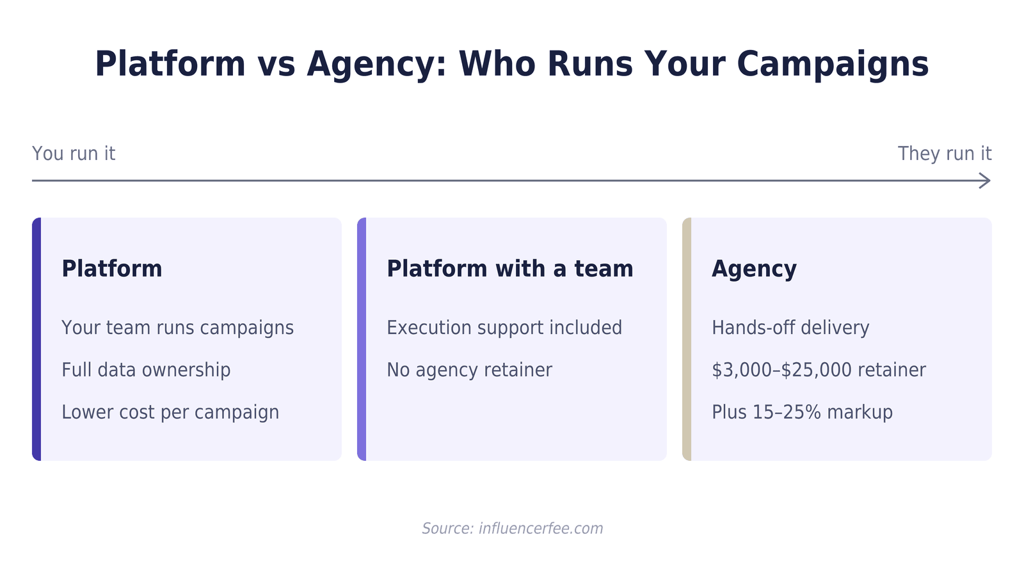
A US influencer marketing agency typically charges a monthly retainer of roughly $3,000 to $25,000 plus a 15 to 25% markup on creator spend. That structure makes sense when the brand has no internal team to run campaigns, when the work involves complex coordination across many markets, or when speed to execution matters more than cost control.
A platform gives the brand full data ownership, direct creator relationships, and lower per-campaign cost once the team is trained. The trade-off is that someone internally has to run it, building shortlists, managing outreach, briefing, reviewing content, and handling payments.
A platform with a team behind the workflow sits between the two, offering that execution support without the agency retainer. The influencer marketing agency vs platform guide covers the trade-off in full.
For teams that want discovery plus full campaign execution in one place, Hypefy covers both without a monthly subscription.
How to Choose an Influencer Marketing Platform for Your US Brand
Before you commit to a platform, work through this checklist and get each answer in writing from the vendor:
US creator coverage on Instagram, TikTok, and YouTube in your category, such as beauty, food, or fitness (ask for a sample search with real profiles).
Pricing that fits your campaign frequency, where an annual subscription suits year-round activity and campaign-based pricing suits a few launches a year.
Contract length and minimum commitment, including how and when you can cancel.
Storefront integration with Shopify, WooCommerce, or your store of choice if you need sales attribution.
Payments and tax paperwork, meaning whether the platform collects W-9s and issues 1099-NEC forms or leaves both with your team.
FTC disclosure built into the workflow, in the brief and at the content approval step.
Reporting depth, where you can see attributed revenue alongside reach and impressions.
Not every platform will score well on all seven, so rank them by how often you'll use each one. A brand running two campaigns a year will most likely care more about contract length and payments than about a full-year subscription.
Running US Campaigns With Hypefy
Hypefy fits US brands that want Instagram and TikTok campaigns without an annual contract or a monthly subscription. Its discovery tool handles matching and outreach, contracts, content approval, payment, and reporting follow in the same workflow, with the cost sitting inside the campaign budget rather than on top of it.
US coverage is the largest in the creator database. 169,763 Instagram creators above a thousand followers, 102,210 of them above ten thousand.
TikTok coverage in the US is currently at just under 6,000 creators, so a US campaign that has to run on TikTok at scale is worth discussing before you plan around it.
If you would rather have the campaign run for you end to end, see Hypefy's influencer marketing agency services in the USA.
The model suits brands that run campaigns in bursts, such as a product launch, a seasonal push, or a quarterly program, since you're not paying for a subscription in the months between them.
Hypefy covers Instagram and TikTok only, so a US brand whose influencer program depends on YouTube creators, Twitch integrations, or deep Amazon revenue attribution will be better served by GRIN, Upfluence, or Modash for those campaigns.
Best Influencer Marketing Platform for US Brands FAQs
1. What is the best influencer marketing platform for US brands?
It depends on your size and workflow, so match the platform to how you run campaigns.
GRIN for tying creator activity to Shopify revenue in DTC brands.
Modash for discovery at scale, with month-to-month billing available at $299/month.
Aspire for DTC creator communities.
Hypefy for end-to-end campaigns without a subscription.
CreatorIQ for enterprise multi-region programs.
2. What is the best influencer marketing platform for US e-commerce brands?
GRIN ties creator activity to Shopify order-level revenue, while Upfluence starts from your existing customer base, since its Live Capture feature finds creators already in a Shopify or Klaviyo list.
Both require annual contracts, so factor a full year of cost into your comparison.
3. How much do influencer marketing platforms cost in the US?
Published pricing as of September 2026 ranges from free plans to custom enterprise quotes.
Collabstr has a free plan and paid plans up to $333/month billed annually, with a 10% fee on Free and Pro and 5% on Premium.
Modash costs $199/month billed annually or $299/month billed monthly.
GRIN has a free plan, and paid plans start at $200/month.
HypeAuditor starts at $299/month billed annually.
Upfluence, Aspire and CreatorIQ price on request, so you’ll need a quote.
Hypefy is campaign-based with no monthly fee.
4. Do platforms handle 1099s for US creators?
GRIN includes 1099 processing, while most discovery-only tools leave tax paperwork with the brand.
For payments made in 2026, the 1099-NEC reporting threshold rose from $600 to $2,000 under the One Big Beautiful Bill Act.
Collect a W-9 from each creator before the first payment so you have their taxpayer ID on file whatever the amount, and confirm the details with your tax contact.
5. Do platforms help with FTC disclosure?
Some platforms build disclosure into their brief templates and content approval steps, while others leave it to you.
Either way, write into the brief that content must carry a clear and conspicuous disclosure, such as #ad or the platform's paid partnership label, and check that it appears before you approve each post, since the brand typically shares responsibility for the finished content.
Confirm the details with your legal counsel.
6. What is the best influencer marketing platform for small US brands?
Modash suits brands that mainly need discovery, at $199/month billed annually or $299/month if you'd rather not commit to a year.
Collabstr has a free plan with a 10% fee per hire on Free and Pro, so you pay as you hire.
Hypefy suits small brands that want the full campaign run, from matching and outreach through contracts, approval, and payment, without a monthly fee between campaigns.
7. Can a platform based outside the US run campaigns with US creators? And is it the best influencer platform for US DTC brands?
Yes, a platform's location doesn't limit which creators you can work with, so check whether it indexes US creators in your niche and whether it collects W-9s and files 1099s. Hypefy runs campaigns with US creators on Instagram and TikTok.
The United States is the largest identified market in Hypefy’s creator database, with 169,763 Instagram creators above a thousand followers, though TikTok coverage in the US is much smaller.
8. Do US influencer platforms require annual contracts?
Many do. GRIN, Upfluence, Aspire, and CreatorIQ require annual contracts, while Modash offers month-to-month billing at $299/month (or $199/month billed annually) and Hypefy has no subscription or contract.
9. What is the difference between an influencer marketing platform and an agency?
A platform is software your team runs itself, while an agency runs campaigns for you and typically adds a retainer plus a 15–25% markup on creator spend, with creator relationships usually staying on the agency's side.
The agency vs platform guide covers the trade-off in full.