A platform suits brands that want control and lower cost and have some time to run campaigns. An agency suits brands that want the work done for them and have the budget for it.
There is also a third option, a done-for-you platform that combines the economics of software with hands-on execution, and this page covers all three.
The right answer depends on three variables: your budget, how much in-house time and expertise you have, and how often you run campaigns. A fourth, the number of markets you run in, settles the question on its own for some brands. Work through all of them and the model that fits your brand is usually clear.
Start at the top and read through, or jump to the variable that feels most uncertain.
The Core Difference Between Influencer Marketing Agency and Platform
A platform is software you use to run campaigns yourself. An agency is a service that runs them for you. Cost, control, speed, and who is responsible for what all follow from that single difference.
The trade-off is control and lower cost on one side, hands-off delivery and senior expertise on the other. The rest of this page is about figuring out which side you belong on or whether the done-for-you middle option is the better fit.
One more thing before going further: neither model is objectively better. Agencies win for specific brands in specific situations. Platforms win for others. The wrong choice is picking the model that does not match your actual situation, regardless of which one wins the abstract comparison.
Factor | Platform | Agency |
|---|---|---|
Who does the work | Your team | The agency team |
Control | Full, you make every decision | Shared, you brief, they execute |
Cost model | Subscription or campaign-based fee | Retainer or percentage of spend |
Speed to start | Quick to set up, a few days to launch | Weeks of onboarding and briefing before setup begins |
Creator pool | Varies: some platforms search all creators, some only those registered with them | The agency's roster plus direct outreach |
Multi-market campaigns | One brief, one workflow, a separate campaign per market | Usually a separate agency per region, or one agency subcontracting locally |
Expertise | Yours to supply | Provided by the agency |
Best-fit brand | Capable team, frequent campaigns, cost-conscious | No in-house time, comfortable budget, occasional campaigns |
See how Hypefy sits between the two models → Run campaigns like an Influencer Marketing Agency
What's Your Budget, and What Are You Really Paying For?
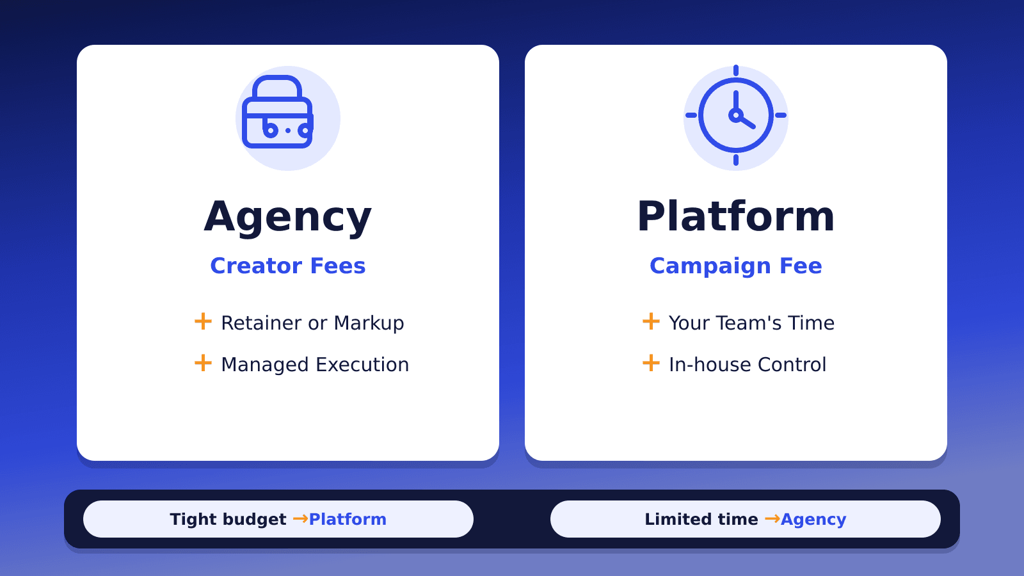
Budget is the first filter, because platforms generally cost less while agencies cost more, but the more useful question is what each model charges you for.
What does your budget reality look like? Can you absorb a retainer or an agency markup on top of creator fees and media spend? Or does the budget need to go as directly as possible toward the campaign itself, with as little as possible spent on infrastructure and service fees?
Agencies typically work on a monthly retainer or take a percentage markup on creator fees and media spend. The retainer covers their team's time, strategy, creator sourcing, negotiation, management, reporting, and client communication. That cost sits on top of the campaign itself.
The value is real when the agency delivers expertise and execution the brand could not produce internally.
The question is whether that value justifies the premium in the current budget cycle.
Platforms typically charge a subscription fee or a campaign-based fee, and the cost is for access to the software and the creator pool. Your team's time is the hidden cost on the platform side, and it is a real cost.
If the person running the platform is a senior marketer, their hours carry a real cost. That cost is invisible on the platform invoice and very visible in the higher-value work those hours could have gone to instead.
That is worth accounting for honestly before concluding that the platform is simply cheaper.
The cost question on the agency side is which model you are buying, because a retainer, a project fee, and a percentage of spend behave very differently as your volume changes.
A retainer is predictable and gets cheaper per campaign the more you run. A percentage of spend rises with the budget whether or not the work rises with it. Ask which one you are signing, then model it against the number of campaigns you realistically expect this year.
A tight budget points toward a platform or done-for-you platform. A comfortable budget with no desire to do the work points toward an agency.
How Much Time and Expertise Do You Have In-House?
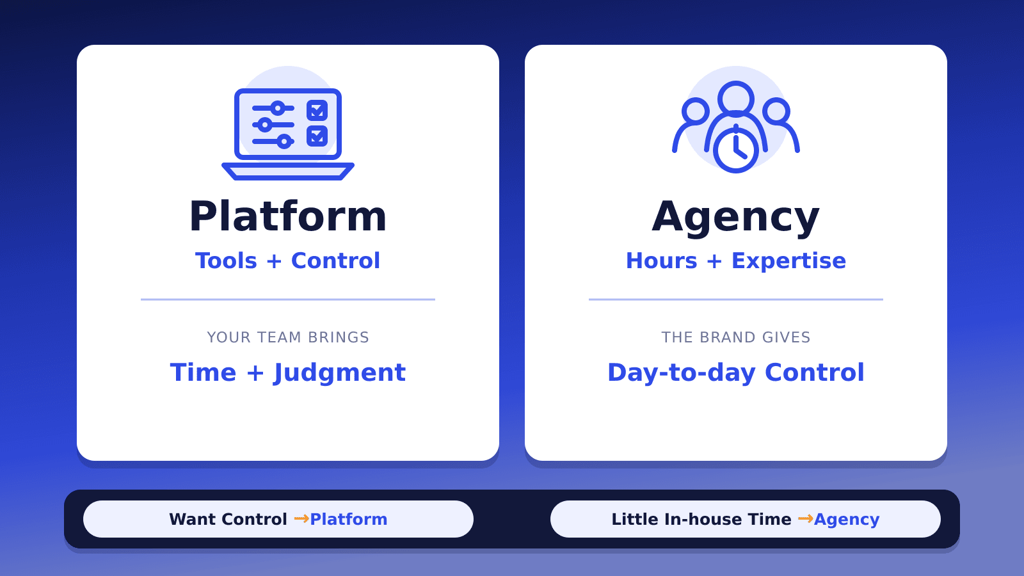
The second filter is whether you have the people, time, and know-how to run campaigns yourself, because a platform assumes you do and an agency assumes you do not. Assess your in-house reality honestly.
Do you have someone who can own influencer marketing end-to-end, covering creator discovery, vetting for engagement quality and audience fit, negotiating terms, briefing, content review, payment management, and reading results well enough to improve the next campaign? Or is influencer marketing one of many responsibilities for a generalist who is already at capacity?
A platform gives you the tools to do all of that, but you supply the hours and the judgment. A good platform cuts the manual work of discovery, outreach, and tracking.
The strategic instinct that determines which creators to brief, what the brief should say, and how to interpret the results still has to come from your team. That still requires someone who knows what they are doing or is willing to learn quickly.
There is a sharper version of the agency argument that deserves a direct answer.
A platform can return ten thousand creators who match a filter, and a filter cannot tell you which of them hold the audience relationship that makes a campaign work. That is a fair criticism of filters.
It is less true of matching built on third-party audience data rather than follower counts and self-reported media kits, which are frequently inflated, and a done-for-you platform closes the rest of the gap by putting a person on the shortlist before it reaches you.
An agency supplies the hours and senior expertise built on running many campaigns across many categories, while day-to-day decisionssit with the agency team. Briefings go through account managers. Changes require back-and-forth. The agency's view of what works may differ from yours, and aligning on it takes some time and trust.
For brands with experienced influencer marketing teams, that loss of control is frustrating. For brands starting out, it is valuable.
This is where agencies earn their keep. Creator vetting, rate negotiation, brief writing, disclosure and ad-labeling compliance, content approval, and attribution setup all have nuance that takes time to develop, and a good agency has already made those expensive mistakes on other clients' campaigns.
An agency removes that learning curve entirely. A platform compresses it, but the judgment still develops over time.
Little in-house time or influencer marketing expertise points toward an agency. A capable team that wants control and is comfortable with the work points toward a platform.
Model your campaign budget before committing to either model with the marketing budget calculator.
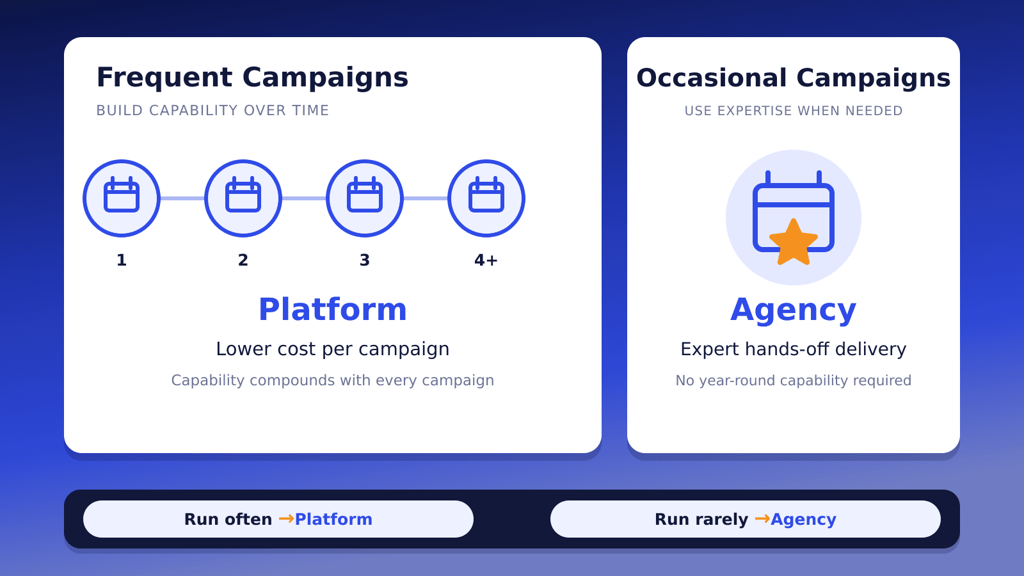
The third filter is frequency. Running campaigns regularly rewards building capability in-house on a platform. Occasional or one-off campaigns often favor an agency you can bring in as needed.
How often do you run influencer campaigns? Monthly? Quarterly? Once or twice a year for a product launch or seasonal moment? The answer shapes the economics significantly.
Frequent campaigns make a platform's lower per-campaign cost compound over time. Your team gets better at the work with each campaign. Creator relationships develop, the same creators come back, briefs get shorter, revision rounds shrink, and performance data from each campaign informs the next one.
The in-house capability becomes an asset that accumulates value the longer it runs. The platform subscription begins to look very cheap per campaign once a team is running five or ten campaigns a year.
Rare or high-stakes campaigns can justify paying an agency for expert, hands-off delivery you do not need year-round: a product launch that happens once, a seasonal campaign you need to execute perfectly, or a market entry where you have no creator relationships.
These are the situations where agency experience and relationships deliver clear value. The cost per campaign is higher, but you are not paying a fixed fee year-round for capability you use twice.
There is also a quality-of-execution argument for frequency. A brand that runs one influencer campaign a year and uses a platform will run that campaign less well than an agency would, because neither the platform nor the team behind it has had time to develop judgment.
The same brand running campaigns monthly develops real competence, and develops it on its own performance data. Frequency accelerates the learning that makes platform investment worthwhile.
Frequent campaigns point toward a platform or done-for-you platform. Occasional or one-off campaigns point toward an agency.
What If You Run in More Than One Market?
The fourth variable is geography, and for some brands it settles the question before the other three are considered.
Few agencies cover several markets with one team. The usual outcome is a separate agency per region, each with its own rate card, reporting format, and definition of a good creator, or one agency subcontracting to local partners you never meet.
A platform changes the unit of work.
One brief can run as a separate campaign per market, with local teams reviewing and approving the creator list for their own country while the campaign structure stays consistent everywhere.
Comparing performance across markets becomes possible because the data was collected the same way in each one.
For example, Argeta ran 21 campaigns across 14 European markets in 18 months on Hypefy, including 11 campaigns across 11 markets in a single quarter and a five-country launch that went live on the same day.
One market, run once a year, points toward an agency. Several markets, run regularly, points toward a platform or a done-for-you platform.
Three Questions the Comparison Usually Skips
Three practical questions decide more campaigns than the abstract comparison does.
What happens when a creator drops out mid-campaign? An agency carries a replacement bench and contract remedies. A platform has to answer the same question, and the good ones do.
Offers going to a large pool at once, budget filling as creators accept, unspent budget returned rather than absorbed, and competitor exclusions and exclusivity written into the brief so a breach is a contract matter rather than an argument.
Who owns the content afterward, and can you put paid budget behind it? Boosting rights, raw footage for repurposing, and permission to edit are three separate permissions, and they are the ones in-house teams most often forget to negotiate. Whichever model you choose, settle usage rights in the brief rather than after the content performs well.
Who pays the creators, and when? On most platforms, that becomes your finance team's problem, with one invoice per creator, often falling due before your own client has paid you.
Ask whether the model you are buying consolidates that into a single invoice on terms that match your cash cycle.
What If the Variables Disagree?
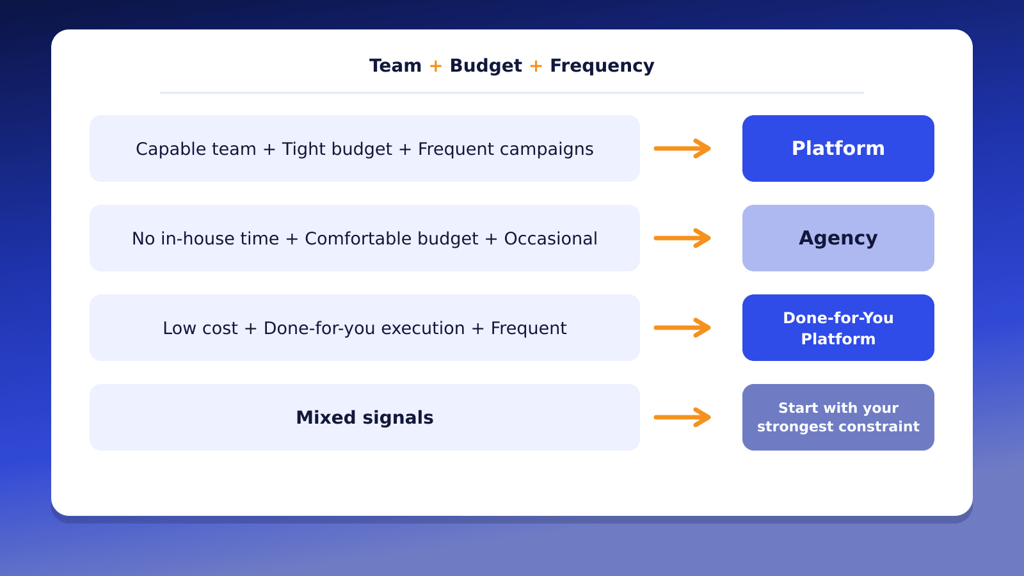
Most brands do not get a clean sweep. They want low cost, and they want the work done for them, and they run campaigns often, and those pull in different directions.
This is the most common conflict pattern at mid-market scale: a marketing team of two or three people, a need to run influencer campaigns regularly, a budget that cannot absorb retainer pricing, and no one on the team with deep influencer marketing experience.
A platform leaves them under-resourced. A full-service retainer is out of budget. Neither model was designed for this exact brand. The done-for-you model sits outside that binary.
The resolution is a done-for-you platform. This model gives the cost and control of a platform. Pricing sits inside the campaign budget, and a team handles discovery, matching, and campaign execution the way an agency would.
You get the workflow handled without paying a fixed fee on top of your campaign spend.
This is not a category anyone invented recently. Several platforms sell a managed-service tier, and several agencies run their campaigns inside licensed software, so the model itself is not the differentiator. The cost structure is, and that is the part worth comparing.
Hypefy works this way. It is a platform with a team behind it, offering AI-led creator matching through semantic search, end-to-end campaign management from discovery through outreach, content review, and payments, all priced inside the campaign budget, with no separate service fee on top.
The fee is a percentage of the influencer budget; there is no subscription and no long-term commitment. Hypefy pays every creator directly, and invoices you once, and any budget that goes unspent comes back to you.
One more arrangement worth naming. You can license a platform and keep an agency for strategy or creative, both working inside the same campaign. Some agencies already run this way on behalf of their clients.
For brands that want lower cost, execution support, and the ability to run campaigns regularly without building a dedicated in-house team, it resolves the conflict the other two models create.
Your Verdict, Four Variables at Once
Put the four variables together, and the right model is usually clear.
Your situation | Points to |
|---|---|
Capable team, tight budget, frequent campaigns, one market | Platform |
No in-house time, comfortable budget, occasional campaigns | Agency |
Low cost wanted, execution done for you, frequent campaigns | Done-for-you platform |
Several markets, run regularly, small central team | Platform or done-for-you platform |
If the signals are mixed, start with the variable you feel most strongly about. Budget constraints rarely flex, so if the budget is tight, start with the platform and done-for-you options. If in-house time is zero, start with agency and done-for-you platform options and let budget separate them. The strongest constraint is usually the right first filter.
See Where You Land With Hypefy
If the variables pointed you toward a platform or a done-for-you platform, Hypefy is a practical next step.
You get the control and cost of a platform: no retainer, no subscription, and no long-term commitment.
A team handles discovery, creator matching, content review, and payments, so the campaign runs without your team doing every step manually.
For brands that have been sitting between the platform and agency options without finding a clean fit, the done-for-you model is often the answer that was missing from the comparison.
Influencer Marketing Agency vs Platform FAQs
What is the difference between an influencer marketing agency and a platform?
A platform is software your team uses to run campaigns. An agency runs them for you, and cost, control, speed, and expertise all follow from that one difference.
Is a platform or an agency cheaper for influencer marketing?
A platform is generally cheaper because you supply the labor; an agency costs more because it supplies the labor, through a monthly retainer or a markup on your spend. The comparison only holds once your team's hours are priced in, and once you know whether the agency fee is a retainer, a project fee, or a percentage of spend, because those three behave very differently as your campaign volume changes.
How do I decide between an influencer marketing agency and a platform?
Answer four questions in order: what the budget can absorb, whether anyone in-house can own the work, how often you will run campaigns, and how many markets you need to cover. Decide first on the most fixed answer, because it rules out more options than the others.
When is an agency worth the higher cost?
When you have no in-house capability, when campaigns are occasional or one-off, or when the stakes are high enough that experienced execution matters more than cost. That expertise comes from running many campaigns across many categories and knowing what works before you spend the budget testing it.
Can you get agency-style support from a platform?
Yes, with a done-for-you platform: platform pricing, plus a team that handles discovery, matching, content review, and payments the way an agency would. The cost structure is what differs: pricing sits inside the campaign budget rather than arriving as a fixed fee on top of it. Hypefy works this way.
Which is better for a mid-size brand, an agency or a platform?
It depends on the variables, but mid-size brands often fit the done-for-you platform best: some capacity but no dedicated specialist, a meaningful but not unlimited budget, and regular campaigns. If the team already has deep influencer experience, a pure platform is often the right answer.
Do influencer marketing platforms only give you creators who signed up for them?
Some do, and it is worth asking before you buy, because a closed pool limits you to creators who already registered. Others search the open creator base on Instagram and TikTok and approach creators on your behalf, which is closer to how an agency works. Ask which kind you are looking at.
I run an agency. Should I be using a platform?
Often, yes. Agencies use platforms as an operational layer, keeping the client relationship and the strategy while the software handles search, briefing, content review, and creator payments. If you are an agency reading this comparison, the question is less which side to pick and more which parts of your workflow are worth keeping manual.