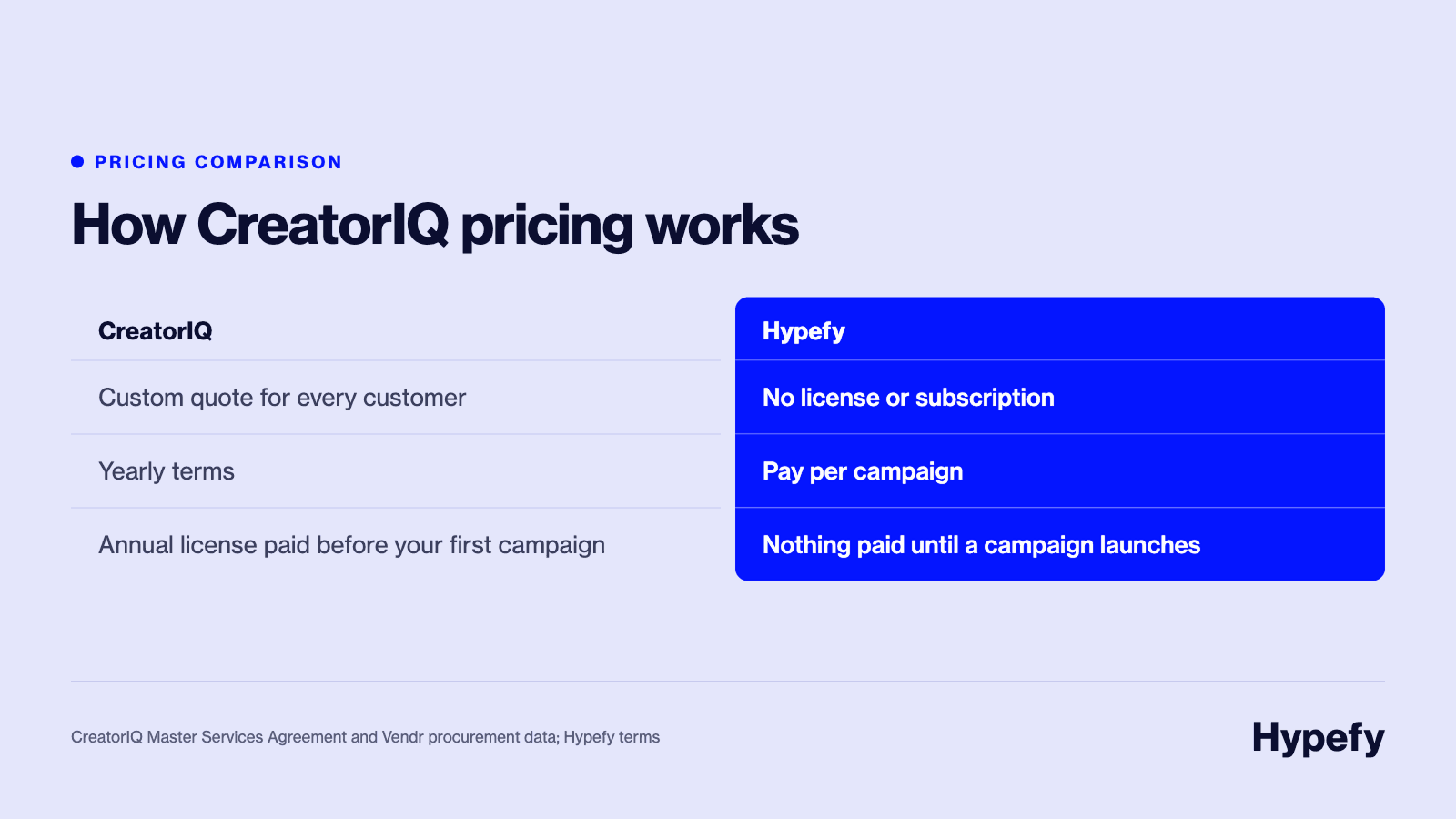
CreatorIQ doesn't publish its pricing, and every quote is custom. Procurement platform Vendr puts the typical annual contract at $30,000 to $59,500, with a median of $39,250.
So what is CreatorIQ? It's an enterprise platform that brands and agencies use to discover creators, manage relationships, run campaigns, and measure results.
Below, you’ll find what the price includes, what costs extra, what the contract commits you to, and what real users say, plus how to work out whether CreatorIQ is worth it at your campaign volume.
How Much Does CreatorIQ Cost?
CreatorIQ typically costs $30,000 to $59,500 a year, with a median of $39,250, based on Vendr's procurement data (checked October 2026).
There are no public CreatorIQ pricing plans, and each customer is priced separately. Its pricing page is a request form, and a Platform Specialist then recommends a package.
CreatorIQ doesn’t say what drives the price, so ask on the call how these four affect the quote:
How many creators you manage
How many seats your team needs
Which modules you include
How many markets the program covers
What the Public Sources Report
The table lists every published CreatorIQ price we found and when we checked it.
Source | What It Reports | Checked |
|---|---|---|
Vendr (procurement data) | $30,000 low, $39,250 median, $59,500 high, per year | October 2026 |
Starting at $36,000 per user, per year | October 2026 | |
Starting at $36,000 per user, per year | October 2026 | |
G2 (buyer data) | No price listed, 13% average discount, two months to implement | October 2026 |
Capterra and Software Advice list their price per user, while Vendr reports the total contract value, so the two figures aren't directly comparable.
Why doesn't CreatorIQ publish pricing? Custom quotes let CreatorIQ price each customer separately, since a global brand running 30 markets and a regional brand running one need very different packages, so the price you pay depends partly on what you ask for.
What the Price Includes and What Costs Extra
A CreatorIQ quote covers the modules in your package, and CreatorIQ doesn't publish which ones are standard. Its website groups the products into three sets.
Group | Products CreatorIQ Lists |
|---|---|
Core capabilities | Creator Discovery, Creator Evaluation, Community Insights, Creator Management, Campaign Execution, Measurement |
Execution at scale | CreatorIQ Recruit, CreatorIQ Convert, CreatorIQ Pay |
Insights | BenchmarkIQ, SafeIQ, ExchangeIQ, MeasureIQ |
Payments run through CreatorIQ Pay, which CreatorIQ lists outside the core set, so check whether payments are in your quote or priced as an add-on.
Costs to Confirm Outside the License
Ask about these three costs before you sign. Each one has a public data point behind it.
Implementation and onboarding take about two months according to G2 buyer data, so ask whether setup and training are part of the quote.
Additional seats matter because Capterra lists CreatorIQ’s price per user, per year, so ask how many seats the quote includes and what each extra one costs.
Extra modules can add to the price, since CreatorIQ lists its Insights products, such as BenchmarkIQ and SafeIQ, separately from the core platform, so ask which ones are included.
CreatorIQ’s contract FAQs say its service level agreement is the same for every customer and can’t be customized.
The Cost That Isn't in the Quote
CreatorIQ is software, so your own team runs the campaigns in it, from searching for creators and sending offers to managing contracts, approving content, and building reports.
Add that person’s time to the license when you work out what CreatorIQ costs your team.
Contract Length and What You're Committing To
CreatorIQ is sold on yearly terms. Vendr reports annual contract values, and Capterra lists a single plan billed per user, per year.
A year is a long commitment for a team whose budget or strategy may change mid-year. G2 buyer data puts the time to see a return on CreatorIQ at about 14 months, which is longer than a single 12-month term.
Renewal and Notice Terms
CreatorIQ’s Master Services Agreement sets a 12-month term unless the order form says otherwise, and the contract renews automatically for another 12 months unless you give notice at least 60 days before it ends.
Its contract FAQs add that CreatorIQ doesn’t allow termination for convenience and invoices all fees once the order form is signed.
Ask for the renewal clause in writing before you sign, and check how many days' notice you need to give to stop the contract from renewing.
What Happens to Your Data When the Contract Ends
According to CreatorIQ’s contract FAQs, when a contract ends, CreatorIQ will return your data or give you a reasonable time to retrieve it from the platform on request, or delete it if you ask, within 30 days.
The FAQs don’t say which format the export comes in.
Before you sign, ask three questions about your campaign history and creator data:
What can you export when the contract ends?
In what format does the export come?
Does it include past campaign performance, or only a list of creators?
What Real Users Say About CreatorIQ
CreatorIQ reviews are strongly positive. The table shows its scores on G2 and Capterra, checked in October 2026.
Site | Rating | Reviews | Notable Sub-Scores |
|---|---|---|---|
G2 | 4.6 / 5 | 580 | Quality of support 9.5, ease of use 8.6, ease of setup 8.4 (out of 10) |
Capterra | 4.5 / 5 | 17 | Customer service 4.5, ease of use 4.4, value for money 4.1 (out of 5) |
On G2, 577 of 580 reviews give 4 or 5 stars. Capterra's score rests on only 17 reviews, so G2's much larger sample carries more weight.
What Users Praise
Support scores 9.5 out of 10 on G2, and many of Capterra’s 17 reviewers single out the support and account team.
Analytics and reporting lead the praise in pros and cons summary, where the most mentioned strengths are frequent updates and extensive analytics, followed by a clear overview of each influencer’s performance. Capterra reviewers add client-ready reports, one-sheets, and detailed audience data.
Influencer management and ease of use come up too, with G2 reviewers valuing the influencer management features and the intuitive interface.
What Users Raise
Creator discovery. G2 reviewers mention too little information when sourcing new creators, and several Capterra and Software Advice reviewers find discovery hard to learn or weaker than the rest of the platform.
Data delays and glitches. G2 reviewers mention fluctuating statistics, and Capterra reviewers report sync delays, outdated numbers, and posts that keyword tracking missed.
Complexity and navigation. G2 reviewers find the data and processes complex and the navigation clunky, and Capterra reviewers mention a learning curve.
Payments. G2 reviewers report payment delays and a lack of proactive notifications, which leaves creators to flag problems themselves.
Value for money. On Software Advice, one reviewer rated value for money 2 out of 5, and a few rated it 3 out of 5.
G2's themes come from an AI summary of its reviews, and each one rests on 2 to 5 mentions, so read them as patterns rather than majorities.
What Reddit Users Say
Three threads on r/influencermarketing give the unfiltered view. They're small samples, so treat each CreatorIQ review there as an individual experience rather than a rating.
Price came up in a 2023 thread from a 50-person company weighing CreatorIQ, where one user expected to spend $30,000+ a year, and another felt that was double a fair price. A third said a company that size probably doesn’t need a platform until it spends around $500,000 a year on influencers.
Analytics depend on creators opting in, according to one user in the same thread, who noted that CreatorIQ’s analytics are blended unless creators connect their accounts, which works for ambassador programs but less well for one-off campaigns.
Workflow and payments got mixed marks in a 2025 thread, where one user rated campaign analytics and discovery as the strongest features. The same user found campaign management rigid, the interface dated, and the payments feature unable to produce the itemized invoices their compliance team needed.
Whether CreatorIQ is legit came up in a 2024 thread, where a creator contacted through CreatorIQ by a brand confirmed they were paid on time and described CreatorIQ as the platform rather than the party making the offer. Other users called it a legitimate but expensive platform.
CreatorIQ Pros and Cons
The table sets CreatorIQ's strengths against the conditions that make it a poor fit, based on its own website, review sites, and procurement data.
Pros | Cons |
|---|---|
Top-rated support, scored 9.5 out of 10 on G2 | No public price, with a median contract of $39,250 a year on Vendr, which a small program has to carry in full |
Deep analytics and reporting, the most praised feature on G2 and Capterra | Yearly terms, so you commit before your first campaign runs |
Broad platform coverage, including Instagram, TikTok, YouTube, Facebook, and Snapchat | About two months to implement on G2, which is slow if you need a campaign live this quarter |
Enterprise governance and integrations with tools such as Shopify, Google Analytics, DocuSign, and Tableau | Complexity in the data and processes, which G2 reviewers flag |
Scale, with CreatorIQ saying it serves 1,300+ brands and agencies and indexes posts from 20 million creators | Discovery that reviewers rate below the rest of the platform, which matters if finding creators is your main problem |
CreatorIQ’s strengths all reward scale, since reporting depth, governance, and integrations pay off when a large team runs creators across many markets all year, while for a team running a few campaigns a year the same features turn into fixed costs and extra work.
Is CreatorIQ Worth It?
The answer depends on who's buying and how they work.
Who CreatorIQ Is Worth It For
Large in-house teams running continuous creator programs across several markets, where reporting depth and a shared creator database get used every week.
Brands that need governance, meaning approval controls and permissions across many users, brands, or regions.
Agencies reporting to enterprise clients who expect detailed, client-ready reporting. CreatorIQ names agencies such as Dentsu and Burson among its customers, alongside brands such as Unilever, Sephora, and Google.
Who CreatorIQ Isn't Worth It For
Teams running a handful of campaigns a year, since the full license is spread across very few campaigns.
Brands with nobody dedicated to operating the platform, since the license pays for software rather than for someone to run it.
Companies whose main problem is finding creators, since reviewers on G2, Capterra, and Software Advice rate discovery below the rest of the platform.
Check fit before price, since a small team can end up paying for governance features it never opens.
What CreatorIQ Costs Per Campaign
Divide the annual license by the number of campaigns you run to see what CreatorIQ adds to each one.
The table uses Vendr's low, median, and high contract values and covers the license only, before any creator fees, implementation, or staff time.
Campaigns per Year | $30,000 License (Low) | $39,250 License (Median) | $59,500 License (High) |
|---|---|---|---|
4 | $7,500 | $9,813 | $14,875 |
12 | $2,500 | $3,271 | $4,958 |
40 | $750 | $981 | $1,488 |
At 40 campaigns a year, the median license adds under $1,000 to each campaign, which is easy to justify for a team running campaigns all year.
At four campaigns a year, the same license adds about $9,800 to each one. That’s more than the whole budget of a typical Hypefy campaign, which runs at around €2,500 (see Hypefy pricing).
What to Ask Before You Sign
Take these questions into the demo call, or paste them into an email to your CreatorIQ contact before the meeting.
How many creators does the quote cover, and what happens to the price if we go past that number?
What does onboarding cost, and how long until we can run our first campaign?
How many seats are included, and what does each extra seat cost?
Which modules are in the quote, and which are add-ons?
Are payments through CreatorIQ Pay included?
What are the renewal terms, and how much notice do we need to give to stop the contract from renewing?
What data can we export when the contract ends, in what format, and does it include past campaign performance?
Two Questions That Change the Price
These two can lower the quote rather than just clarify it.
What does the quote look like without the modules we're unsure about?
What would a shorter first term cost?
G2 buyers report an average discount of 13%, so treat the custom quote as open to discussion and ask what’s possible before you sign.
Why Hypefy Is the Better Alternative to CreatorIQ
The difference starts with the pricing model. CreatorIQ sells an annual license for software your own team operates. Hypefy has no license at all, with no subscription and no setup fee.
The cost sits inside the campaign budget rather than on top of it, so nothing is paid until a campaign runs.
CreatorIQ vs. Hypefy at a Glance
The table compares the two on the points this page has covered.
Factor | CreatorIQ | Hypefy |
|---|---|---|
Pricing model | Annual license, custom-quoted ($30,000 to $59,500 a year on Vendr) | No license or subscription, cost sits inside each campaign budget |
Paid upfront | An annual license, committed before your first campaign | Nothing until a campaign launches |
Contract length | Yearly terms | No annual commitment, pay per campaign |
Who runs the campaign | Your in-house team, inside the platform | Hypefy, with your team approving creators, briefs, and final content |
Time to first campaign | About two months to implement (G2) | No implementation period |
Platforms | Instagram, TikTok, YouTube, Facebook, Snapchat | Instagram and TikTok |
Suits | Large in-house teams and agencies running programs across many markets | Brands and agencies that want campaigns run for them |
What Four Campaigns a Year Cost
Take a brand running four campaigns a year, each with a €5,000 budget.
With CreatorIQ, the brand carries the full license across four campaigns, about $9,800 (roughly €8,700) each at the Vendr median, and the €20,000 for creators comes on top.
With Hypefy, the four €5,000 budgets are the total cost, €20,000 for the year with no license on top, and nothing is paid in the months between campaigns.
What Hypefy Does
Hypefy runs the whole campaign on Instagram and TikTok. It matches creators to your brief, then handles outreach, rates, contracts, briefing, content review, payments, and reporting, while your team approves the creators, the brief, and the final content.
A CreatorIQ buyer still needs someone in-house to do all of that work, and the license assumes that team already exists. You can try matching with Hypefy's influencer discovery tool.
When CreatorIQ Is Still the Right Call
CreatorIQ remains the better choice for global enterprise programs.
Choose it if you need governance and approval controls across many users and markets, YouTube coverage alongside Instagram and TikTok, or the reporting depth a large in-house team works with every day.
Results From Hypefy Campaigns
NIVEA ran 129 campaigns across four CEE markets over three years, with a combined reach of 43.2 million at an average 3.85% engagement rate per reach (NIVEA case study).
Argeta ran 21 campaigns across 14 markets in 18 months, with a combined reach of more than 4.6 million (Argeta case study).
ABOUT YOU ran nine campaigns across seven markets, with a combined reach of 1.57 million at 3.56% engagement per reach and a blended €0.61 per engagement (ABOUT YOU case study).
For the full head-to-head, see Hypefy vs CreatorIQ, and for a wider list of options, see our guide to CreatorIQ alternatives.
See what your campaign could look like. Book a demo with our team.
CreatorIQ Pricing FAQs
1. How much does CreatorIQ cost?
CreatorIQ typically costs $30,000 to $59,500 a year, with a median of $39,250, according to procurement platform Vendr.
CreatorIQ doesn't publish an official price, so every figure comes from outside the company.
2. Does CreatorIQ publish its pricing?
No, CreatorIQ doesn't publish its pricing. Its pricing page is a request form, and a Platform Specialist then recommends a package for your team.
CreatorIQ doesn’t say what the price depends on, so ask how creators, seats, modules, and markets affect it.
3. Is CreatorIQ worth it?
CreatorIQ is worth it for large in-house teams running continuous programs across several markets, and for agencies reporting to enterprise clients.
It's harder to justify for a team running a few campaigns a year. At four campaigns, the median license adds about $9,800 to each campaign before any creator is paid.
4. Is CreatorIQ legit?
Yes, CreatorIQ is a legitimate, established platform. It holds a 4.6 out of 5 rating from more than 580 reviews on G2, and the company says 1,300+ brands and agencies use it.
On Reddit, a creator contacted through CreatorIQ confirmed they were paid on time.
5. Does CreatorIQ require an annual contract?
CreatorIQ is sold on yearly terms. Vendr reports annual contract values, and Capterra lists a single plan billed per user, per year.
CreatorIQ's Master Services Agreement sets a 12-month term that renews automatically unless you give at least 60 days' notice, so confirm the renewal clause and notice period in your order form before you sign.
6. What is included in a CreatorIQ subscription?
A CreatorIQ subscription includes the modules in your package. The core platform covers Creator Discovery, Creator Management, Campaign Execution, and Measurement.
CreatorIQ Pay and Insights products such as BenchmarkIQ and SafeIQ are listed separately, so ask which ones your quote includes.
7. Is there a free trial?
No, CreatorIQ doesn't offer a free trial or a free version, according to Capterra.
Access starts with a demo and a custom quote.
8. How is CreatorIQ different from other influencer marketing platforms?
CreatorIQ is built for enterprise programs.
It combines governance controls, integrations with tools such as Shopify and Tableau, and coverage across Instagram, TikTok, YouTube, Facebook, and Snapchat.
It's also priced to match, with custom yearly contracts rather than published plans.
9. Who is CreatorIQ best for?
CreatorIQ is best for large in-house teams, brands that need governance across many users, and agencies serving enterprise clients.
It suits teams with someone dedicated to running the platform every day.
10. What are cheaper alternatives to CreatorIQ?
Hypefy is a cheaper alternative for brands that run a few campaigns a year, since it charges no license or subscription and the cost sits inside each campaign budget.
For a wider list of options, see our guide to CreatorIQ alternatives.