Influencer marketing drives product discovery and sales for e-commerce brands by putting products in front of engaged audiences through creators whom those audiences already trust.
The tools that support it range from creator databases that stop at the shortlist to full platforms that carry a campaign from brief through to creator payment. Where they differ most is how sales get attributed back to individual creators.
This guide compares six of them against what an e-commerce store needs, then covers how to run the campaigns those tools exist to support.
The Best e-commerce Influencer Marketing Tools, Grouped by Fit
The right tool depends on how a store plans to work, whether the primary need is creator discovery, campaign management, sales attribution, or all three. Rather than a single ranking, the tools below are grouped by fit.
The six below are the platforms e-commerce teams most often shortlist.
They are listed alphabetically rather than ranked, and each is headed by the job it best answers.
Pricing and G2 ratings were checked against each vendor's own pricing page and G2 profile, and review counts are shown because a score drawn from five reviews and a score drawn from five hundred are not the same evidence.
Tool | Best for | Pricing | G2 rating (reviews) | Summary |
|---|---|---|---|---|
Aspire | DTC brands wanting creators to apply inbound to campaigns | Custom pricing | 4.6 | Creator marketplace inverts the cold-outreach model; pricing not published |
GRIN | Shopify brands with an existing creator network | $0 to $1,500/month, month-to-month | (483) | Strong product seeding and content rights; discovery lags behind dedicated tools |
HypeAuditor | Brands prioritizing audience authenticity before committing budget | From $299/month, billed annually | (264) | Best-in-class fraud detection and audience analysis; discovery filters gated by tier |
Hypefy | Campaign-based e-commerce programs run end-to-end without a subscription | Campaign-based, no subscription | 4.9 | Full workflow from creator matching to payments, priced against the campaign budget; attribution by code and UTM |
Modash | Shopify teams wanting the full workflow on published pricing | From $199/month annual, $299 monthly | 4.9 | Large creator index plus outreach, gifting, and Shopify attribution; some niche-search and reach-estimate gaps |
Upfluence | Brands selling across multiple storefronts needing ROAS attribution | Custom, modular (12-month minimum) | (140) | Best multi-platform e-commerce integration; steep learning curve |
Pricing and G2 ratings verified August 2026.
1. Aspire for Inbound Creator Applications
Aspire's creator marketplace inverts the standard cold-outreach model, where brands post a campaign brief and creators apply to collaborate. This is its primary strength and most meaningful differentiator.
Ambassador program management and tiered reward systems are well-regarded. Pricing is custom and not published, which is the most common friction point in G2 reviews.
Best for: DTC brands running community-first programs where inbound creator interest matters.
Main strengths: Inbound creator marketplace, with strong ambassador program management and tiered reward systems.
Main limitation: Pricing transparency and difficulty finding quality matches early in usage.
Pricing: Custom and quote-only. Aspire does not publish pricing and requires a demo.
2. GRIN for Shopify Seeding and Content Rights at Scale
GRIN is built around Shopify and is the strongest tool for brands that already have a creator roster and need to manage product seeding, gifting logistics, and content rights systematically. Its e-commerce-native workflows cover product sends, affiliate tracking, and a content library.
Creator discovery is its weakest area, where G2 reviewers and independent analyses consistently note that search lags behind dedicated discovery tools.
Best for: Established Shopify DTC brands with existing creator relationships who prioritize workflow automation and sales attribution over creator discovery.
Main strengths: e-commerce-native workflows for product seeding, gifting logistics, affiliate tracking, and content rights.
Main limitation: Discovery is weak; most users supplement with an external search tool.
Pricing: $200 to $1,500/month, billed month-to-month. GRIN prices by usage-based credits, and a free tier is available.
3. HypeAuditor for Audience Verification Before Budget
HypeAuditor's core function is audience authenticity. It audits creator profiles for fake followers, bot activity, and geographic anomalies with more granularity than any other tool in this list.
It is most often used as a vetting layer before committing budget to a creator, either standalone or alongside a broader discovery tool.
Outreach tools and a built-in creator CRM come with every plan, so it is not analytics only, but the discovery side is where the tiering bites.
Best for: Brands where audience quality verification is the primary concern before signing any creator deal.
Main strengths: Best-in-class fraud detection and audience authenticity analysis.
Main limitation: Reviewers flag higher-tier pricing and feature bundling, along with data-accuracy gaps such as occasional inaccurate metrics and limited coverage of platforms like LinkedIn and livestream.
Pricing: From $299/month billed annually. Higher tiers are quote-only.
4. Hypefy for Campaign-Based Programs Without a Subscription
Hypefy is built for e-commerce brands that want to run the full campaign in one place without a monthly subscription eating into the budget before a single creator has been contacted.
The platform finds creators through semantic matching, reading what they post and the meaning of their content, which surfaces niche-fit creators that filter-based tools miss.
Smart Pricing sets fair creator rates based on real recent engagement, so the budget goes toward actual reach. Outreach, content review, contracts, payments, and campaign performance reporting all run in the same platform, with sales attributed per creator through discount codes and UTM links you read in your own store analytics. See how the discovery tool works.
Hypefy may not be the best choice if you need order-level attribution inside the platform or a native Shopify connection. Those buyers are better served by Upfluence or GRIN.
Best for: e-commerce brands running regular campaigns who want end-to-end management without a subscription fee between campaigns.
Main strengths: Semantic matching for niche-fit discovery, Smart Pricing tied to real engagement, and the full campaign in one place (outreach, review, contracts, payments, tracking).
Main limitation: Newer to G2 than established tools, so the review volume is smaller.
Pricing: Campaign-based, from €2,500 per campaign. No monthly subscription.
5. Modash for the Full Workflow on Published Pricing
Modash indexes a large creator database with strong audience demographic filters, particularly for geographic targeting.
Since acquiring the creator CRM Promoty in early 2025, it has expanded to cover the wider workflow too, with outreach on verified creator emails, gifting, discount codes, content tracking, creator payments, and a native Shopify integration on every tier.
Best for: Shopify DTC teams that want the whole workflow on published pricing rather than a quote.
Main strengths: Large creator index with reliable audience data and strong geographic filtering.
Main limitation: Reviewers note that niche searches can surface off-target creators, that some profiles lack contact data, and that reach estimates (Instagram Stories especially) do not always match actuals, with no Twitch or LinkedIn coverage.
Pricing: From $199/month on annual billing, or $299 month-to-month.
6. Upfluence for Store-Native Attribution Across Storefronts
Upfluence's differentiator is its multi-platform e-commerce integration, spanning Shopify, WooCommerce, Magento, BigCommerce, Amazon, and Klaviyo. Its Live Capture feature identifies existing customers who are also creators, which is a useful starting point for gifting campaigns.
Discovery is filter-heavy and well-regarded. The trade-off is complexity. G2 reviewers consistently cite a steep learning curve and a module-based pricing structure that adds up quickly for smaller teams.
Best for: Multi-storefront brands needing ROAS attribution tied directly to their e-commerce stack.
Main strengths: Broad multi-platform e-commerce integration, plus Live Capture, which surfaces existing customers who are also creators.
Main limitation: The learning curve and price floor rule it out for smaller teams.
Pricing: Modular and quote-based, quoted per module on a 12-month minimum. Upfluence does not publish public pricing.
What to Look for in Influencer Marketing Software
A checklist for an e-commerce buyer evaluating tools:
Creator discovery and matching. The tool should surface creators by niche, audience demographics, and engagement quality. Follower count alone is the least useful filter for finding creators who convert. Semantic matching, or content-based search, is more useful for niche products than keyword filtering.
Audience and fraud checks. Every creator shortlisted should have their audience verified before outreach. Fake followers, bot activity, and geographic mismatches between the creator's stated market and their actual audience are common enough to check on every shortlist as standard practice.
Campaign and workflow management. The tool should hold briefs, deliverables, approval stages, and posting schedules in one place. Campaigns managed across email threads and spreadsheets lose track of which content is approved, which creator has been paid, and which post has gone live.
Communication and outreach. Outreach with follow-up sequences, and ideally the ability to track reply rates and response times, saves significant time when running campaigns with more than a handful of creators simultaneously.
Content approval and rights management. Creator content often needs review before posting. The tool should include a review step, and any content use beyond the original post should have rights agreed in writing before production.
Performance tracking tied to sales. Creator-level attribution starts with unique discount codes and UTM links, issued per creator before anything goes live. These work on any storefront and are the portable method because they travel with the creator. A platform should generate and hold them as part of the core workflow rather than leaving you to build them in a spreadsheet. Where a tool connects directly to Shopify or WooCommerce, it removes the reconciliation step and catches orders where the customer never entered the code, which is useful once volume is high enough that manual matching becomes a job in itself.
Integrations with the e-commerce and analytics stack. The question is how creator performance data reaches your reporting. Shopify, WooCommerce, Google Analytics, and Meta Ads Manager are the common connection points, and a native link means the data lands without anyone moving it. Without one, attribution runs on code redemptions and UTM traffic exported and matched against store data, which is manageable for a handful of creators per campaign and gets steadily more expensive as the roster grows. Worth knowing which of the two you are signing up for before you commit.
Influencer Databases vs. Creator Marketing Platforms
This is the decision most e-commerce buyers get wrong, and it costs time and budget before the mistake becomes obvious.
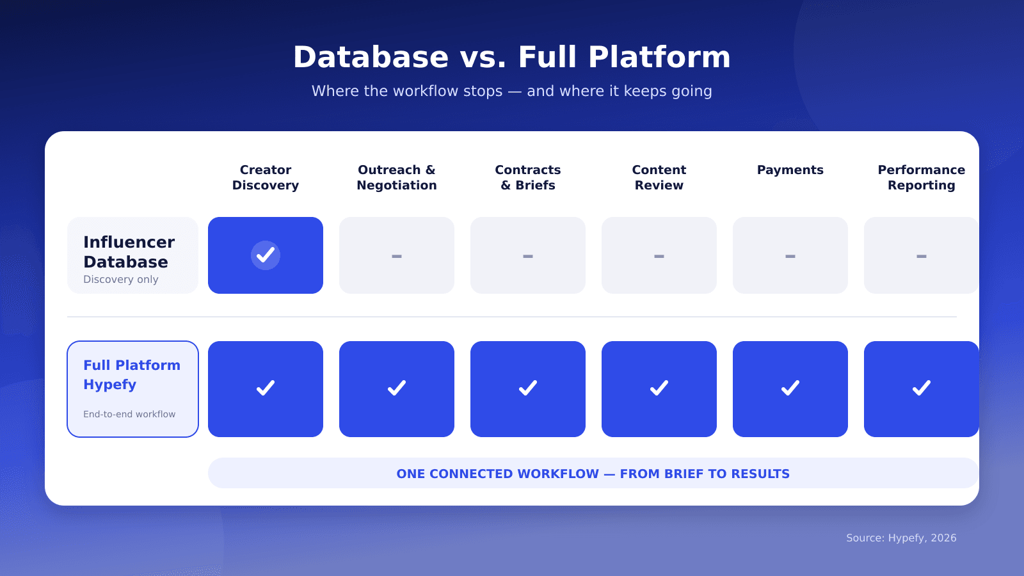
An influencer database provides a searchable list of creator profiles, along with engagement data and audience demographics.
That is where it stops. After the shortlist is built, outreach happens via email, negotiation happens over the phone or in DMs, contracts are managed in Google Docs or DocuSign, payments go through bank transfer or PayPal, and tracking is compiled manually.
Each step requires a separate tool and a person to manage the handoff between them.
A creator marketing platform covers the full workflow: discovery, outreach, briefing, content review, payments, and performance reporting in one place. The campaign runs from brief to result without leaving the platform.
A database is the right choice when a team only needs to find and vet creators and already has established workflows for everything after discovery. Agencies and in-house teams with dedicated operations staff can make this work.
A full platform works best when the team is small, campaigns run regularly, and the manual overhead of stitching tools together is where time and accuracy are lost. For most e-commerce brands running more than a few campaigns per year, the platform pays for itself in coordinator time alone.
Hypefy is a full platform. Discovery, briefing, outreach, content review, and creator payment run in one place, with campaign reporting on reach, CPM, and engagement, and no subscription between campaigns. Sales are attributed per creator through discount codes and UTM links read in your own store analytics. See how it works end-to-end.
How to Judge Value for Money
A headline monthly price is the wrong way to evaluate e-commerce influencer marketing software. The right question is what the tool delivers against what the store spends.
Attribution you can act on lets the store reinvest in what works, which increases the return on every subsequent campaign. Whether that comes from per-creator codes or a native store connection depends on how the program runs.
A tool that tracks sales back to individual creators lets the store reinvest in what works, which compounds the return on every subsequent campaign. A tool that handles outreach, approval, and payments saves coordinator hours that cost more than the platform fee in salary.
Three questions worth asking a vendor before signing.
Does the pricing model charge per creator, per campaign, or as a flat subscription, and what is the all-in cost for a realistic campaign at the scale the store plans to run?
What happens to the cost if the store runs more creators per campaign or more campaigns per quarter? Does the cost scale with volume or stay flat?
Is performance tracking tied to sales, or only to engagement metrics? If the store cannot see which creators drove which orders, the tool is not generating the data it needs to improve.
The sections above cover the work the tool supports, including what influencer marketing does for a store, which campaign types drive sales, how to find creators who convert, and how to run and scale campaigns once the tooling is in place.
What Influencer Marketing Does for an E-Commerce Brand
For a store, influencer marketing is a customer acquisition and content production channel at the same time.
Product discovery in feeds that paid ads cannot buy. A creator posting about a product reaches their audience through a trusted source. That is a meaningfully different placement than a paid advertising slot.
That distinction matters because the creator's endorsement carries the weight of a personal recommendation. That credibility is what paid advertising cannot replicate. Audiences who find a product through a creator they follow are already predisposed to trust it.
Trust that converts. Creator content performs better than brand-produced content for the same reason word-of-mouth outperforms a billboard.
A real person demonstrating how a skincare product changed their skin, how a kitchen tool saved them time, or how a piece of clothing fits on a body like theirs is answering the question a product page rarely can, which is whether the product will work for someone like them.
Content the brand can reuse. Creator posts, Reels, and videos can be repurposed for product page imagery, paid social ads, email campaigns, and retargeting.
UGC repurposed into paid ads often outperforms studio-produced creative because it retains the native look and feel that audiences recognize as authentic. A single campaign can produce a content library that lowers production costs across multiple channels for months.
Customer acquisition at a lower cost than paid social. As cost-per-click on Meta and Google increases, influencer marketing offers an alternative acquisition route. A well-matched nano or micro creator can drive meaningful traffic to a product page at a cost per acquisition that paid channels struggle to match, particularly in saturated categories.
5 Types of Influencer Campaigns That Drive E-Commerce Sales
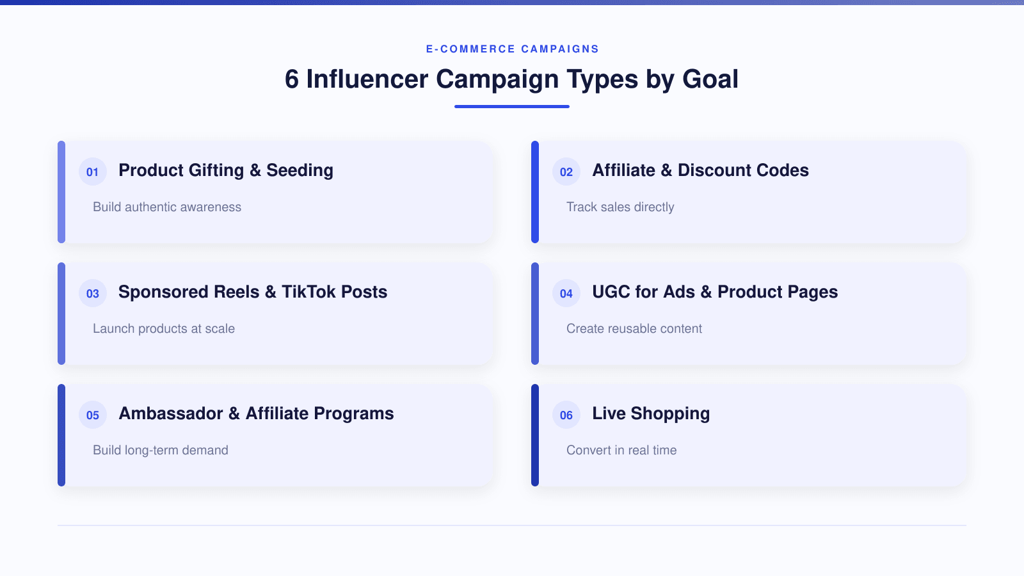
1. Product gifting and seeding are the entry points for most stores. Send products to creators whose content naturally aligns with the brand, with no content obligation attached. Creators who like the product post organically, and the brand captures authentic content and reach without a paid commitment.
It works across Instagram, TikTok, and YouTube and is the lowest-friction way to test a creator relationship before investing in a paid deal. Pair each creator with a unique discount code to build in attribution.
2. Affiliate, discount code, and ambassador programs are the most trackable campaign type for e-commerce. The creator shares a unique code or link and earns a commission on sales it drives, and the brand gets clean attribution without needing a platform integration.
Commission rates typically run 5% to 30% of the sale value, depending on the program. Works well with nano and micro creators who have purchase-ready audiences and are willing to earn from results. TikTok Shop affiliate deals have become a common format for stores selling on TikTok. The recurring version of this is an ambassador program, where a defined group of creators is briefed across many campaigns over months or years and earns commission on every sale. It takes more relationship management than one-off deals, but the returns build as the same creators feature the brand again and again.
3. Sponsored Reels and TikTok posts are the workhorse format for awareness and product launches. The creator produces a short-form video featuring the product, posted to their own channel.
Performance depends heavily on creator-product fit and how natural the integration feels. The best-performing sponsored posts are ones where the product appears in a context that the creator's audience already expects from them.
4. UGC for ads and product pages separates the content creation from the posting. Brands commission creator-style videos for internal use, such as paid social ads, product page imagery, and email campaigns, without requiring the creator to post to their own channel.
Lower creator cost (no audience access fee), retains the authentic look that performs well in ads. Increasingly common for brands that have learned what creative style converts best.
5. Live shopping is relevant for brands selling on TikTok Shop or through YouTube Shopping. A creator hosts a live session featuring the product, with direct in-app purchase links.
Live shopping suits demonstrable categories like food, beauty, fashion, and gadgets, where watching a product used in real time and getting a question answered on the spot does more than a standard feed post can. The format requires a creator who is comfortable presenting on camera at length and a product that benefits from live demonstration.
Commission UGC from creators matched to your product with Hypefy's discovery tool.
How to Find the Right Creators for Your Store
Finding creators who convert for a store is different from finding creators with large followings. The criteria that matter are specific to e-commerce.
Audience fit with the product is the first filter. A creator whose audience matches the store's target customers, in age, interest, geography, and purchasing behavior will outperform a larger creator whose audience does not.
A fitness equipment brand needs creators whose followers work out, not creators who post about fitness as part of a broader lifestyle aesthetic.
Engagement quality over follower count. Saves and comments with specific product questions are stronger signals than likes. A creator whose audience saves posts about products they want to buy and comments asking where to get them have a more purchase-ready following than one with the same follower count but generic engagement.
Evidence that the creator's audience buys. Creators who regularly feature affiliate links and report strong conversion rates are signaling that their audience acts on recommendations. Asking for recent affiliate performance data before committing to a deal is reasonable, and any experienced creator will have it.
Past performance with similar products. A creator who has previously featured products in the same category and whose audience responded is a lower-risk brief than one who has never posted in the product space. Check their sponsored content history before outreach.
The main discovery routes for a store are manual search on Instagram and TikTok using niche hashtags, checking who already follows and tags the brand, influencer databases that filter by niche and audience demographics, creator marketplaces where creators apply to brand campaigns, and full platforms with creator matching.
Hypefy's semantic matching finds creators by reading the meaning of what they post. A creator who consistently posts dinner recipe content matches a food brand's brief, even if their bio never mentions cooking.
How to Set Up a Campaign That Sells
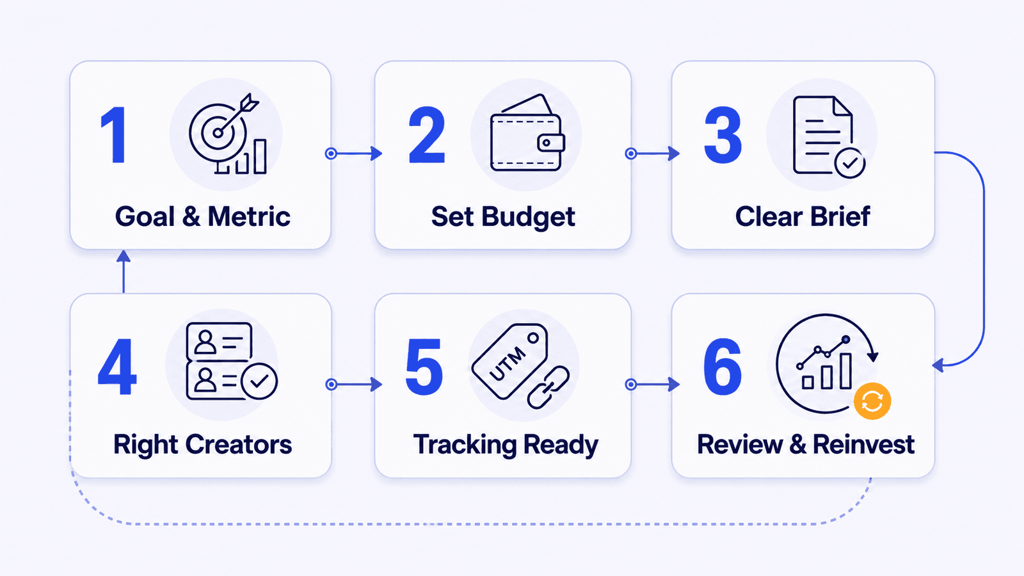
1. Define the goal and the metric that proves it. For a store, that metric is sales or attributed revenue. Setting reach or impressions as the primary metric misaligns the whole campaign. Set the target before briefing anyone. The metric determines which creators to choose, which campaign type to run, and what tracking to set up.
2. Set a budget and understand how it will be spent. The budget covers creator fees or product cost and ideally stays within a defined pool without expanding with each new creator added. Knowing the budget before starting creator selection avoids the common problem of building a shortlist that the budget cannot support.
3. Write a clear brief. The brief covers the product, the target customer, the key message, required disclosure, the deliverable, the posting window, and what is off-limits. It does not script the creator's words. Creator content that sounds like a brief performs worse than content that sounds like the creator.
4. Choose the right creators and campaign type for the goal. Product launches suit sponsored posts from mid-tier creators for reach, while nano and micro creators are best for conversion. Sustained sales growth is suited to an ambassador or affiliate program. UGC production for ads suits a product seeding campaign with a content rights agreement.
5. Set up tracking before the first post goes live. Every creator gets a unique discount code and UTM link. These go in before posting. Setting them up after the fact produces incomplete attribution. Post-campaign attribution is consistently incomplete because some customer behavior, like using a code they saw three days earlier, cannot be reconstructed retroactively.
6. Review what worked and reinvest in it. After the campaign, rank creators by cost per sale and cost per click. The top performers get briefed again. The bottom performers get replaced or briefed differently. One round of data is rarely enough to optimize. The second campaign, built on the first round's data, produces better results than starting from scratch.
How E-Commerce Brands Scale Influencer Marketing
A store running its first three influencer campaigns can manage with email, a shared spreadsheet, and manual payment. A store running twenty creators per month across three campaigns cannot. The tipping point is less a fixed number of creators than the moment coordination outgrows a spreadsheet and manual follow-up.
When volume increases, briefing becomes inconsistent without a standardized template, content approvals stack up and create delays, payment timing falls behind and damages creator relationships, tracking fragments across different spreadsheets, and the data that should be informing the next campaign is too scattered to use.
Managing many creators at once requires a central record of every creator, every deliverable, every payment due date, and every piece of content in review. Without it, things fall through the gaps. The creator who was paid late mentions it. The content that needed approval before Tuesday goes live without it.
Standardizing briefs and tracking is what makes campaigns reproducible. A brief that is written once, tested, and refined across campaigns produces better creator output than one that is rewritten from scratch each time. UTM structures and discount code naming conventions that are consistent across campaigns make performance data comparable across them.
Building ambassador and affiliate programs that renew is where influencer marketing becomes a channel that builds momentum over time. Creators who are briefed on a recurring basis, paid reliably, and given genuine creative latitude build audience associations with the brand that compound over time. The third campaign with the same creator outperforms the first one on content quality and conversion rate, consistently.
Reinvesting in what works is the discipline that separates compounding programs from flat ones. The creator's performance data from each campaign should directly determine who gets briefed next and at what investment level. Programs that reinvest in top performers and cut underperformers improve their average cost per sale over time.
Check engagement quality before shortlisting with the Instagram engagement rate calculator.
Running E-Commerce Influencer Marketing With Hypefy
Hypefy covers the workflow this guide describes.
It matches creators to the product using semantic search, manages the campaign through outreach, content review, and approvals, and prices creators based on real engagement data against the campaign budget rather than adding a separate tool fee.
For e-commerce brands, that means finding creators whose content fits the product, briefing them through a structured workflow, and managing the campaign in one place. Hypefy reports on reach, CPM, and engagement, while sales tracking stays on your side, through per-creator discount codes and UTM links read in your own store analytics.
Influencer Marketing Tools for E-Commerce Brands FAQs
1. What is e-commerce influencer marketing?
e-commerce influencer marketing is partnering with creators on Instagram, TikTok, and YouTube to drive product discovery and sales. The goal is a measurable store outcome such as orders, revenue, or customer acquisition.
2. How do e-commerce brands find influencers?
E-commerce brands find influencers through hashtag search, checking who already tags the brand, influencer databases, creator marketplaces, and full platforms with creator matching. For niche products, tools that match by content meaning find more relevant creators than keyword filters.
3. What is the best type of influencer campaign for e-commerce?
The best type depends on the goal. Affiliate and discount code deals are the most trackable. Product seeding is the lowest-cost entry point. Sponsored Reels and TikTok posts work best for product launches. UGC-commissioned paid ads produce the highest-converting creative for Meta and TikTok.
4. Do influencer campaigns work for small online stores?
Yes. Nano and micro creators are affordable, more engaged, and more niche-concentrated than larger tiers. A gifting campaign with well-matched nano creators can drive meaningful traffic and sales at a lower total cost than a single paid social campaign.
5. How do you measure the ROI of e-commerce influencer marketing?
Track revenue through creator-specific UTM links and discount codes. Divide the attributed revenue by the total campaign cost to get the return multiple. Set up tracking before the first post goes live; retroactive attribution is always incomplete.
6. What should I look for in influencer marketing software for e-commerce?
The features to look for are creator discovery with audience fit filters, engagement quality data, sales attribution tracking, content approval workflow, payment management, and creator-level performance reporting. Attribution starts with per-creator discount codes and UTM links, which work on any storefront and are what most tools rely on. A native Shopify or WooCommerce connection removes the manual reconciliation step, which matters more the larger your creator roster gets.
7. What is the difference between an influencer database and a platform?
A database helps you find and vet creators. Everything after is your responsibility. A platform covers the full workflow from brief to performance report in one place. Databases suit teams who only need discovery. Platforms suit stores running regular campaigns where manual overhead across multiple tools costs more than the platform fee.