Top health creators in 2026 include Dr. Mike Varshavski, Steph Grasso, Andrew Huberman, and Dr. Julie Smith, covering medical education, nutrition, wellness, and mental health.
This guide groups the creators worth knowing by what they cover, across both Instagram and TikTok, with follower counts and credentials checked at the time of writing.
If you are here to find credible creators to follow, the lists below are sorted by topic.
If you are a brand evaluating a partner, each entry names the kind of brand it suits, and the sections that follow cover how to vet a creator, the disclosure and claim rules that apply specifically to health content, and a faster way to find creators in this niche.
Top Health Influencers
General health creators cover nutrition, preventive care, evidence-based lifestyle habits, and accessible medical education. Most combine some level of credential, often a registration, a degree, or a clinical background with content that is practical and non-prescriptive.
Follower counts are time-sensitive, and the platform figure is from September 2026.
1. Steph Grasso MS, RD
Handles: @stephgrassodietitian (TikTok, Instagram) | Platforms: TikTok strongest | Followers: 2.1M TikTok, 269K Instagram | Credential: Registered Dietitian, MS in Nutrition
Brand fit: food brands, supplement companies, and grocery retailers looking for evidence-based nutrition credibility with a 25-40 female audience.
Steph Grasso makes nutrition science practical and unstuffy, with grocery guides, high-protein meal ideas, and myth-busting diet culture.
Her TikTok is high-volume and consistently well-received, as shown by features on Good Morning America, The Washington Post, and a Penguin Random House cookbook deal.
2. Dr. Idz (Idrees Mughal) MBBS, MRes
Handles: @dr_idz (TikTok, Instagram) | Platforms: TikTok strongest | Followers: 1.9M TikTok, 769K Instagram | Credential: NHS doctor (MBBS), MRes in Nutritional Research, board-certified in lifestyle medicine
Brand fit: evidence-based supplement brands, whole-food companies, and health technology whose claims are genuinely research-backed.
Dr. Idz debunks nutrition and wellness misinformation with an evidence-first approach, taking apart fad diets, "superfoods," and exaggerated health claims in short, punchy explainers.
His clinical-plus-nutrition credential makes him a strong fit for brands that need a claim to survive scrutiny.
3. Dr. Karan Rajan, MBBS
Handles: @dr.karanr (TikTok, Instagram) | Platforms: TikTok strongest | Followers: 5.4M TikTok, 2M Instagram, 2M YouTube | Credential: NHS general surgeon (MBBS), honorary clinical lecturer
Brand fit: broad health and science brands with evidence-based products; verify no conflict with his own gut-health lines.
Dr. Karan Rajan covers general health and science myth-busting, from gut and body facts to debunking viral health trends, delivered with dark humour that travels well on short video.
He founded gut-health ventures (Loam, Throne Science), so screen for category overlap before partnering.
4. Kylie Sakaida, RD
Handles: @kyliesakaida (TikTok, Instagram) | Platforms: TikTok strongest | Followers: 3M+ TikTok, 1.9M Instagram, 1.9M+ YouTube | Credential: Registered Dietitian
Brand fit: Whole-food brands, kitchen tools, and companies positioned around simplicity and accessibility rather than premium supplementation.
Kylie Sakaida focuses on realistic nutrition and anti-diet messaging, alongside practical eating tips that don't require expensive products or complicated routines.
Her tone is approachable and her audience skews younger millennials and Gen Z.
5. Kat Maki, PhD
Handles: @epidemiologistkat (TikTok, Instagram) | Platforms: TikTok strongest | Followers: 285K TikTok, 109K Instagram | Credential: Doctor of Epidemiology, PhD
Brand fit: public health campaigns, diagnostics companies, and supplement brands with genuine clinical backing.
Kat Maki translates public health data and epidemiology into plain language: what studies show, what they don't, and how to read health headlines without being misled.
Her audience is health-curious and skeptical, which makes her a strong fit for brands that want to make a credible evidence-based claim.
6. Abbey Sharp, RD
Handles: @abbeyskitchen (Instagram, TikTok, YouTube) | Platforms: TikTok strongest | Followers: 1.2M TikTok, 430K Instagram, 716K YouTube | Credential: Registered Dietitian
Brand fit: food and grocery brands wanting credibility alongside mainstream appeal, and supplement companies whose products are evidence-based.
Abbey Sharp is known for her food reviews and recipe content, but her strongest editorial angle is holding wellness misinformation to account; she regularly critiques misleading diet culture content from other creators.
7. Dr. Megan Rossi RD, PhD
Handles: @theguthealthdoctor (Instagram) | Platforms: Instagram strongest | Followers: 599K Instagram | Credential: Registered Dietitian, PhD in gut health, research fellow at King's College London
Brand fit: fibre and whole-food brands, gut-friendly food companies, and digestive-health products outside her own product lines.
Dr. Megan Rossi translates microbiome and gut-health research into practical eating advice, fibre diversity, and honest takes on probiotics and bloating.
She runs her own food and supplement brands (Bio&Me, SMART STRAINS), so she suits non-competing partners.
8. Dr. Rupy Aujla, MBBS, MRCGP
Handles: @doctors_kitchen (Instagram, YouTube, TikTok) | Platforms: YouTube strongest | Followers: 749K Instagram, 788K+ YouTube, 16.2K TikTok | Credential: GMC-registered GP (MBBS, MRCGP), MSc in Nutritional Medicine
Brand fit: whole-food and cooking brands, kitchenware, grocery retailers, and evidence-based health apps. He runs his own recipe app, The Doctor's Kitchen, so check for overlap before partnering.
Dr. Rupy Aujla is a London-based GP who founded The Doctor's Kitchen to show how everyday cooking supports health.
His content turns nutrition research into practical, plant-forward recipes, backed by a podcast, five cookbooks, and a recipe app.
9. Dr. Jessica Knurick, PhD, RDN
Handles: @drjessicaknurick (Instagram, TikTok) | Platforms: Instagram strongest | Followers: 1.8M Instagram, 498.4K TikTok| Credential: Registered Dietitian, PhD in Nutrition Science
Brand fit: evidence-based food and nutrition brands, public-health campaigns, and consumer health education platforms. Partnerships should leave room for nuanced, well-supported claims.
Dr. Jessica Knurick explains nutrition science, public health, and food policy in clear, evidence-based terms.
Her content addresses wellness and chronic-disease misinformation while giving audiences context for evaluating health claims.
Her focus on prevention and accessible education makes her a strong fit for a general health roundup.
If your campaign leans toward workouts and training, our Fitness Influencers Tool is the better place to look.
Top Wellness Influencers
Wellness creators cover sleep, stress, mindfulness, recovery, longevity, supplements, and skin health. The category is broader and less clinically defined than health.
Most wellness creators speak from personal experience, a coaching certification, or interest-led expertise rather than a clinical license, which affects both the tone of a partnership and the claims that can safely be made.
Follower counts are time-sensitive, and the platform figure is from September 2026.
1. Mel Robbins
Handles: @melrobbins (Instagram, TikTok, YouTube) | Platforms: Instagram strongest | Followers: 12.8M+ Instagram, 6M TikTok, 6.2M YouTube | Credential: No clinical license; author, speaker, certified life coach
Brand fit: productivity tools, sleep brands, supplement companies, and mental wellness apps targeting a 30–55 audience looking for practical self-improvement content.
Mel Robbins is the largest wellness creator on this list by follower count. Her 5-second rule and high-output content on mindset, habit change, and mental resilience reach a broad adult audience.
2. Andrew Huberman, PhD
Handles: @hubermanlab (Instagram, TikTok, YouTube) | Platforms: Instagram strongest | Followers: 8M Instagram, 7.8M YouTube, 662K+ TikTok | Credential: PhD in Neuroscience, associate professor at Stanford School of Medicine
Brand fit: sleep products, supplements, athletic recovery tools, and consumer health technology.
Andrew Huberman covers sleep, light, stress, hormones, and performance from a neuroscience lens.
His content is long-form and protocol-heavy, with practical instructions backed by research citations. His audience skews male, 25-45, and is unusually willing to act on supplement and tool recommendations.
3. Dr. Rhonda Patrick PhD
Handles: @foundmyfitness (Instagram, YouTube, TikTok) | Platforms: Instagram strongest | Followers: 1M+ Instagram, 726K YouTube, 101.8K TikTok | Credential: PhD in Biomedical Science
Brand fit: longevity-focused supplement brands, cold therapy equipment, and health technology companies targeting a science-literate audience.
Rhonda Patrick covers micronutrients, sauna, cold exposure, and the intersection of genetics and longevity. Dense, research-heavy content for an audience that reads studies.
4. Dr. Mark Hyman, MD
Handles: @drmarkhyman (Instagram, YouTube, TikTok) | Platforms: Instagram strongest | Followers: 3.7M Instagram, 1.51M YouTube, 428K+ TikTok | Credential: MD, functional medicine specialist
Brand fit: functional food brands, supplement companies, and lifestyle health brands aligned with his integrative approach.
Mark Hyman covers functional medicine, food as medicine, and lifestyle-based approaches to chronic health.
His audience is large and skews health-conscious, 35-55. His approach sits outside mainstream clinical guidance in places, so verify any product claim against current evidence before partnering.
5. Jessie Inchauspé (Glucose Goddess)
Handles: @glucosegoddess (Instagram, TikTok) | Platforms: Instagram strongest | Followers: 6.3M Instagram, 649K+ TikTok | Credential: Master of Science in Mathematical Biology; not a clinician
Brand fit: blood glucose monitoring technology, low-glycemic food brands, and metabolic health supplements.
Jessie Inchauspé makes blood glucose science accessible, with meal sequencing, spike management, and continuous glucose monitor data explained in clear infographics.
Her audience is highly engaged with metabolic health.
6. Bryan Johnson
Handles: @bryanjohnson_ (Instagram, YouTube, TikTok) | Platforms: Instagram strongest | Followers: 2.7M Instagram, 2.23M YouTube, 873K+ TikTok | Credential: No clinical background; tech entrepreneur (founder of Braintree and Kernel), runs the Blueprint longevity protocol
Brand fit: longevity and biohacking brands that don't compete with his Blueprint line; vet claims and brand safety carefully given the scrutiny around his protocol.
Bryan Johnson documents his "Don't Die" anti-aging regimen, tracking sleep, diet, supplements, and dozens of biomarkers as a public self-experiment.
His reach in longevity is large, though he sells his own supplement and food line though he sells his own supplement and food line, and his protocol is a personal self-experiment rather than a clinical study.
Find dietitian and nutrition creators matched to your brief with Hypefy's influencer discovery tool.
Top Mental Health Influencers
Mental health creators range from licensed therapists and psychologists sharing clinical education to advocates sharing lived experience.
The distinction between licensed and non-licensed matters more here than anywhere else on this blog; an audience dealing with serious mental health concerns deserves to know whether the person they're watching holds a clinical qualification.
Handle this category with care. A creator's content supports awareness and general education. Following someone on TikTok is not a substitute for professional support.
Brands working in this space should be especially careful about tone, the claims made in any sponsored content, and the kind of content they ask a creator to produce.
Follower counts are time-sensitive, and the platform figure is from September 2026.
1. Dr. Julie Smith, Psychologist
Handles: @drjuliesmith (TikTok, Instagram, YouTube) | Platforms: TikTok strongest | Followers: 4.9M TikTok, 2.2M Instagram, 1.93M YouTube | Credential: Doctorate in Clinical Psychology, practicing psychologist
Brand fit: mental wellness apps, therapy platforms, and wellbeing brands with a genuine mental health positioning.
Dr. Julie Smith covers therapy skills, emotional regulation, and mental health literacy in short, accessible clips.
She's one of the most followed licensed mental health professionals on TikTok globally and is the author of the bestselling book ‘Why Has Nobody Told Me This Before?’.
2. Kati Morton, LMFT
Handles: @katimorton (YouTube, Instagram, TikTok) | Platforms: YouTube | Followers: 1.5M+ YouTube, 104K Instagram, 274.5K TikTok | Credential: Licensed Marriage and Family Therapist
Brand fit: mental health platforms, telehealth services, and wellness brands whose positioning genuinely supports mental health access.
Kati Morton has spent over a decade making therapy concepts accessible online. Her content covers anxiety, eating disorders, trauma, and the decision of when to seek professional help.
3. Dr. Nicole LePera, PhD
Handles: @the.holistic.psychologist (Instagram, TikTok, YouTube) | Platforms: Instagram strongest | Followers: 8.9M Instagram, 1.5M TikTok, 849K YouTube | Credential: PhD in Psychology, licensed psychologist in Pennsylvania
Brand fit: wellness and self-development brands; not suited to brands whose claims must be clinically grounded.
Nicole LePera reaches an enormous audience with content on self-healing, reparenting, and nervous system regulation.
Her work is popular and has been both praised and critiqued within clinical psychology. Her approach is self-directed rather than clinical, so verify alignment before partnering.
4. Patrick Teahan, LICSW
Handles: @patrickteahanofficial (YouTube, Instagram, TikTok) | Platforms: YouTube strongest | Followers: 831K YouTube, 331K Instagram, 234.2K TikTok | Credential: Licensed Independent Clinical Social Worker
Brand fit: mental health platforms, therapy-adjacent apps, and publishers in the self-help and recovery space.
Patrick Teahan specializes in adult children of alcoholics and dysfunctional family recovery. His audience is highly specific and deeply loyal.
5. Nedra Tawwab, LCSW
Handles: @nedratawwab (Instagram, TikTok) | Platforms: Instagram | Followers: 1.8M Instagram, 22K+ TikTok | Credential: Licensed Clinical Social Worker
Brand fit: productivity and wellness apps, therapy platforms, and self-help publishers.
Nedra Tawwab covers boundaries, relationships, and emotional health through infographic-led Instagram content and bestselling books. Her audience is large, engaged, and skews toward professional women 25-40.
6. Elyse Myers
Handles: @elysemyers (TikTok, Instagram) | Platforms: TikTok strongest | Followers: 7.1M TikTok, 3.9M Instagram, 1.09M YouTube | Credential: No clinical credential listed; shares lived experience
Brand fit: campaigns focused on reducing stigma, community, and lived-experience storytelling. Avoid positioning her as a clinical expert or asking her to make treatment or product-efficacy claims.
Elyse Myers is a writer, comedian, and creator whose storytelling includes her personal experiences with anxiety, depression, postpartum depression, and ADHD.
She brings a lived-experience perspective to the list, but her content should be understood as personal storytelling rather than clinical mental health education.
Check engagement quality and sponsorship history before shortlisting with the Instagram engagement rate calculator.
Top Medical and Healthcare Influencers
Medically qualified creators, doctors, nurses, pharmacists, dentists, and registered dietitians offer a brand something wellness and health creators typically cannot: clinical credibility with a skeptical audience.
For products that affect health outcomes, a recommendation from a practising physician carries more weight than one from a wellness creator, and that matters especially when the audience is health-anxious or has been burned by overclaiming brands before.
The trade-off is that what a medical professional can say in a sponsored post is more tightly constrained. Claims must be accurate. Anything that could be construed as medical advice about a specific condition requires careful legal review.
Follower counts are time-sensitive, and the platform figure is from September 2026.
1. Dr. Mike Varshavski, DO
Handles: @doctor.mike (Instagram, TikTok, YouTube) | Platforms: YouTube strongest | Followers: 15M+ YouTube, 5.6M Instagram, 3.1M TikTok | Credential: Doctor of Osteopathic Medicine, board-certified family medicine physician
Brand fit: health services, consumer health technology, telehealth, and mainstream health and wellness brands with evidence-based products.
One of the most-followed practising physicians on English-language social media.
Dr. Mike covers myth-busting, medical education, and trending health topics with clinical accuracy and broad entertainment appeal. He was named to TIME100 Health in 2026.
2. Dr. Danielle Jones, MD
Handles: @mamadoctorjones (TikTok, Instagram, YouTube) | Platforms: YouTube strongest | Followers: 1.2M TikTok, 1.5M+ YouTube, 314K Instagram | Credential: OB/GYN, associate professor at Texas A&M Health Science Center, co-founder of Association for Healthcare Social Media
Brand fit: reproductive health brands, women's health platforms, and sexual health companies; Tampax has previously worked with her.
Dr. Danielle Jones covers reproductive health, sexual health, and women's healthcare for a young adult audience. Her content is evidence-based, inclusive, and targets health topics often poorly covered elsewhere.
3. Dr. Anthony Youn, MD
Handles: @doctoryoun (TikTok, Instagram, YouTube) | Platforms: TikTok strongest | Followers: 8.5M TikTok, 1.7M Instagram, 5.5M+ YouTube | Credential: Board-certified plastic surgeon
Brand fit: skincare brands, anti-aging products, and aesthetic treatment providers.
Dr. Anthony Youn covers anti-ageing, skincare science, and plastic surgery education in an accessible and often humorous format. His content reaches a broad audience interested in skin health.
4. Nurse Blake, BSN, RN
Handles: @nurseblake (TikTok, Instagram, YouTube) | Platforms: TikTok and Instagram | Followers: 1.2M+ TikTok, 1.2M Instagram, 2.2M Facebook | Credential: Registered Nurse
Brand fit: healthcare employers, nursing education platforms, and medical supply companies reaching clinical staff.
Nurse Blake makes nursing and hospital life relatable and funny, with an underlying thread of genuine patient care advocacy. His audience is both healthcare professionals and general health audiences.
5. Dr. Jen Gunter, MD
Handles: @drjengunter (Instagram, TikTok) | Platforms: Instagram strongest | Followers: 464K+ Instagram, 345K+ TikTok | Credential: OB/GYN, board-certified pain medicine physician
Brand fit: evidence-based women's health brands; she's unlikely to partner with products that aren't rigorously backed.
Dr. Jen Gunter is one of the most prominent debunkers of women's health misinformation, known particularly for challenging pseudoscientific wellness claims. Her audience is highly educated and skeptical of overclaiming.
6. Dr. Glaucomflecken, MD
Handles: @docglauc (Instagram, YouTube, TikTok, X) | Platforms: TikTok strongest | Followers: 2.6M TikTok, 860K Instagram, 1.29M YouTube | Credential: Practising ophthalmologist
Brand fit: healthcare organizations, medical education, workforce initiatives, and public-awareness campaigns where humor fits the message.
Will Flanary, known as Dr. Glaucomflecken, creates medical comedy about clinical life, healthcare systems, and ophthalmology.
He identifies himself as a practising ophthalmologist and medical-comedy creator. The humor and healthcare commentary are central to his format; his content is not a substitute for condition-specific patient education.
Find medical and healthcare creators matched to your campaign with Hypefy's influencer discovery tool.
Health Influencers on Instagram vs TikTok
The two platforms serve health content differently, and the choice of platform shapes the kind of campaign that's possible.
Instagram is better for considered, visual health content. Infographics, before-and-after formats, carousel education, and polished photography all perform well. The audience is typically slightly older than TikTok and more likely to engage with long-form captions and saved posts.
Health content that requires context, such as a nutritionist explaining a supplement or a pharmacist walking through an interaction, lands better in carousel format on Instagram than in a 30-second TikTok clip.
Creators who are strongest on Instagram from the lists above: Nedra Tawwab, Jessie Inchauspé, Dr. Megan Rossi, Bryan Johnson, and Andrew Huberman (for static posts).
TikTok is better for fast, hook-driven health content. The For You Page distributes based on watch time and completion rate, which rewards punchy, surprising formats, myth-busting, "did you know," and reaction-to-trend structures.
Medical professionals who adopt a naturally quick, direct style perform particularly well. TikTok's health audience skews younger, is quicker to share, and has been shown to amplify health topics widely when a creator picks up a viral angle.
Creators who are strongest on TikTok from the lists above: Dr. Julie Smith, Dr. Idz, Dr. Karan Rajan, Steph Grasso, Nurse Blake, Dr. Anthony Youn, Elyse Myers, and Dr. Mike Varshavski.
A campaign that needs depth and credibility with an older audience should lean toward Instagram. A campaign that needs reach and virality with a younger audience, or that can land its key message in under 30 seconds, should lean toward TikTok.
Model your campaign budget for a medical creator at this tier with the CPM calculator.
How to Choose the Right Health Influencer for Your Brand
Verify credentials at the source. A creator who describes themselves as a nutritionist may or may not hold a registered dietitian credential, and the two are meaningfully different in many markets.
Check the licensing body rather than the self-description. For clinicians, a license is typically verifiable through a state or national board.
Read engagement quality. In the health niche, comment quality matters more than in most categories.
A product question, a personal disclosure, or an "I've been looking for something like this" from a commenter signals a purchase-ready audience, while a comment section full of emoji reactions and generic encouragement is less useful.
As a reference point, engagement in this niche is flatter than the general rule of thumb suggests.
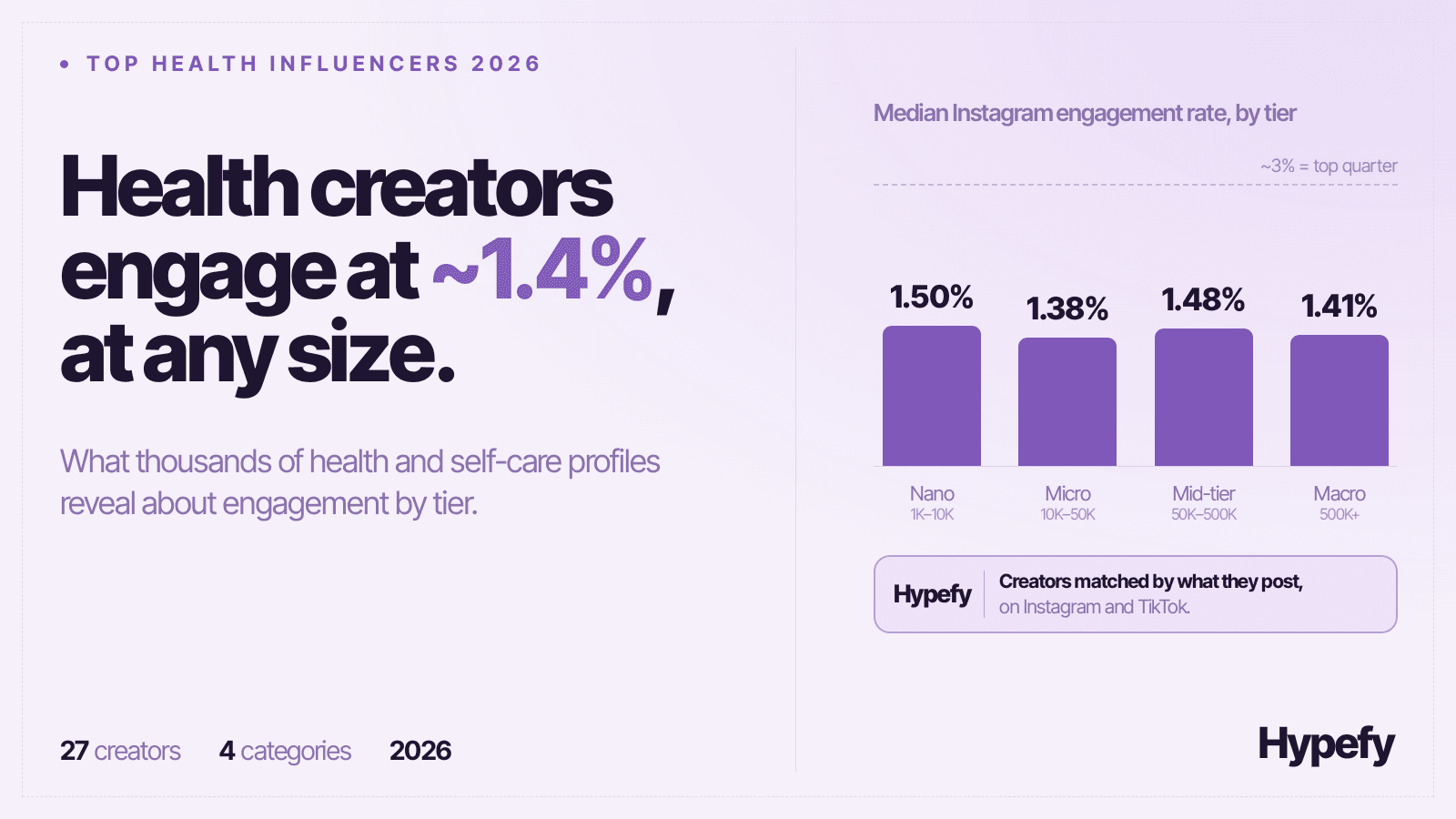
Across Instagram, creators tagged health or self-care in the Hypefy database, the median engagement rate runs at 1.50% for nano accounts (1K-10K), 1.38% for micro (10K-50K), 1.48% for mid-tier (50K-500K) and 1.41% for macro (500K+), on samples of several thousand profiles per tier.
The practical read is that a large health account is not automatically the weaker engager, and a small one is not automatically the stronger.
A rate around 1.4% is ordinary at any size in this niche, and anything approaching 3% sits in the top quarter.
The engagement rate benchmarks page covers how this compares with other niches, and the Instagram engagement rate calculator runs the math on any handle.
Check whether the audience is in your market. A US-based health creator with a primarily US audience is a different proposition from one with a globally distributed audience, even at the same follower count. Ask for audience location data before briefing anyone.
Look at how they've handled previous sponsorships. A creator who's promoted products that would sit badly next to your brand, who has made health claims that were later disputed, or whose sponsored content receives noticeably lower engagement than organic content is a risk that follower count doesn't offset.
Check the sponsorship density. A health creator who posts a new brand deal every week has an audience that's fatigued by commercial content. Look for creators whose organic-to-sponsored ratio gives sponsored posts room to breathe.
Campaign Ideas for Health and Wellness Brands
Credential-led education. A qualified creator explains the science behind a product claim, using their clinical training to make the mechanism legible.
Works for supplements, diagnostics, and consumer health technology where the audience is skeptical of unverified claims.
Routine or protocol integration. The creator shows how a product fits into an existing health routine, such as a morning supplement stack, a sleep protocol, or a recovery ritual. The product stays in context rather than taking over.
Works for supplements, sleep aids, and recovery products where the use case is habitual rather than one-off.
Myth-check or debunk series. A qualified creator addresses common misconceptions in a product category, with the brand positioned alongside accurate information.
Particularly effective for categories damaged by pseudoscience, such as collagen, probiotics, and glucose monitors.
Considered-purchase explainer. Longer-form content on YouTube or an Instagram carousel that walks an audience through a decision they're already making, such as choosing between two supplement types or understanding when to see a doctor versus managing something at home.
Suits higher-consideration health products with longer purchase cycles.
Lived-experience content for mental health and wellness positioning. Non-clinical creators share authentic experience with a product or approach, with appropriate disclosure and no medical claims.
Suits mental wellness apps, mindfulness products, and sleep brands where a personal voice is more credible than a clinical one.
An Easier Way to Find Health Influencers
Finding health creators manually, verifying credentials, checking engagement quality, confirming audience geography, and reviewing past sponsorships is time-intensive work even before a single outreach message goes out.
Hypefy matches creators on Instagram and TikTok by what they post about, so a brief describing the product category and the target audience returns a shortlist of relevant creators rather than a keyword search through a generic database.
Outreach, contracts, content approval, and payment all sit in the same workflow. That matters in the health niche specifically, because approving content before it goes live is a compliance requirement here, and keeping that step in one place stops it from slipping.
Coverage is Instagram and TikTok. Brands whose health campaigns depend on YouTube, LinkedIn, or podcast integrations should plan those placements separately.
Describe a campaign and the discovery tool returns a matched shortlist to start from.
Top Health Influencers FAQ
1. Who is the top health influencer right now?
By combined reach and credibility, Dr. Mike Varshavski leads, a board-certified family medicine physician named to TIME100 Health in 2026.
For nutrition, Steph Grasso leads among registered dietitians. For mental health, Dr. Julie Smith is the most-followed licensed clinical psychologist.
Your answer depends on which part of health you're interested in.
2. Who are the top health influencers on Instagram?
Dr. Mike Varshavski, Andrew Huberman, Jessie Inchauspé (Glucose Goddess), Nedra Tawwab, and Abbey Sharp are among the strongest voices in 2026, each covering a distinct niche.
3. Who are the top health and wellness influencers?
The top health and wellness influencers differ by topic:
Health and nutrition: Steph Grasso, Abbey Sharp, and Kylie Sakaida
Wellness and longevity: Andrew Huberman, Dr. Rhonda Patrick, and Jessie Inchauspé
Mental health: Dr. Julie Smith, Kati Morton, and Nedra Tawwab
Medical education: Dr. Mike Varshavski, Nurse Blake, and Dr. Danielle Jones
4. Who are the best mental health influencers to follow?
Dr. Julie Smith (clinical psychologist) and Kati Morton (licensed therapist) for licensed clinical content.
Elyse Myers for honest lived experience with anxiety and ADHD. Nedra Tawwab for relational health and boundaries.
If you're seeking support personally rather than general content, a licensed therapist is always more reliable than social media.
5. Are health influencers actually licensed professionals?
Some are, some aren't. Several on this page hold clinical licenses as physicians, psychologists, dietitians, or nurses.
Others use wellness or coaching titles that don't require a regulated license. Check the specific claim against the relevant regulatory body, since the bio alone isn't reliable.
6. How much do health influencers charge for a sponsored post?
Rates rise with follower count and engagement quality. Influencer Marketing Hub's 2026 data puts nano creators at roughly $10-100 per Instagram post and micro creators at $150-500, with larger tiers climbing well beyond that.
Qualified creators in the health niche often command a premium above their tier, because the credential carries commercial weight.
The cost of influencer marketing guide covers the full breakdown.
7. Do health influencers have to disclose paid partnerships?
Yes. FTC guidelines require clear, conspicuous disclosure of any paid or gifted partnership. For health content, claims about a product's effect on health must also be accurate and not misleading.
8. Is Instagram or TikTok better for health influencer campaigns?
TikTok suits younger audiences and fast, hook-driven content, such as myth-busting and quick explainers.
Instagram suits more considered content, such as carousels and detailed captions for a slightly older audience.
The platform section above covers the differences in full.
9. How do brands find health influencers in a specific country?
Filter by audience location rather than creator location, since the two don't always match. Most discovery platforms support audience geography filters.
Hypefy's matching on Instagram and TikTok reads content meaning alongside audience data, surfacing local creators by language and cultural context rather than stated geography alone.