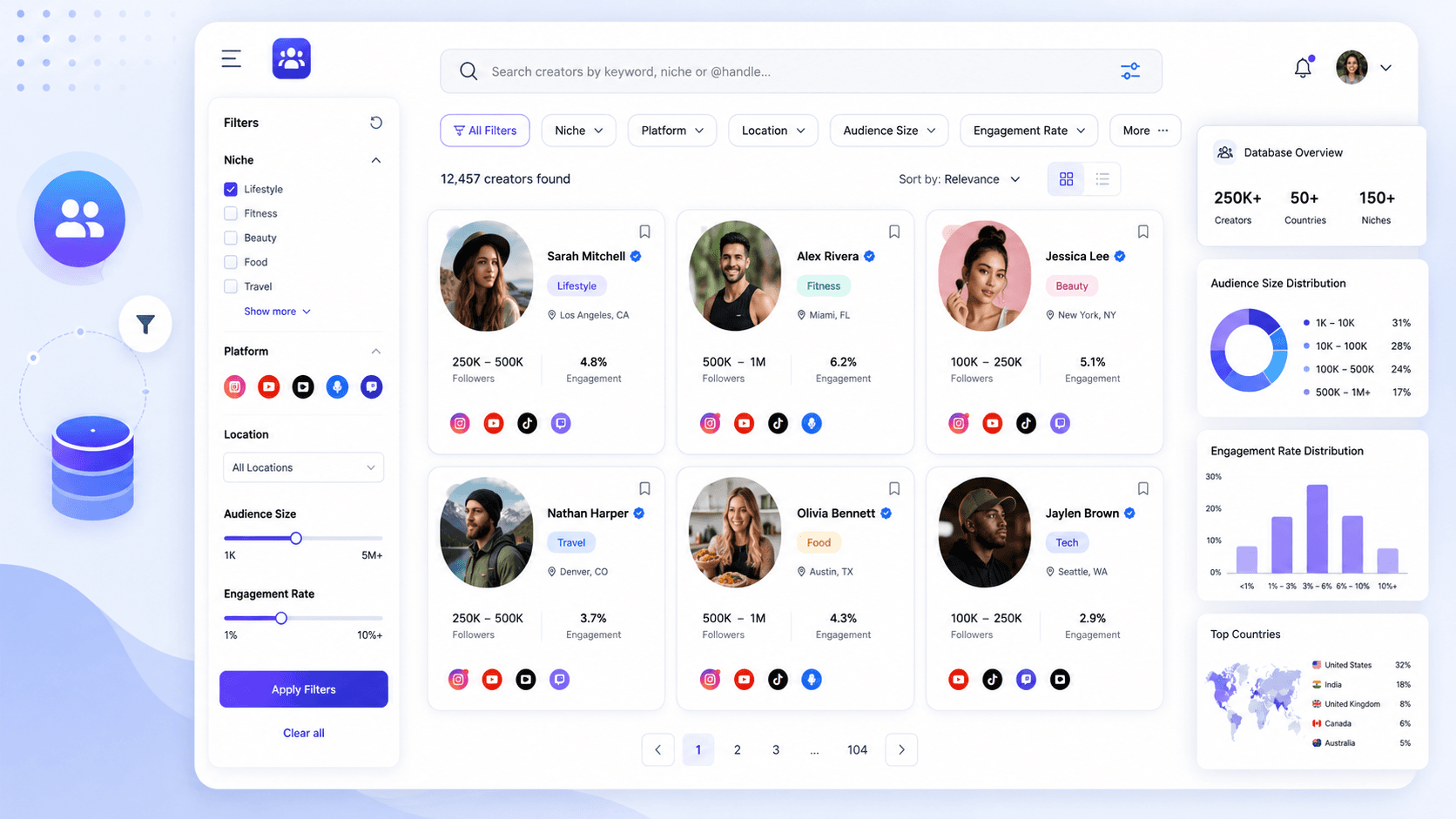
An influencer database is a searchable collection of creator profiles compiled from social media data, organized to enable brands to quickly find and filter creators.
As influencer marketing has grown into a roughly $32.5 billion market, searching for creators manually across Instagram, TikTok, and YouTube has stopped being workable. Creator communities now span multiple platforms, formats, niches, and markets. No spreadsheet keeps up with that.
A database solves the first problem: finding creators at scale. It does not solve everything that comes after.
This guide covers what an influencer database is, the types available, the features that matter, the main options, and the mistake that costs brands the most money when using one.
What an Influencer Database Is and Why It Matters
An influencer database, sometimes called a database of influencers, is a searchable collection of creator profiles built from public social data. The profiles typically include follower count, engagement rate, niche, location, audience demographics, and in some cases, contact information.
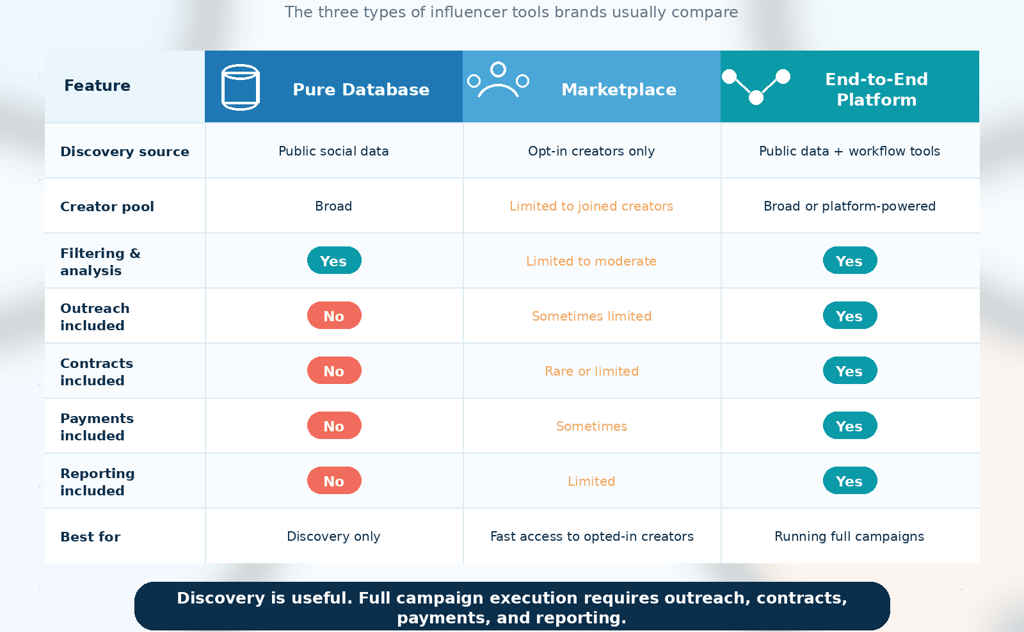
Brands use them to narrow a very large pool of creators down to a shortlist that fits their brief. The three types of tools brands encounter are worth distinguishing clearly because they are often confused:
Pure databases index creator profiles and let you filter and analyze them. That is where the tool stops. Outreach, contracts, payments, and reporting happen elsewhere.
Influencer marketplaces list creators who have opted in and are actively looking for brand partnerships. Discovery is limited to those who joined the platform. For some searches, that is fine. For others, you are looking at a small subset of the available creator pool.
End-to-end platforms combine discovery with the rest of the campaign workflow, including outreach, contracting, content review, payments, and reporting in one place. Hypefy is in this category. The database is only the entry point to the wider product.
The distinction matters because finding creators is rarely the whole job. Brands still have to contact them, agree on terms, review content, and process payment. A database-only tool hands you a list and leaves the rest to you.
What to Look For in an Influencer Database
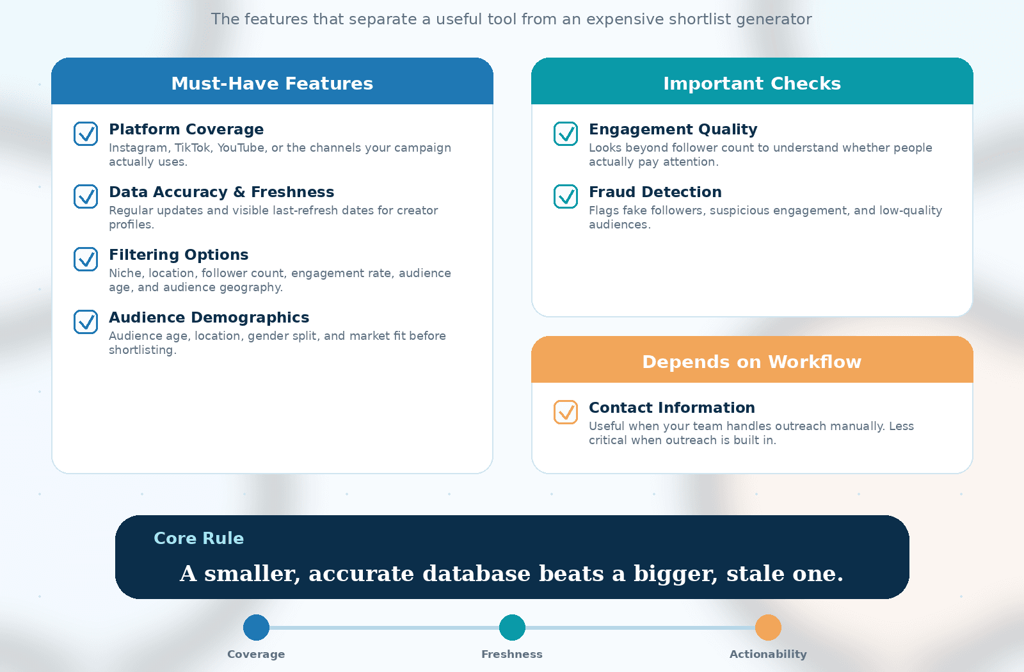
Not all databases are built equally. These are the features that separate a useful tool from one that generates a shortlist you cannot actually act on.
Coverage across the platforms you use. A database with strong Instagram data but weak TikTok coverage is less useful if your campaign runs on both. Regional reach and overall size matter too. A broader influencer marketing database that spans more countries gives you a wider starting pool when you run campaigns in specific markets. Check platform coverage before you subscribe.
Data accuracy and freshness. This matters more than total database size in 2026. Creator profiles can change quickly across Instagram, TikTok, and YouTube. Data that is three months old may reflect a creator who has since changed their content focus, audience, or posting activity. Look for databases that update creator data regularly and show when each profile was last refreshed.
How the data is collected. Databases build profiles either through official platform integrations or by indexing public data. Integration-sourced metrics tend to be more accurate and fresher, while publicly indexed data covers far more creators but can lag behind reality. Ask vendors which method they use for each platform, because the answer explains most of the differences in accuracy between tools.
Filtering options that match how you actually brief campaigns. Niche, location, follower count, engagement rate, and audience age and geography are the standard filters. Audience location specifically is critical. A creator with 80,000 followers concentrated in a market you do not sell in is not a useful candidate, regardless of their engagement rate.
Audience demographics and engagement quality data. Follower count tells you the size of the room. Engagement rate tells you whether anyone is paying attention. Audience quality data tells you whether those engagements are real. All three are necessary. The first one alone is close to useless. Hypefy’s own campaign data makes the point: across 11,968 completed Instagram posts, nano creators deliver a median engagement rate of 2.0% of reach, while micro creators deliver 1.4%. The room gets bigger, and the attention gets thinner.
Fraud and fake follower detection. Fake followers are structural across the creator ecosystem. A database without audience quality scoring or fraud flagging is giving you numbers that may not reflect real reach. Check whether the platform surfaces this data by default or requires a separate audit per creator.
Contact information. Some databases provide it, some do not. If you plan to do outreach yourself, you need it. If you are using a platform that handles outreach for you, it is less critical.
Top Influencer Databases for Brands
The right tool depends on your budget, the platforms you care about, and whether you need more than discovery.
Here is a comparison of the main options brands evaluate.
| Tool | Database size | Platforms | Standout strength | Starting price | Best for |
|---|---|---|---|---|---|
| Hypefy | Open creator universe on Instagram and TikTok (no opt-in required) | Instagram, TikTok | Full workflow: discovery, outreach, contracts, payments, reporting in one place | Campaign-based, no subscription | Brands wanting discovery plus end-to-end campaign management |
| Modash | 380M+ profiles | Instagram, TikTok, YouTube | Volume discovery with strong geographic audience filters | From $199/month | Teams needing large-scale discovery with detailed audience data |
| HypeAuditor | 227M+ profiles | Instagram, TikTok, YouTube, X (Twitter) | Best-in-class audience authenticity and fraud detection | From $299/month | Brands prioritizing audience quality verification above all else |
| Heepsy | 11M+ profiles | Instagram, TikTok, YouTube | Affordable with solid location-based search | From $69/month | Local businesses and small budgets |
| Upfluence | Approximately 3 to 12 million | Instagram, TikTok, YouTube | eCommerce integration | Custom pricing | DTC eCommerce brands connecting influencer activity to sales |
| Influencity | Over 170M | Instagram, TikTok, YouTube and Twitch | Deep audience analytics and campaign management | From $318/month | Data-driven teams prioritizing audience research |
1. Hypefy
Hypefy searches creators directly from Instagram and TikTok rather than relying on who joined a platform. The discovery layer is backed by AI matching that scores creators on audience fit and engagement quality before follower count. Smart pricing sets fair rates based on a creator’s actual recent engagement, so rate negotiation is built into the process.
Outreach, contracts, content review, payments, and performance reporting all sit in the same platform. See how the discovery tool works.
2. Modash
Modash indexes 380M+ creator profiles across Instagram, TikTok, and YouTube with strong audience demographic filters. It catalogs every public creator with at least 1,000 followers, which makes it unusually strong for nano- and micro-discovery. It is one of the more comprehensive database tools available for brands that need volume discovery with reliable geographic audience data. Contracts, outreach, and payments happen outside the platform.
3. HypeAuditor
HypeAuditor’s core strength is audience quality. It audits creator profiles for fake followers, bot activity, and suspicious engagement patterns and is widely regarded as the most rigorous tool available for that specific task. It does not manage outreach, contracts, or payments.
4. Heepsy
Heepsy covers 11M+ creators across Instagram, TikTok, and YouTube with solid location-based search, making it the most accessible option for brands on a tight budget or local businesses looking for regional creators. Audience data is less granular than HypeAuditor.
5. Upfluence
Upfluence’s distinctive feature is its eCommerce integration. For Shopify and WooCommerce stores, it can identify existing customers who are also creators, which is a useful starting point for gifting campaigns. The creator pool is curated and verified rather than exhaustively indexed, and it is strongest in the US and UK. Pricing is quote-based and typically involves an annual commitment.
6. Influencity
Influencity combines influencer discovery with audience analytics and campaign management. Strong for teams that want to run detailed audience research before committing to partnerships. Unlike most rivals, it publishes monthly pricing, with entry plans from around $398 per month, and it suits mid-size and larger teams best.
The Costliest Mistake Brands Make With Influencer Databases
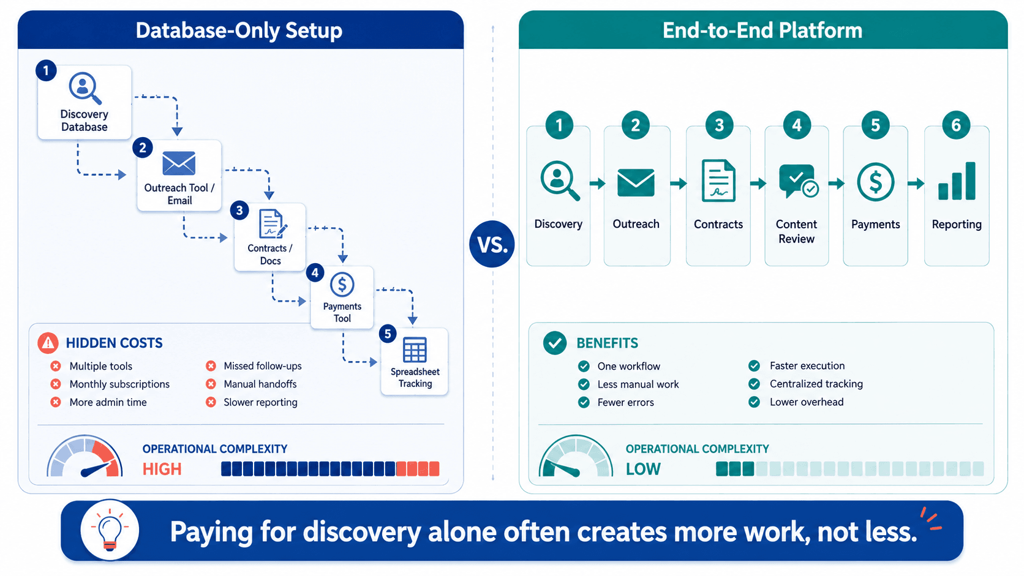
This is the decision that quietly inflates the total cost of running influencer campaigns for most brands. A pure database subscription may help with creator discovery, but it still leaves your team to handle the rest of the process manually.
After that, outreach still has to happen. Rates still have to be negotiated. Contracts still have to be drafted and signed. Content still has to be reviewed. Payments still have to be processed. Results still have to be tracked.
Each of these steps requires time, another tool, or both. A team that subscribes to a database, uses email for outreach, Google Docs for contracts, and a spreadsheet for tracking has not simplified its operation.
It has fragmented the process across four different systems, with someone still responsible for managing every handoff.
Skip that workload with Hypefy’s outreach tool, which automates first messages, follow-ups, and negotiations.
Some teams try to avoid the subscription entirely and build their own influencer database in a spreadsheet or CRM.
That holds up for a handful of relationships, then breaks the same way. The spreadsheet records who you have already found, but not who you missed. It is a shortlist without a denominator.
The cost shows up in two ways.
First, in direct tool costs. A discovery database at $200 to $400 per month; an outreach tool (if used); and whatever handles payments and reporting.
Second, in the coordination time that disappears between systems. The outreach that was not followed up because it lived in a separate inbox; the creator who was paid late because the payment trigger was in the spreadsheet and the spreadsheet was not checked; the campaign report that was assembled three weeks after the campaign ended because the data was in three places.
Hypefy changes the math by covering discovery, outreach, contracts, content review, payments, and reporting in one place, with a team operating the workflow behind the platform. The platform fee is built into the campaign budget, with no additional monthly subscription fee.
For brands that are currently paying for a database and doing the rest by hand, that structure typically costs less overall while removing most of the manual overhead.
Run It End-to-End With Hypefy
Hypefy is a practical way to go beyond a list and actually run the campaign. It uses AI to find creators that match your brand, sets fair rates based on a creator’s real, recent engagement, and manages discovery, outreach, contracts, content review, payments, and reporting in one place. You pay when you run a campaign. Nothing before, nothing between campaigns.
Influencer Databases FAQs
What is an influencer database?
An influencer database is a searchable collection of creator profiles built from public social media data.
Brands filter is by niche, location, follower count, engagement rate, and audience demographics. It handles discovery and analysis.
Outreach and campaign management sit outside it.
What is the best influencer database?
Depends on what you need.
Modash is a good choice for large-scale discovery with strong audience filters. HypeAuditor for audience authenticity verification. Heepsy for affordable local discovery.
Hypefy if you want discovery plus the full campaign workflow in one place. The best database for your brand is the one that covers the platforms you use, has accurate audience data, and integrates with how you actually run campaigns.
How much does an influencer database cost?
Entry-level options start from $69 to $199 per month. Mid-range databases with stronger audience data typically run $299 to $500 per month. Enterprise platforms are custom-priced. Hypefy operates on a campaign-based model with no monthly subscription, so the cost only applies when you run a campaign.
What is the difference between an influencer database and a marketplace?
A database indexes creator profiles from public social data, including creators who have never heard of the platform.
A marketplace lists creators who have opted in and are actively looking for brand partnerships.
Databases give you broader coverage. Marketplaces give you creators who are ready to move quickly.
How accurate is influencer database data?
Accuracy varies significantly by platform.
Data freshness is the biggest variable: creator audiences and engagement rates change, and a profile that was accurate three months ago may not be accurate now.
Fake follower detection quality also varies. HypeAuditor is generally regarded as the most rigorous in terms of audience quality. For any tool, check when profiles were last updated before building a shortlist.
Do I need an influencer database or a full platform?
If you only need to find and evaluate creators, a database may be enough.
If you also need to contact creators, negotiate rates, manage content review, process payments, and track results, a full platform such as Hypefy covers all of it in one place and is typically more cost-effective than combining a database with several other tools.