A brand without an in-house team to run creator campaigns should buy fully managed influencer marketing rather than software, choosing between a full-service agency, a platform with an attached agency services team, or a managed platform where automation does the work an agency’s account team would.
The distinction matters because software gives an existing team better infrastructure, while a managed service replaces the team you don’t have. A discovery tool still needs someone on your side to write briefs, chase creators, and pay invoices, while a managed partner takes that work off your plate.
Below, you’ll see what each type of company does, what it costs, and how it charges, along with the exact questions to ask a firm before signing.
Can You Outsource Influencer Marketing?
Yes, you can outsource influencer marketing completely, and the outside team then works as your influencer department. Day to day, that team:
plans the campaign
finds and vets creators
handles outreach and negotiates rates
writes contracts and briefs creators
manages product seeding
runs content approvals and secures usage rights
pays creators and reports results
The trade-off is that you end up further from the creators and from your past campaign data, since both sit in the provider’s systems by default.
Stay close to both by asking for three things after every campaign, in a format you keep, such as a spreadsheet export:
The creator list, with handles and contact details
The agreed rates, per creator and per deliverable
The campaign results, per creator and per post
Write this export into the contract so the data comes with you if you change providers.
11 Things a Fully Managed Influencer Marketing Service Handles
A fully managed influencer marketing service handles the whole operational sequence below, in the order a campaign runs.
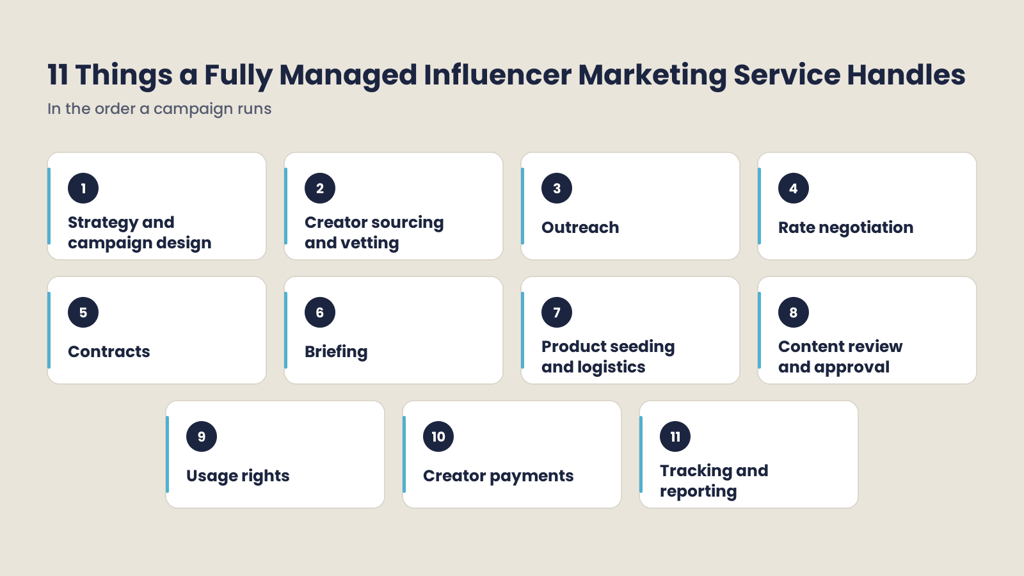
Strategy and campaign design. The provider turns your objective into a plan covering platforms, creator tiers, content formats, timing, and the key performance indicators (KPIs) the campaign will be judged on.
Creator sourcing and vetting. The team finds creators whose audience matches your market and checks them for fake followers, audience location, and past work for competing brands.
Outreach. Each creator gets a pitch for the campaign and follow-ups until they confirm or decline.
Rate negotiation. The team agrees on a fee per creator and per deliverable, keeping the total inside your budget.
Contracts. Each creator signs an agreement naming deliverables, deadlines, payment terms, disclosure rules, and usage rights.
Briefing. Creators receive a written brief with the key message, mandatory mentions, and anything they must avoid saying or showing.
Product seeding and logistics. The provider ships product to creators and tracks each delivery so content isn’t held up waiting for a parcel.
Content review and approval workflow. Drafts are checked against the brief, then sent to you for sign-off before anything is posted.
Usage rights. The team secures written permission for any reuse of creator content, such as reposting it organically or running it as a paid ad, along with how long that permission lasts.
Creator payments. Every creator payment runs through the provider, including the invoices, currencies, and tax paperwork that come with it.
Tracking and reporting. Reports cover reach, engagement, clicks, and sales from discount codes or tracked links, broken down per creator and per campaign.
Use this list as a checklist when comparing proposals, since any line a vendor leaves out becomes work your own team has to pick up.
5 Things You Keep Control Of
Five decisions stay with your brand, whichever provider runs the campaign:
Objectives, meaning what the campaign must achieve and how you'll judge it
Budget, including the ceiling the provider can't exceed
Brand guidelines, covering tone, claims you can and can't make, and visual rules
Creator approval, so nobody represents your brand without your yes
Final content sign-off before anything goes live
These five decisions mark the line between a managed service and losing control of your brand.
A provider that wants to approve creators or content on your behalf is taking a decision that belongs to you, even if it presents the offer as saving you work.
Write all five into the contract as decisions only your brand can make, and walk away from any provider that pushes back.
4 Ways Brands Run Influencer Marketing
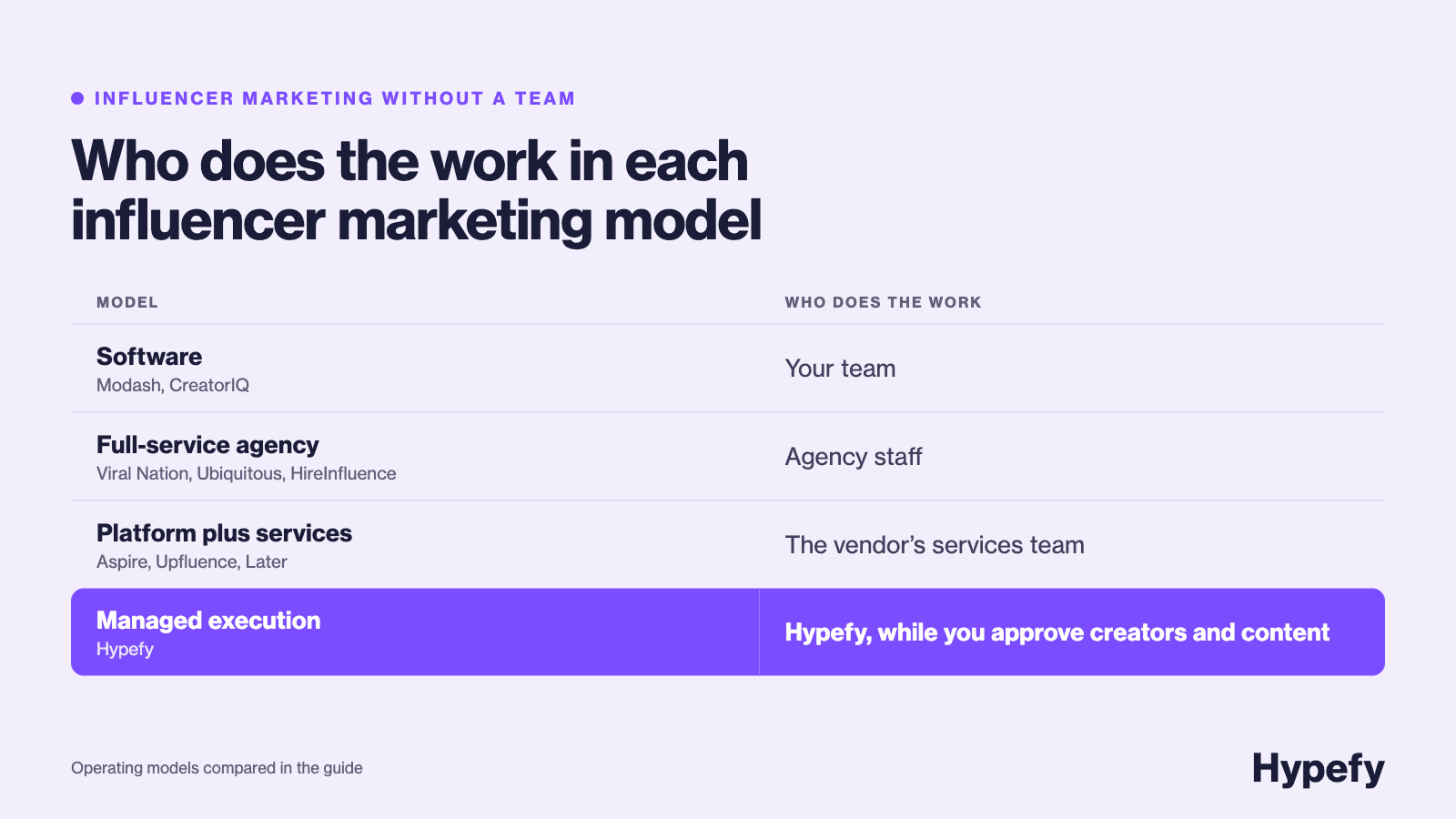
Brands choose between four operating models, and the difference between them comes down to who does the work.
Software you operate. The tool finds creators and tracks results, while your team does everything else. Modash and CreatorIQ are examples.
Full-service agency. The agency’s staff do the whole job, paid through a retainer or project fee. Viral Nation, Ubiquitous, and HireInfluence work this way.
Platform with an agency services team. You buy software access plus a services team that runs campaigns inside it. Aspire, Upfluence, and Later offer this setup.
Managed execution. Automation does the account team’s work of matching, outreach, contracting, and payments, while you approve creators and content. This is Hypefy’s model.
The agency versus software question is about labor. Software makes an existing team faster, while an agency becomes the team, so a brand with nobody to operate a tool should rule software out first.
Choosing between an agency and a platform is a question of visibility, since a traditional agency runs campaigns on its own systems while a platform-plus-services vendor runs them in software you can log into.
Upfluence, for example, gives agency services clients full access to its platform to see costs, time spent, and communications with influencers.
Five points decide the purchase, and here’s how the four models compare on each.
Model | Who does the work | Cost and how it's charged | Contract length | First campaign | Who holds creator relationships afterwards |
|---|---|---|---|---|---|
Software you operate (Modash, CreatorIQ) | Your team, end-to-end | Modash from $199/month billed annually ($299 billed monthly). CreatorIQ: custom pricing (on request) | Modash: monthly or annual, cancel anytime. CreatorIQ: not published | Once your team has briefs, rates, and contracts ready | You, inside your account. Modash deletes account data 90 days after cancellation |
Full-service agency (Viral Nation, Ubiquitous, HireInfluence) | Agency staff | Custom pricing (on request). Ubiquitous states a minimum budget without publishing it | Not published | Not published | The agency, unless the contract hands creator data over |
Platform + agency services (Aspire, Upfluence, Later) | The vendor's services team, inside the vendor's software | Custom pricing (on request). Upfluence charges a fixed platform fee | Upfluence: 12-month minimum. Aspire and Later: not published | Not published | Visible in the platform while you subscribe |
Managed execution (Hypefy) | Hypefy's automation and team, with brand approvals | A campaign budget you set, invoiced at launch. No subscription, retainer, or setup fee. Hypefy’s share sits inside the budget | Per campaign | Setup in minutes, then about three weeks from brief to published content while creators produce | Not published |
Agency or In-House? The Numbers That Decide It
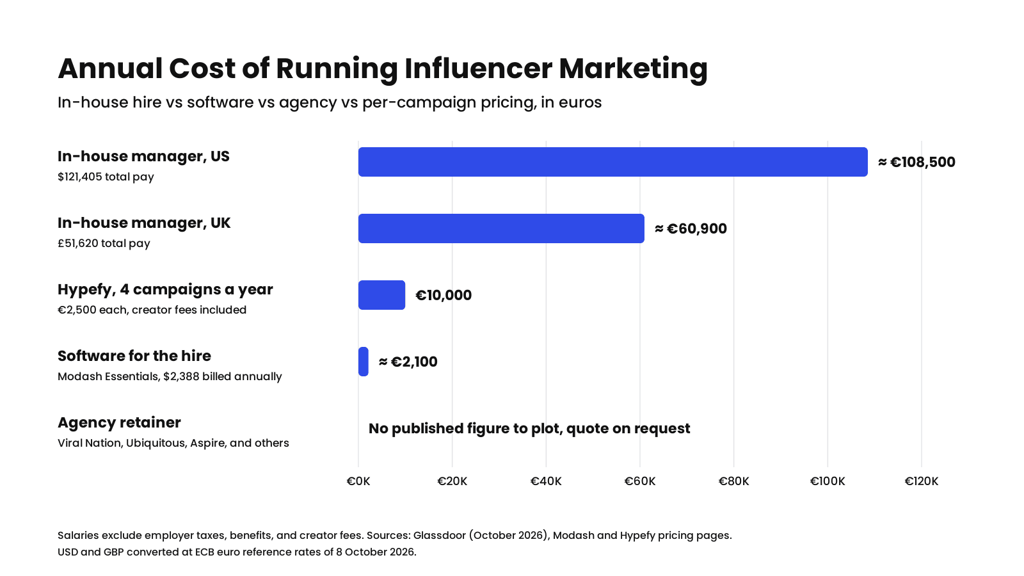
Compare the options as yearly costs, using these four figures:
An in-house manager. Glassdoor puts an influencer marketing manager’s total pay at £51,620 a year in the UK and $121,405 in the US, based on 50 salaries in each country (checked October 2026). That’s before employer taxes, benefits, and software.
Software for that hire. A discovery and campaign tool adds its own line, such as Modash Essentials at $2,388 a year billed annually.
An agency retainer. Agencies rarely publish fees. HireInfluence, itself an agency, writes that “there is no reliable published rate for this category,” and Viral Nation, Ubiquitous, Aspire, Upfluence, and Later all quote on request.
Per-campaign pricing. Hypefy publishes per-campaign pricing typically from €2,500, with creator fees included, on its Hypefy pricing page.
When a Managed Service Wins
Occasional campaigns favor a managed service, since the fixed cost of a hire isn’t justified by a few launches a year.
A handful of managed campaigns a year is a variable cost with creator fees included and nothing to pay in the months between, while a UK manager costs £51,620 in pay before a single creator is booked.
When In-House Wins
If you run campaigns all year round, hiring your own influencer manager starts to make sense. At some point, what you pay an agency for its work each year (not counting creator fees) gets close to what a manager would cost in total pay plus software.
From then on, a hire costs about the same, and your brand keeps the creator relationships and the campaign history instead of the agency.
To see where you stand, ask every agency to list its own fee separately from creator fees. Add up that fee for a full year and compare it with a manager’s total pay in your market.
The Hidden Costs of In-House
Many comparisons stop at salary and leave out three costs:
Software on top of salary, since a manager without a discovery and campaign tool is searching Instagram and TikTok by hand
Ramp-up time, because a new hire has to build a creator roster and negotiate first rates before the first campaign ships
Relationships that leave with the hire, which happens whenever creator contacts live in one person’s inbox
Keep contacts, rates, and results in a shared system from day one so the next hire starts from the same roster.
Who to Shortlist, and When Each One Fits
The nine options below fall into four groups, and the right group depends on your budget, your channels, and whether anyone in-house will touch the tools.
Large full-service agencies for big budgets and complex multi-channel programs: Viral Nation, Ubiquitous, and HireInfluence
Platforms with an agency services team for brands that want software access alongside a team: Aspire, Upfluence, and Later
Managed platforms for brands that want the campaign run without a retainer: Hypefy
Software that needs an operator, which only fits brands with someone in-house: Modash and CreatorIQ
1. Viral Nation
Good for: Brands with large budgets running multi-channel programs that combine creators with paid media and social strategy.
Limitations: A poor fit for brands that need a budget figure before the first call, since pricing and minimums aren’t published.
Viral Nation runs influencer marketing alongside paid media, community management, and a content studio, and operates its own CreatorOS software. Viral Nation lists Amazon, Google, and Walmart under “Trusted by” on its homepage.
2. Ubiquitous
Good for: TikTok-heavy brands that want organic creator content combined with paid ads.
Limitations: Works only with brands that meet its minimum budget requirement, and doesn't publish what that minimum is.
Ubiquitous handles strategy, contracts, briefs, payments, and performance tracking, running full-service campaigns on TikTok, Instagram, YouTube, and Facebook. The agency says it has activated 40,000+ creators.
3. HireInfluence
Good for: Campaigns that mix creators with experiential events and produced content.
Limitations: Brands that want a packaged offer won’t find one, since the agency says “no canned packages” and doesn’t publish pricing or minimum spend.
HireInfluence describes itself as an influencer marketing agency specializing in full-service social media influencer campaigns, and adds events, paid media management, and content production.
4. Aspire
Good for: eCommerce brands that want creator, affiliate, and creator-ad tools with a full-service agency option on top.
Limitations: Not suited to brands that want to compare prices before talking to sales, since cost depends on a demo and a quote.
Aspire pairs its creator marketing platform with a full-service agency for end-to-end program execution. Aspire says it's trusted by 800+ brands.
5. Upfluence
Good for: Brands that want an agency now and plan to run the software themselves later.
Limitations: 12-month minimum contract, with custom pricing set after an initial call.
Upfluence offers a services team that takes care of campaigns "from A to Z," plus seeding campaigns and affiliate program setup, on top of its software.
6. Later
Good for: Brands that want Later's own team to plan, produce, and manage creator programs.
Limitations: Brands that need contract terms before a sales call will have to ask, since pricing and terms for the full-service programs aren’t published.
Later sells a self-serve influencer platform and full-service programs where its team handles strategy, creator selection, content, and reporting.
7. Hypefy
Good for: Brands that want Instagram and TikTok campaigns run end-to-end without a retainer.
Limitations: Covers Instagram and TikTok only, so YouTube, events, or paid media need another partner.
Hypefy matches creators, runs outreach, contracts, payments, and reporting, while the brand approves creators, briefs, and content. The next section covers the model in full.
8. Modash
Good for: Brands with at least one person who'll run outreach, negotiation, and briefing.
Limitations: Your team does the campaign work. Creator payments start on the Performance plan at $499/month billed annually, and contracts aren't listed on its pricing page.
Modash covers 380M+ creators and includes discovery, inbox outreach, campaign tracking, and gifting on every plan.
9. CreatorIQ
Good for: Enterprises and agencies with established influencer teams.
Limitations: Pricing is on request, and the software needs a team to operate it.
CreatorIQ sells an enterprise suite covering discovery, management, campaign execution, payments, and measurement. CreatorIQ says it's trusted by 1,300+ brands and agencies.
Don’t buy a discovery tool like Modash or an enterprise suite like CreatorIQ if nobody will operate it, since the subscription keeps running while no campaigns ship.
How Hypefy Runs Campaigns Without an In-House Team
Hypefy works as a handoff. You supply the objective, the product, the market, and the budget. Hypefy then:
Matches creators on Instagram and TikTok to your brief
Handles outreach and rates through Smart Pricing, which prices each creator on recent post performance, reach, engagement, and audience value
Writes contracts, briefs creators, and coordinates delivery
Collects content and handles creator payments, with VAT covered inside the budget
Reports results, covering reach, engagement, link clicks, and conversions from personal codes or links
You approve the creators, the brief, and the final content before anything goes live.
The commercial model is what separates Hypefy from an agency retainer. There’s no subscription, no retainer, and no setup fee. You set a campaign budget, and it’s invoiced once when the campaign goes live.
Hypefy’s work sits inside that budget rather than on top of it, so the total never exceeds the figure you set. The starting minimum can vary by market.
Because each campaign is billed on its own, there’s no long contract tying you in, and brands can keep running campaigns for as long as the results hold up. NIVEA, for example, has run 129 campaigns with Hypefy across Croatia, Serbia, Slovenia, and Bosnia and Herzegovina over three years.
See what your campaign could look like. Book a demo with our team.
6 Questions to Ask an Influencer Marketing Partner Before You Sign
Many vendors call their service end-to-end, even when their software still needs someone on your side to run the program.
The quickest way to find out what you’re actually buying is to put your requirements in writing, so paste the paragraph below into your first email to every vendor.
“We don't have an in-house influencer marketing team. We'll supply the campaign objectives, the budget, our brand guidelines, and approval of creators and final content. We need your team to handle everything else: campaign strategy, creator identification and vetting, outreach, rate negotiation, contracting, briefing, project management, content collection and approvals, creator payments, tracking, and reporting. Please confirm in writing which of these your team performs and which you'd expect us to perform.” |
Then send these six questions, which expose any gap between the pitch and the work:
Who writes the creator brief, and who approves it?
Who negotiates each creator's rate?
Who pays the creator, and who handles invoices and tax forms?
What happens if a creator misses a deadline or posts off-brief?
What do we receive if we leave, including creator contacts, rates, and campaign data?
Does your fee sit inside the creator budget or on top of it?
If a vendor answers “your team” to who writes the brief, who negotiates rates, or who pays creators, you’re being sold software, so keep looking.
Influencer Marketing for Brands With No In-House Team FAQs
1. Can I outsource influencer marketing?
Yes, you can outsource influencer marketing completely, from strategy and creator sourcing to contracts, payments, and reporting.
Your brand keeps the objectives, budget, brand guidelines, creator approvals, and final content sign-off.
2. What is fully managed influencer marketing?
Fully managed influencer marketing is a service where an outside provider runs every operational step of a creator campaign while you approve creators and content.
It covers strategy, creator sourcing and vetting, outreach, negotiation, contracts, briefing, seeding, content approvals, usage rights, payments, and reporting.
3. Who can run influencer campaigns for me end-to-end?
Three kinds of companies can run influencer campaigns for you end-to-end:
A full-service firm, such as Ubiquitous
A platform with an agency services team, such as Upfluence
A managed platform, such as Hypefy
Confirm in writing that the partner negotiates rates and pays creators, since those two jobs show whether it does the work or hands you software.
4. What is the best influencer marketing service for a brand with no in-house team?
The best influencer marketing service for a brand with no in-house team is a fully managed one that handles outreach, contracts, and payments while you keep the approvals.
Hypefy runs Instagram and TikTok campaigns without a retainer.
For multi-channel programs with paid media, a full-service agency fits better.
5. What is the best influencer marketing agency for a brand with no in-house team?
The best influencer marketing agency for a brand with no in-house team depends on budget and channels.
Viral Nation fits large multi-channel programs, Ubiquitous works well for TikTok-heavy brands, and HireInfluence suits campaigns that mix creators with events.
None of the three publishes pricing, so ask each for its minimum budget in your first email.
6. What is the best influencer marketing platform for a brand with no in-house team?
The best influencer marketing platform for a brand with no in-house team is a managed platform that runs the campaign for you. Software you operate yourself, such as Modash or CreatorIQ, needs someone on your team to do the work.
Hypefy runs Instagram and TikTok campaigns with no subscription.
7. Should I hire an influencer marketing agency or build an in-house team?
You should hire an influencer marketing agency or managed service if you run occasional campaigns, and build an in-house team once the fees you pay outside approach a manager’s total pay plus software.
Glassdoor puts total pay for the role at £51,620 in the UK and $121,405 in the US.
8. What is the difference between an influencer marketing agency and software?
The difference between an influencer marketing agency and software is who does the work.
Software gives your team tools for discovery, outreach, and tracking, while an agency's staff run the campaign for you.
9. How much does managed influencer marketing cost?
Managed influencer marketing with Hypefy costs a per-campaign budget you set, with creator fees included and no subscription or retainer.
Full-service agencies and platform-plus-services vendors such as Viral Nation, Ubiquitous, Aspire, and Upfluence don't publish fees and quote on request.
10. Which agency handles creator outreach and contracts?
Ubiquitous is one agency that handles creator outreach and contracts, along with briefs, deadlines, and payments.
Ask any firm to confirm it signs contracts with creators and pays them directly.
Hypefy also handles outreach and contracts within the campaign budget.
11. Do I need a platform if I use an agency?
No, you don't need a platform of your own if you use an agency, since the agency runs campaigns on its own tools.
Ask for creator lists, rates, and results to be exported to you after each campaign so the data stays with your brand.
12. How long does it take to launch a first campaign?
Launch time depends on who you’re working with and how quickly creators can produce.
On Hypefy, setting up a campaign takes minutes, and your first shortlist comes back in the same session.
You should then allow around two to three weeks from approved brief to published content so creators have time to film and you have time to approve.
Agencies don't publish onboarding timelines, so ask each partner for the date the first creator content will go live.