Done-for-you influencer marketing means a third party runs the campaign on the brand's behalf, covering creator sourcing, negotiation, contracts, content approval, payment, and reporting.
It's delivered in one of four ways:
A traditional agency
A freelancer or independent consultant
A platform's managed service
A platform that automates the workflow with a team behind it
This page covers what is included in each model, what each costs, how quickly a campaign can launch, what to ask before handing a campaign over, and which specific services to consider.
What Is Done-for-You Influencer Marketing?
Done-for-you influencer marketing is a delivery arrangement in which a provider executes the campaign, and the brand approves.
The distinction is about who does the work rather than which steps are involved.
In a self-serve arrangement, the brand runs the campaign itself using a tool; in a done-for-you arrangement, the provider runs it, and the brand approves at defined checkpoints.
Done-for-you is a delivery model rather than a product category, which is why the same outcome can come from an agency or from software.
What changes between providers is how they price the work and how much control the brand keeps.
What a Done-for-You Service Covers
Typically handled by the provider
Creator sourcing and vetting, finding candidates who match the brief and checking audience quality and engagement
Outreach and negotiation, approaching creators, managing replies, and agreeing on rates and deliverables
Contracting, drafting and sending the agreement and collecting signatures
Briefing, preparing the creative brief and delivering it to the creator
Content review, checking submissions against the brief before the brand sees them
Scheduling, coordinating posting dates against the campaign window
Payment, processing creator payments on the agreed schedule
Reporting, compiling performance data and delivering a campaign summary
Typically retained by the brand
The product or offer and how it is positioned
Brand guidelines and any creative restrictions
Final approval on which creators proceed to contract
Final approval on content before it goes live
The budget decision, how much is allocated and to which markets
Where the line falls varies by provider, which is why the questions further down the page matter before a campaign starts.
Hypefy is the automated platform option on this list. See how it works
The Four Ways to Get an Influencer Campaign Run for You
Model | Who does the work | How it is priced | Typical minimum | Time for the first campaign | Best for |
|---|---|---|---|---|---|
Traditional agency | Dedicated account team, manual | Monthly retainer plus a markup on managed creator fees | $3,000-$10,000/month | 4-8 weeks | Brands with no internal team, complex multi-market campaigns |
Freelancer/consultant | One person or a small network | Day rate or project fee | $500-$3,000 per campaign | 1-3 weeks | Brands running occasional campaigns on a tight budget |
Platform managed service | Platform staff using the platform's own tools | Subscription plus a managed service fee | $1,500-$5,000/month | 2-4 weeks | Brands wanting managed execution with a path to self-serve later |
Automated platform | Software runs the workflow; brand approves | Cost inside the campaign budget, no subscription | Varies by campaign | 5-10 days | Brands wanting a fast launch and predictable all-in cost |
1. Traditional Agency
A traditional influencer marketing agency assigns an account team that handles the campaign from brief to report, giving the brand a dedicated contact, regular calls, and a polished final deliverable.
The trade-off is cost. A typical agency retainer runs $3,000 to $10,000 per month before any creator spend, and agencies commonly add a markup on the creator fees they manage.
Agencies suit brands with no internal capacity and complex campaigns across multiple markets or platforms, where an experienced team's strategic and operational expertise offsets the cost.
2. Freelancer or Independent Consultant
A freelance influencer marketing specialist runs the campaign as a one-off project for a day rate or project fee.
The main advantage is cost, with a fee of $500 to $3,000 per campaign alongside creator spend.
The main limitation is capacity and coverage. A single person cannot scale across many creators or markets at once, and quality varies.
Freelancers work best for occasional campaigns with a defined scope and a brand that has some internal context to guide the brief.
3. Platform Managed Service
Several influencer marketing platforms offer a managed service layer on top of their subscription product, where platform staff run campaigns using the platform's own tooling.
The brand pays for the platform subscription plus an additional managed service fee, typically added to an existing annual contract.
Because execution uses the same data and workflow as the self-serve version, moving to self-serve later is straightforward.
The limitation is that the managed service adds a cost on top of the subscription, and the team works across many clients at once.
4. Automated Platform
An automated platform runs the campaign through software, with the brand approving creators and content at defined checkpoints.
The difference from the other models is that a defined workflow drives step-by-step execution, without a human account team.
Campaigns launch faster, and the cost sits inside the campaign budget, with no subscription or retainer on top.
The limitation is that automated outreach reaches only the platforms and geographies the software supports, and it is less customized than a senior agency team working on a bespoke brief.
Model your campaign budget before choosing a delivery model with the marketing budget calculator.
How Much Does Done-for-You Influencer Marketing Cost?
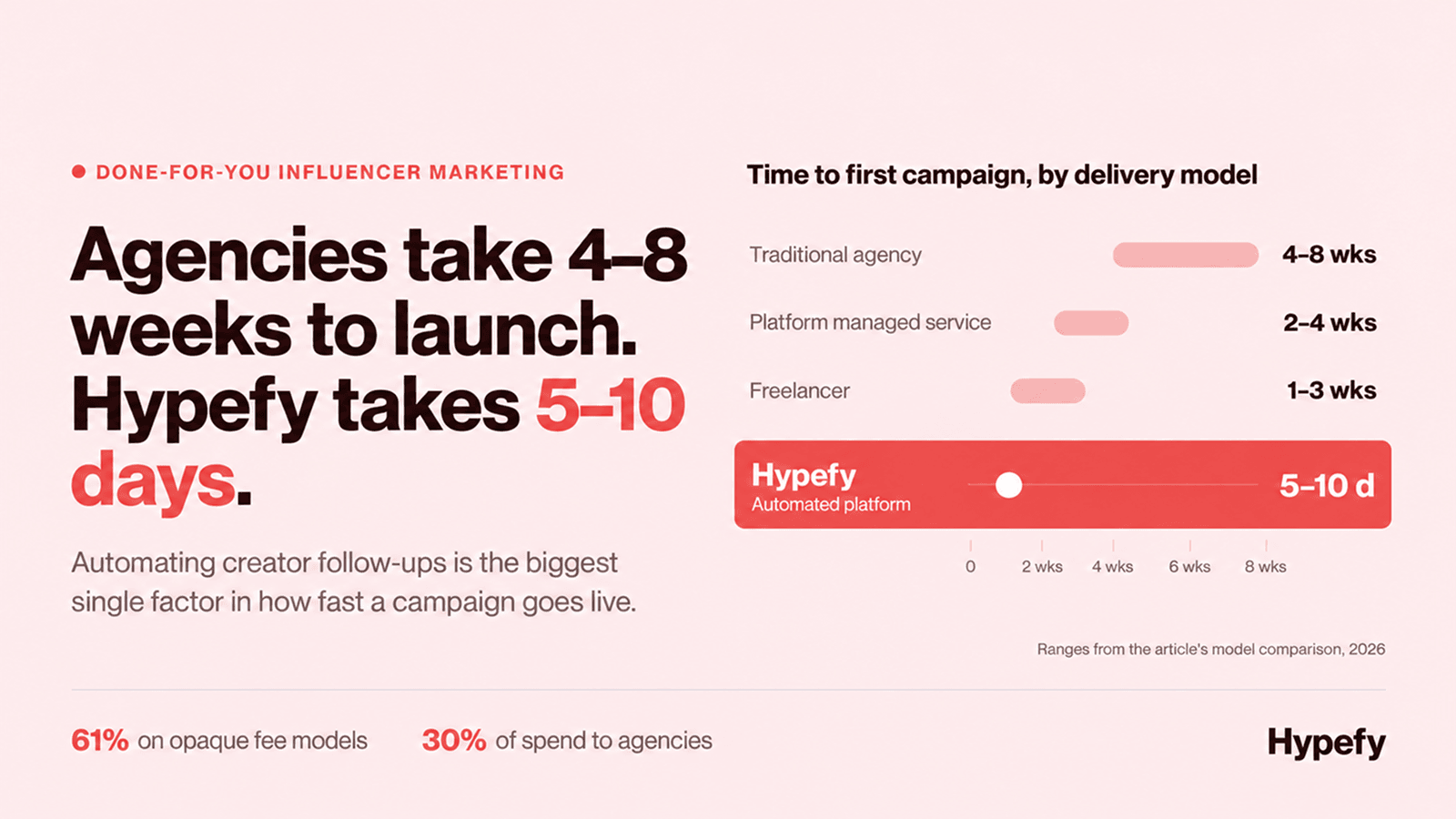
On average, an agency takes 30% of influencer marketing spend, according to the ANA, and the three pricing structures below work differently for a brand with a fixed budget.
The three pricing structures work differently for a brand with a fixed budget.
Monthly retainer. A fixed fee regardless of whether a campaign runs that month. A $5,000/month retainer adds $60,000 per year before any creator spend. Suits always-on programs; expensive for burst campaigns.
Percentage markup on creator spend. The provider adds a markup on the creator fees it manages, and that markup is not always visible.
The ANA's Influencer Marketing Agency Compensation report, published in February 2026, found that on average 30% of influencer marketing spend goes to the agency and 70% to creators.
It also found that 61% of marketers are on compensation models that are either explicitly non-transparent or unknown to them, and only 51% have full visibility into the exact amounts their influencers are paid.
Ask whether creator rates are shown separately or bundled into one figure.
Only 51% have full visibility into the exact amounts their influencers are paid, so ask whether creator rates are shown separately or bundled into one figure.
Cost inside the campaign budget. Some automated platforms bundle execution into the campaign spend itself, with no subscription or setup fee on top. The budget is a pool allocated across creators, and the full amount goes toward reaching the audience. Most predictable for a brand with a fixed allocation.
How Quickly Can a Done-for-You Campaign Launch?
A done-for-you campaign can launch in five to ten days on an automated platform or four to eight weeks with a traditional agency.
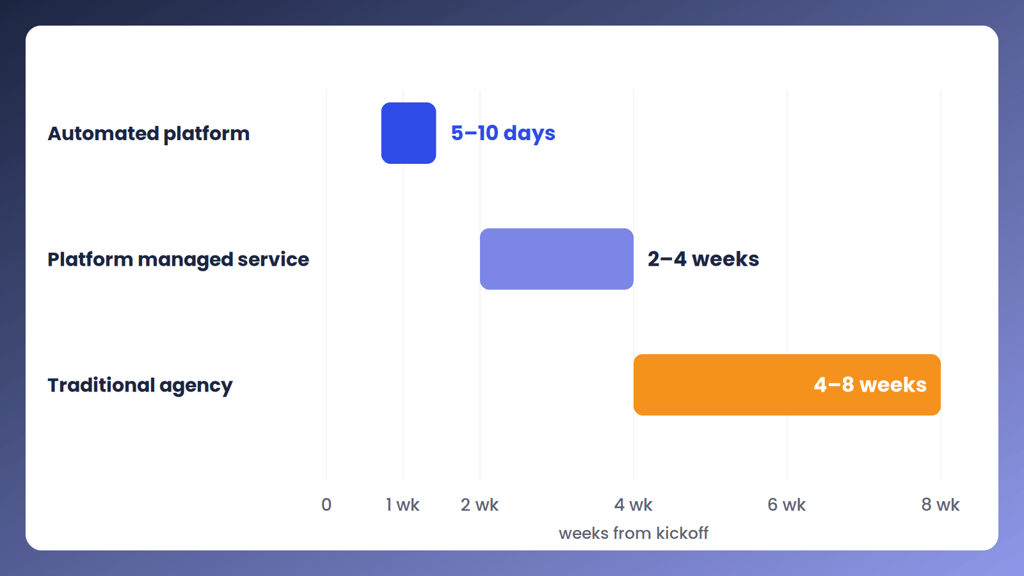
The gap comes down to three things: how long sourcing takes, how many approval rounds sit between shortlist and contract, and whether outreach is manual or automated.
Follow-up is usually the step that stretches timelines most. Most creators do not respond to a first message.
Hypefy's benchmark data across 4,587 contacts in 36 markets found that just over half of creators who reply say yes after a follow-up, and the overall sign rate across all contacts was approximately 18%.
Automated platforms run follow-ups as part of the outreach sequence, while manual outreach relies on an account manager having the time to do it. Automating that follow-up is the biggest single factor in how quickly a campaign launches.
What to Ask Before You Hand Over a Campaign
Who owns the creator relationships after the campaign ends? Agencies typically keep the relationships they build during a campaign, while a platform-based arrangement usually leaves the brand with the contact and history. Ask this when the relationship is the long-term asset you are paying for.
Are creator rates shown transparently or bundled into one figure? Some providers show a clean creator rate alongside their service fee, while others quote a single total. The split tells you whether you are paying a market rate for the creator or a marked-up one.
What happens if a creator underperforms or fails to post? The answer should say exactly what the provider does, whether replacement, refund, or partial credit, and whether that is written into the contract or left to discretion.
Is there a minimum term or contract lock-in? Agencies almost always require a minimum term, platform-managed services often tie to an annual contract, and automated platforms vary. On a first engagement a three-month minimum is reasonable, while a twelve-month lock-in is worth pushing back on until you have evidence of fit.
Which platforms and geographies are covered? Done-for-you rarely means every platform and market, so confirm the service covers the ones your campaign needs before you write the brief.
What does the report include, and how often does it arrive? Reach and impressions tell you far less than attributed revenue, cost per engagement, and creator-level performance, so agree on what the report covers and how often it arrives before the campaign starts.
Who approves content before it goes live? The brand should always have a defined window to review and approve content before the creator posts, no matter how automated the rest of the workflow is.
Which Done-for-You Influencer Marketing Services to Consider
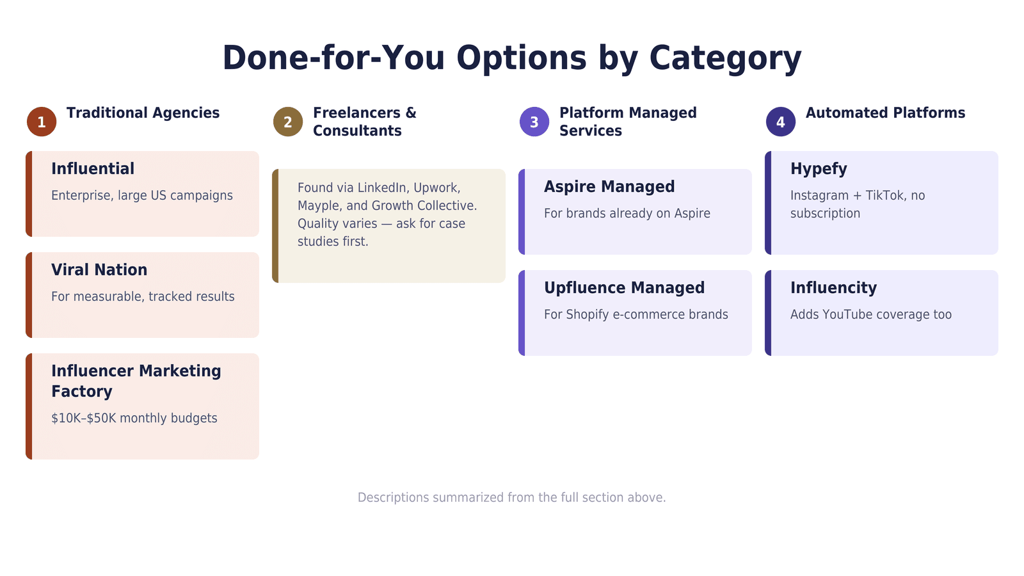
The services below are grouped by the four delivery models, so start with the model that fits your budget and team, then compare the providers within it.
1. Traditional Agencies
Influential - full-service influencer agency, suits enterprise brands running large-scale US campaigns with significant budgets.
Viral Nation - performance-focused agency with proprietary technology alongside traditional account management, suits brands wanting measurable outcomes.
The Influencer Marketing Factory - mid-market agency covering TikTok and Instagram campaigns, suits brands with $10,000 to $50,000 monthly creator budgets.
2. Freelancers and Consultants
You can find freelancers through LinkedIn, Upwork, and specialist networks, including Mayple and Growth Collective. Quality varies substantially. Ask for case studies and a defined process before engaging.
3. Platform Managed Services
Aspire Managed - Aspire's in-house team runs campaigns using the Aspire platform, which suits DTC brands already considering Aspire for self-serve.
Upfluence Managed - Upfluence's managed service layer suits e-commerce brands with Shopify integration requirements.
4. Automated Platforms
Hypefy - automated platform running end-to-end campaigns on Instagram and TikTok, with the cost inside the campaign budget; suits brands wanting a fast, all-in setup with no subscription.
Influencity - semi-automated platform with optional managed service; suits brands needing YouTube coverage alongside Instagram and TikTok.
How Hypefy Runs Campaigns for You
Hypefy handles creator matching, outreach, negotiation, contracts, content approval, payment, and reporting on Instagram and TikTok.
The brand approves the shortlist and content, and the platform does the rest. There is no subscription or setup fee, and the cost sits inside the campaign budget rather than on top of it.
Hypefy's own outreach data across 4,587 contacts in 36 markets shows that just over half of creators who reply say yes, with an overall sign rate of approximately 18%.
NIVEA is one example: an always-on program of 129 campaigns across 4 markets that reached more than 43 million people.
One limit applies. Instagram and TikTok only. Brands needing YouTube, LinkedIn, or Pinterest are better served elsewhere.
Done-for-you Influencer Marketing Service FAQs
1. What is done-for-you influencer marketing?
A third party runs the campaign, sourcing creators, managing outreach and contracts, reviewing content, processing payments, and reporting. The brand approves creators and content, and the provider handles everything in between.
2. Can someone else run my influencer campaign for me?
Yes. The four main options are a traditional agency, a freelance consultant, a platform-managed service, or an automated platform. Agencies offer the most human involvement at the highest cost, while automated platforms launch fastest at the lowest overhead.
3. What is the difference between an influencer marketing agency and a done-for-you platform?
An agency is a team running campaigns manually on a monthly retainer plus a markup on creator spend. A platform automates the workflow, with the brand approving at defined checkpoints and the cost sitting inside the campaign budget.
4. How much does it cost to have someone run your influencer marketing?
It depends on the pricing model. On average, 30% of influencer marketing spend goes to the agency and 70% to creators, according to the ANA.
A freelancer charges a project fee, an agency adds a monthly retainer or a markup on creator spend, and an automated platform bundles execution into the campaign budget with no separate subscription.
5. Is it better to run influencer marketing in-house or outsource it?
In-house is cheaper per campaign once the team is trained, and the brand retains all creator relationships. Outsourcing is faster to start and removes the operational burden.
A done-for-you platform sits between the two, with the brand owning the data and relationships while the platform handles execution.
6. How long does it take to launch a campaign with a done-for-you service?
It takes five to ten days on an automated platform, two to four weeks with a platform-managed service, and four to eight weeks with a traditional agency.
The main variable is outreach follow-up: most creators do not reply to a first message, so a service that automates follow-ups recovers pipeline that manual outreach misses.
7. Who owns the creator relationships when an agency runs your campaign?
Usually the agency. On a platform-based arrangement, the brand retains the creator contact and campaign history.
8. What is the cheapest way to get an influencer campaign run for you?
The cheapest option is a freelance consultant for a one-off campaign, at $500 to $3,000 in fees. For a recurring program, an automated platform keeps costs lowest with no subscription on top of campaign spend.
9. Do done-for-you services work for small budgets?
Yes. Freelancers can run nano- or micro-creator campaigns for $1,000 to $5,000 in total spend, and automated platforms scale down to whatever budget is allocated with no minimum subscription.